AutoClip: An Open-Source AI Pipeline That Turns Long Videos into Highlight Shorts from a Single Link
AutoClip is an open-source AI video-editing tool that takes a YouTube or Bilibili link (or a local video) and chains subtitle extraction, AI highlight analysis,
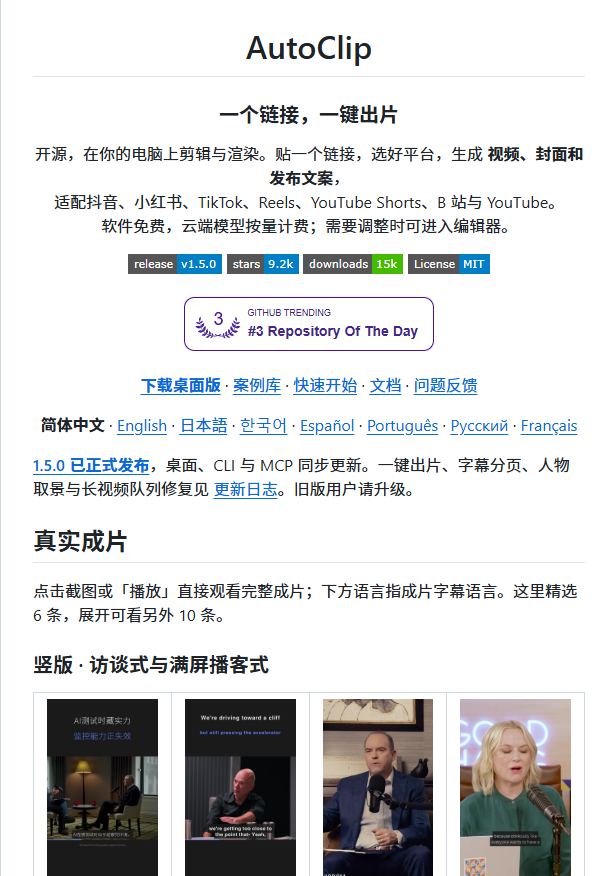
Cutting highlight shorts out of long lectures, podcasts, interviews, or livestream replays is still labor-intensive manual work. AutoClip (zhouxiaoka/autoclip) is an open-source project that chains the whole job into one automated pipeline: acquiring the video and subtitles, analyzing the content with AI, scoring and selecting segments, cutting with FFmpeg, and bundling themed compilations.
Editorial illustration of the AI pipeline concept, not an actual product screenshot. See the @Manorgw X post for the original attachment.
This article covers only what can be confirmed from public evidence: the October 7, 2026 introductory post by X user @Manorgw and the repository's README, HANDOFF, and SKILL documents. Time-sensitive figures such as the GitHub star count are quoted as post claims only.
What AutoClip Does and How the Pipeline Runs
AutoClip describes itself in its README as a "one link, one-click video output" open-source AI clipping and content-repurposing tool, aimed at reworking long videos into highlight shorts (the Chinese creator scene calls this 二创, secondary creation).
The confirmed processing flow is:
- Input: Accepts YouTube or Bilibili (China's large video platform) links, or local video files. Subtitles come from platform captions (existing SRT) or local Whisper transcription when none exist.
- Analysis: An LLM extracts a content outline and a topic-level timeline.
- Selection: Candidate segments are scored and split into accepted clips and alternates. Per the README, up to 10 accepted clips are auto-generated per platform, with the rest listed as alternates.
- Output: FFmpeg cuts and renders the clips, each with a cover, title, description, and a ZIP publishing package. Topic-themed compilations (合集) can also be assembled.
- Progress: Task progress is pushed to the frontend in real time over WebSocket.
Supported targets named in the README include Douyin (Chinese short-video platform), Xiaohongshu (Chinese lifestyle-sharing platform), TikTok, Reels, YouTube Shorts, Bilibili, and YouTube. Vertical layouts offer interview-style and podcast-style options, while Bilibili and YouTube use landscape output.
Tech Stack, LLM Providers, and Delivery Formats
Per the repository's HANDOFF document, the stack is:
- Backend: FastAPI + Celery + SQLite (server deployments use Redis as message broker and cache)
- Frontend: React + TypeScript + Ant Design + Vite
- Desktop shell: Tauri 2 + Rust
- Video processing: FFmpeg/ffprobe
LLM support covers OpenAI, Gemini, Qwen via DashScope (Tongyi Qianwen, Alibaba's large language model), and SiliconFlow. The social post names Qwen as the default understanding model, but the repository supports multiple providers, so this article does not present it as locked to a single model.
Three delivery formats are confirmed: Docker deployment, local script launch (start_autoclip.sh), and a macOS desktop client (DMG). The README states that version 1.5.0 updated the desktop app, CLI, and MCP together. The SKILL document describes passing a local video's absolute path or a Bilibili/YouTube HTTPS link plus target platform list to start_quick_output over MCP.
Who It Helps, and Two Caveats
The confirmed use cases cover the full "long-to-short" workflow: podcast highlights, interview repurposing, course highlights, livestream replay splitting, multi-account content volume, and Bilibili highlight slices. These appear consistently across the social post and repository docs.
Two points need clear separation:
- Star count: "3,700+ GitHub stars" (cited as 3,780+ in a June 2026 mirror) is a claim from the post's publication moment. Check the repository page directly for the current figure.
- Copyright: Downloading, cutting, and re-uploading other people's videos is secondary creation subject to copyright law and each platform's rules. The original post itself warns readers to respect the copyright and compliance line. Start with your own footage or material with clear reuse permission.
Sources
- GitHub repository: zhouxiaoka/autoclip
- Status and roadmap doc: HANDOFF.md
- MCP and CLI usage: skills/autoclip/SKILL.md
- Introductory post: @Manorgw X post (2026-10-07)