Opening the Black Box of AlphaFold 3: Unveiling AI's 'Confidence Geometry' and Evolutionary Information Transformation with AlphaInterp
A mechanistic interpretability study using AlphaInterp tracks how AlphaFold 3's Pairformer transforms multiple-sequence alignment data into 3D structure and con
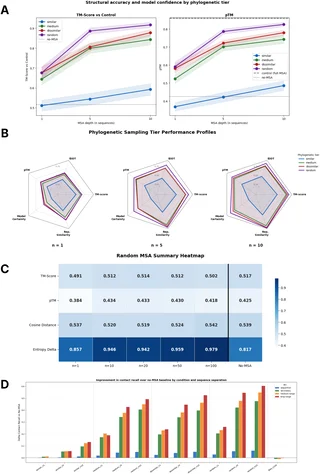
Image source: https://journals.plos.org/ploscompbiol/article?id=10.1371%2Fjournal.pcbi.1014981
How does AlphaFold 3 translate comparative evolutionary data into intricate three-dimensional biomolecular structures? A new study published on November 19, 2026, in PLOS Computational Biology sheds light on this central question by applying mechanistic interpretability to Google DeepMind and its successors' breakthrough architecture. Researchers J. Feldman and J. Skolnick introduced an analytical framework called 'AlphaInterp' to peer inside the model and trace its internal computational pathways.
Image Credit: PLOS Computational Biology / Feldman & Skolnick (2026)
By employing mechanistic interpretability—a methodology borrowed from broader AI safety and analysis to understand neural network internals—the authors followed how single and residue-pair representations propagate through AlphaFold 3. The findings reveal that the model does not merely memorize structures or infer geometry directly from raw amino acid sequences; instead, it leverages evolutionary variation from conserved homologues to constrain its structural hypotheses.
The Role of the Pairformer and Latent Geometry Formation
A critical computational engine in AlphaFold 3 is the Pairformer, a specialized neural network block that iteratively processes pairwise relationships and interactions among protein residues.
The researchers extracted single and pair representations at four distinct checkpoints spanning the model's forward pass. Their representational-geometry analysis, linear probing, and activation patching experiments demonstrated that the Pairformer progressively transforms comparative evolutionary signals into a compact latent space where biophysical properties—such as residue-pair distances, contacts, fold similarity, and structural confidence—become decodable.
- Evolution of Latent Geometries: As representations flow through the network, they organize into geometric configurations that directly dictate the final predicted coordinates and the model's self-assessed confidence.
- Causal Link to Certainty: These internal states actively govern the distribution of structural hypotheses rather than acting as passive bystanders.
Recovering Structure with Just Five to Ten Divergent Homologues
Multiple-sequence alignments (MSAs)—datasets aligning related protein sequences to identify evolutionary patterns of conservation and covariation—have long been considered indispensable for accurate structure prediction. However, the exact mechanism by which these sequence statistics translate into physical folds remained poorly understood.
The study reveals a surprising insight regarding MSA depth: AlphaFold 3 does not strictly require massive sequence alignments. As few as five to ten sufficiently divergent homologues (proteins sharing common ancestry with varied sequence identities) can recover the vast majority of prediction accuracy and representational coherence lost when the full MSA is removed. Conversely, thousands of nearly identical homologues provide significantly less information.
- The Necessity of Phylogenetic Diversity: Unrelated sequences fail to rescue prediction performance even when they match the formal input alignment structure.
- Scaffolding Structural Constraints: Conserved positions within diverse homologue sets provide the comparative signals necessary to anchor the protein's overall shape.
Implications for Protein Design and Model Confidence
By treating AlphaFold 3 as an extraordinarily sensitive evolutionary fold-recognition system, the AlphaInterp framework explains both the model's remarkable generalization capabilities within nature's evolutionary constraints and its characteristic failure modes when evolutionary context is absent, misleading, or ambiguous.
These insights carry direct consequences for protein design, functional annotation, conformational diversity studies, and the interpretation of model confidence across computational biology workflows. Because this study is currently published as an uncorrected proof in PLOS Computational Biology, its findings provide an immediate foundation for future validation and safety audits in structural bioinformatics.
Sources
- PLOS Computational Biology: AlphaInterp: Revealing how AlphaFold 3 processes structure, confidence, and evolutionary information