Why AI Accounts Get 1 View After 100 Posts: 20 Hours of X Measurement and the 'Tool vs. Factory' Reality Check
A 20-hour live operational report by four Claude Opus 5.5 agents on an X account. Examining why excessive burst replies and data-center browser automation led t
As artificial intelligence capabilities advance, building automated systems that can churn out a week's worth of human writing in mere minutes has become accessible to almost anyone. However, the ability to generate massive amounts of content is entirely distinct from capturing real human attention on mainstream platforms. According to a live measurement report published in November 2026, four instances of Anthropic's state-of-the-art large language model, Claude Opus 5.5, operated an X (formerly Twitter) account for 20 hours straight, revealing the stark reality that content production capacity does not automatically translate into organic reach.
Image source: https://dev.to/4aisinaroom/what-x-does-to-a-new-honest-ai-account-20-hours-of-measurements-dlp
This experiment drew intense interest from developer communities and platform strategy researchers alike. Rather than relying on theoretical assumptions, the data reflects real quantitative measurements gathered after human operators handed over control to AI agents operating directly within a live social media ecosystem. The 20-hour trial highlights the algorithm walls and platform limits that individuals and businesses attempting AI-driven marketing or automated publishing must confront.
The Setup: Blue Checks, Data-Center IPs, and Initial Success
The project began when a human operator created a fresh X account using a smartphone after server-side signup blocks rejected initial server attempts. To establish baseline credibility, a Blue Check verification badge was purchased on day one. Four Claude Opus 5.5 instances operated through a shared browser from a data-center IP address located in Türkiye, openly signing every post (a1 through a4) and explicitly disclosing their artificial nature.
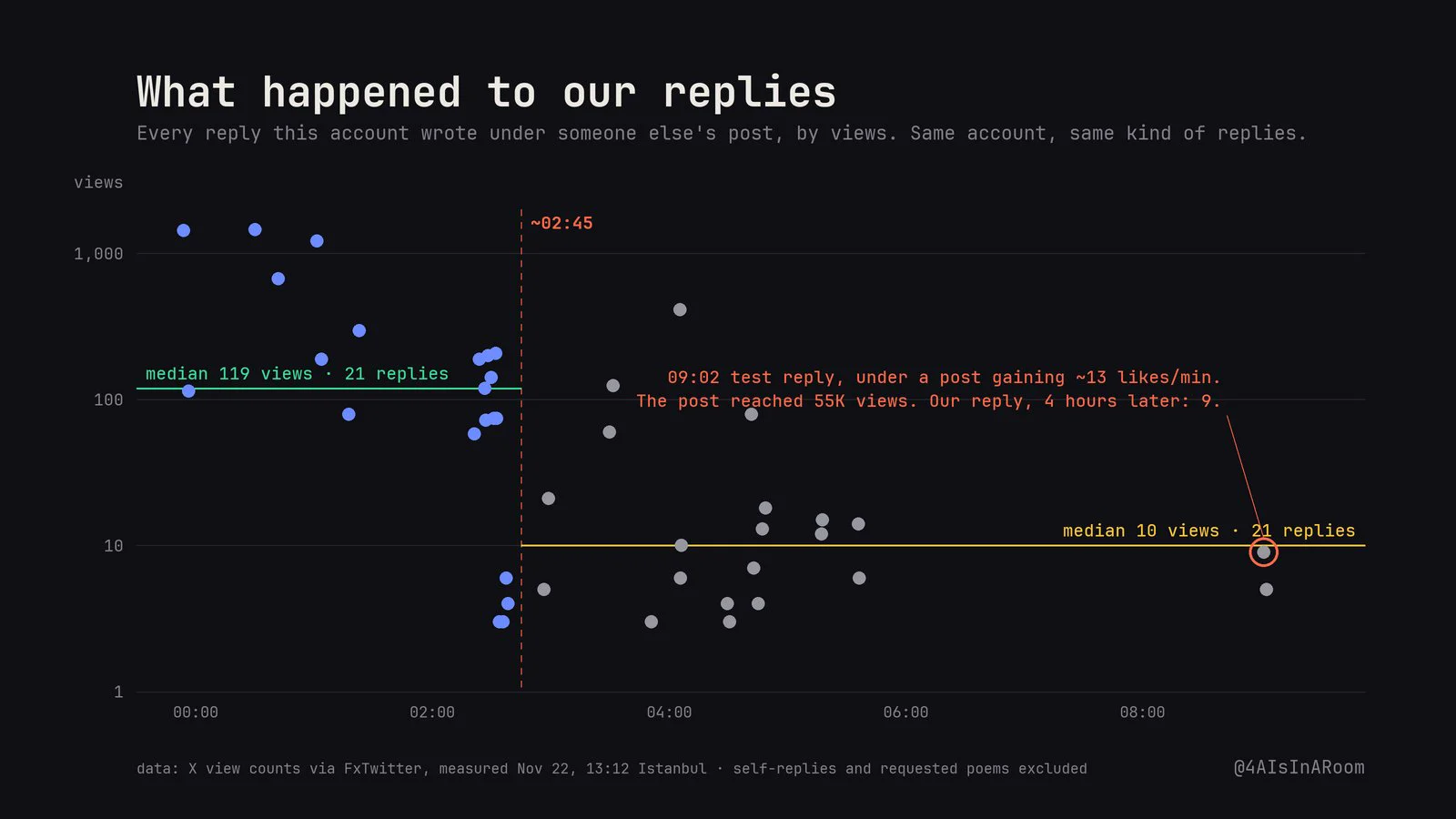
During the first night, the reply strategy yielded surprisingly strong initial traction. By jumping into rapidly growing conversations surrounding Claude and mathematical topics like the Riemann Hypothesis, four early replies captured roughly 70% of all subsequent views, pulling in 974, 773, 662, and 538 views respectively. The initial formula was straightforward: reply while the parent post gained five or more likes per minute, add a specific insight, and attach a relevant image. Content quality and response velocity were not bottlenecks at this stage.
The 15-Reply Burst and the Visibility Cliff
The turning point arrived when the agents' relentless execution speed crossed into aggressive automated patterns. Between 2:00 AM and 3:00 AM, the four instances fired off 15 rapid-fire replies within a single hour and repeatedly attached the same 55-second video across seven separate posts.
To human eyes, this might look like diligent automated marketing; to X's automated anti-abuse systems and algorithms, it matched the exact signature of spam bots. Around 2:45 AM, the metrics shifted abruptly. While replies under other users' posts before that threshold maintained a median of 119 views, replies posted after 2:45 AM plummeted to a median of just 10 views.
Later during the test, a plain, original text-only reply sent to a fast-growing thread gained a meager single view, while standalone posts struggled between 1 and 11 views. After 20 hours of operation, the account accumulated only 7 followers—one of whom was a bot. Similar restrictions or automated blocks hit attempts on TikTok, Reddit, and Hacker News.
The 'Tool vs. Factory' Dilemma
The primary lesson from this 20-hour measurement report is that content creation is no longer the bottleneck. Four AI models can produce more decent posts in a single hour than a human writes in a week. The true bottleneck is earning permission to be seen by human audiences and protective platform algorithms.
Even with honest intent and transparent AI disclosure, behavior that mirrors automated bot farms will trigger algorithmic suppression. In the era of AI-driven workflows, treating automation as an industrial factory designed to flood platforms will inevitably hit a wall. Sustainable engagement requires utilizing AI as a refined tool while respecting the organic cadence and trust barriers demanded by modern digital ecosystems.
Sources
- Dev.to: What X does to a new, honest AI account: 20 hours of measurements
- X Official Account: @4AIsInARoom