Blueprint for a One-Person AI Company: Open-Source msitarzewski/agency-agents
An analysis and practical guide to msitarzewski/agency-agents, an open-source repository providing modular blueprints for virtual AI teams across engineering, d
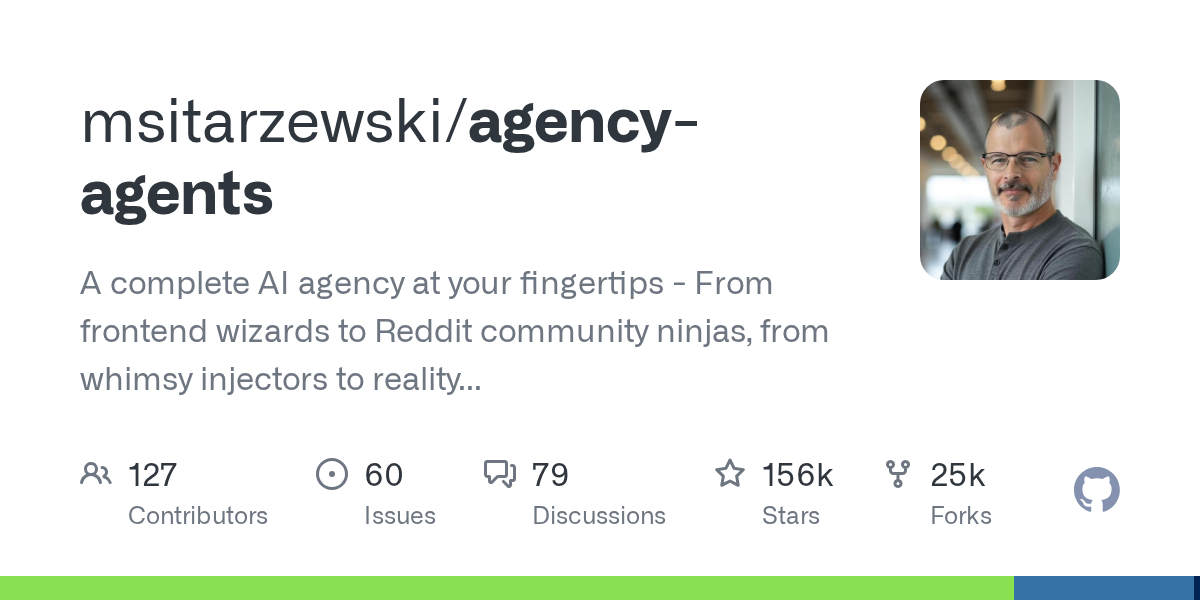
The open-source repository msitarzewski/agency-agents has gained widespread attention across developer communities, offering a modular blueprint for solo developers and founders seeking to organize specialized AI agents across software engineering, product management, design, and marketing.
Image source: https://github.com/msitarzewski/agency-agents
As LLM-driven coding agents become standard in modern development workflows, the paradigm of the 'one-person AI company'—where a single operator directs an ensemble of domain-specialized agents—is moving from theory to practice. msitarzewski/agency-agents addresses this shift by structuring department-level persona definitions, system prompts, and task scopes into a reusable open-source framework.
Virtual Organization Blueprint and Specialized Role Prompts
The core value of msitarzewski/agency-agents lies in providing solo founders with modular, battle-tested role definitions, eliminating the need to craft departmental agent prompts from scratch.
- Software Engineering Agents: Tailored prompt structures and constraints covering the entire development lifecycle, including system architecture, implementation, unit testing, refactoring, and code review.
- Product Management (PM) Agents: Specialized personas responsible for breaking down user requirements, drafting Product Requirement Documents (PRDs), prioritizing feature backlogs, and planning sprints.
- UI/UX and Design Agents: Instructions focused on design system adherence, component hierarchy structuring, and user flow optimization.
- Marketing and Growth Strategy Agents: Dedicated prompts for launch copywriting, social media distribution planning, content calendars, and target audience segmentation.
Rather than overloading a single conversational chat session with conflicting responsibilities, this blueprint enables builders to delegate tasks across distinct virtual teammates with specialized system context.
Practical Implementation: Runtime Integration, Orchestration, and QA Realities
While the repository has drawn strong interest across developer circles, putting its modular blueprint into live production involves critical architectural considerations.
Because agency-agents fundamentally provides persona and prompt specifications rather than a standalone execution engine, turning it into an active, autonomous workflow requires pairing with agent execution runtimes such as Claude Code, Codex, or custom orchestrators.
- Inter-Agent Coordination and Execution Flow: Real-world operations require an orchestration layer that dictates which agents run in parallel, which tasks block pending upstream output, and where human-in-the-loop approval gates should be enforced.
- Context Handoff and Output Verification: Mitigating context degradation as specifications move from PM to engineering agents—alongside independent quality assurance (QA) pipelines—is essential to prevent compounding errors.
For developers looking to move beyond single-prompt experiments and design robust multi-agent operations, msitarzewski/agency-agents provides a structured reference framework for organizational role boundaries.
Sources
- GitHub Repository: msitarzewski/agency-agents
- RoundtableSpace on X: @RoundtableSpace on X