AG-UI: An Open Event-Driven Protocol Connecting AI Agents to Frontend Applications
An overview of AG-UI, an open event-based interaction protocol standardizing how AI agents integrate with user interfaces through 16 standard event specificatio
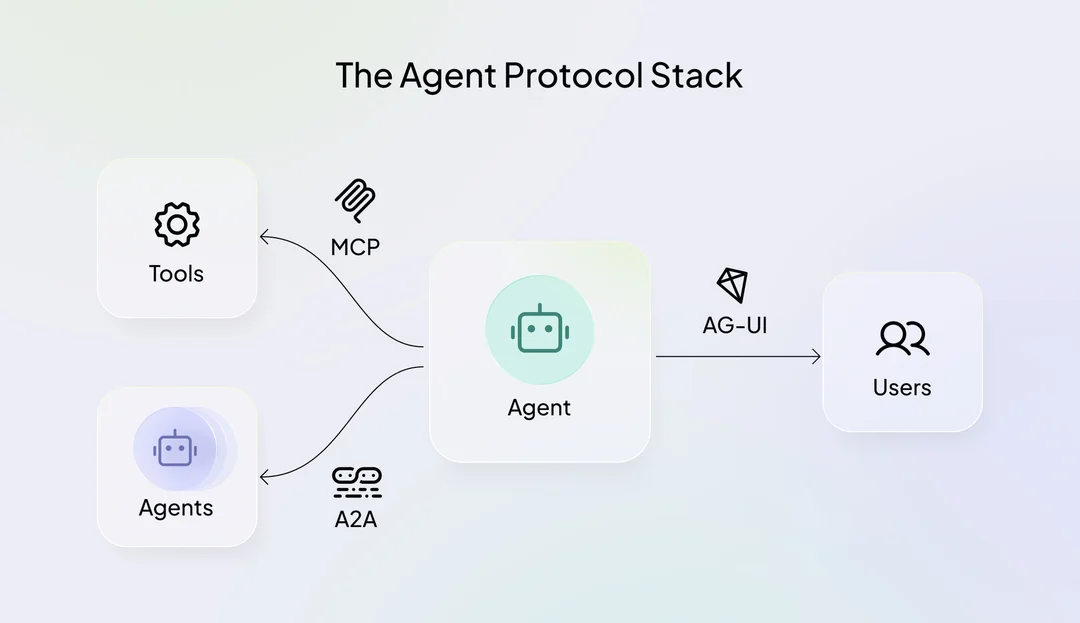
As artificial intelligence agents move beyond terminal scripts and background orchestration into user-facing software, establishing standardized interaction layers between agent backends and frontend clients has become essential. AG-UI (Agent-User Interaction Protocol) is an open-source, lightweight, event-driven protocol designed to standardize real-time communication between autonomous agents and user interfaces through roughly 16 standard event types.
Image source: ag-ui-protocol / GitHub
Initially created in May 2025, AG-UI emerged from practical engineering collaborations across CopilotKit, LangChain, and CrewAI. Through ongoing development leading up to its November 13, 2026 release, the repository has expanded its reach across mainstream orchestration frameworks including Microsoft Agent Framework, Google ADK, and AWS agent runtimes.
The Triad of Agent Protocols: MCP, A2A, and AG-UI on the Frontend
As the autonomous agent stack matures, distinct interaction protocols have emerged for separate architectural boundaries. When an AI agent needs to access external tools, APIs, or databases, Anthropic's Model Context Protocol (MCP) provides the tool-execution pipeline. When independent agents need to negotiate tasks and delegate subroutines among themselves, the Agent-to-Agent (A2A) protocol handles inter-agent messaging.
AG-UI operates alongside both protocols, filling the critical user-facing tier:
- MCP (Model Context Protocol): Connects agents to external tools and enterprise data sources.
- A2A (Agent-to-Agent): Governs inter-agent delegation and autonomous collaboration.
- AG-UI (Agent-User Interaction): Bridges backend agents and client-side user interfaces in real time.
Within this three-tiered architecture, AG-UI decouples underlying agent logic from frontend presentation components. Instead of building bespoke WebSocket handlers or custom serialization layers for every new model pipeline, applications can rely on standard event payloads to orchestrate interactive features.
16 Standard Event Types and Transport-Agnostic Middleware
At the core of AG-UI is an event specification comprising approximately 16 standard event types. Agent execution environments emit events compatible with these specifications, while accepting a standardized set of inputs. This abstraction isolates the client application from backend execution differences.
The protocol includes a flexible middleware layer characterized by several technical attributes:
- Transport Layer Independence: The specification is not bound to a single networking transport. It supports Server-Sent Events (SSE) for unidirectional streaming, WebSockets for bidirectional low-latency data exchange, and webhooks for asynchronous workflows.
- Loose Event Format Matching: The middleware accommodates minor variations in schema payloads, mitigating version mismatches between evolving backend agent engines and deployed client interfaces.
- Reference Implementations: The repository provides a reference HTTP implementation alongside default connectors, enabling developers to wire up applications without writing boilerplate transport plumbing.
This architecture supports advanced agentic user-experience patterns, including bidirectional state synchronization between agent states and UI widgets, Generative UI where tools stream structured UI schemas directly to the screen, and human-in-the-loop confirmation gates.
Ecosystem Support and Getting Started
AG-UI maintains first-party, partnership, and community integrations across major orchestration systems:
- Supported Frameworks: In addition to native partnership integrations with LangChain (LangGraph) and CrewAI, AG-UI supports Microsoft Agent Framework, Google ADK, Google Antigravity, AWS Strands Agents, Mastra, Pydantic AI, Agno, LlamaIndex, and AG2. Community integrations cover Claude Agent SDK, Claude Managed Agents SDK, Langroid, Omnara, and Cloudflare Agents.
- Multi-Language SDKs: The ecosystem is expanding beyond Python and TypeScript into language SDKs including Kotlin, Rust, and Go.
- In-Progress Integrations: Integrations for OpenAI Agents SDK and AWS Bedrock Agents remain actively under development.
Developers can scaffold a working application using the project's official scaffolding CLI:
npx create-ag-ui-app my-agent-app
Distributed under the permissive MIT License, AG-UI offers teams an open standard to bridge agents and frontends. Because the project originated within the CopilotKit ecosystem, engineers adopting advanced UI features should consult the associated documentation to understand shared client dependencies.
Sources
- GitHub: ag-ui-protocol/ag-ui Repository
- AG-UI Official Website: ag-ui.com