Academic Research Skills: An Open-Source Claude Code Agent Toolchain for the Complete Scientific Research Lifecycle
With over 48,000 GitHub stars, Academic Research Skills combines 13 deep-research agents and strict hard gates to guide literature discovery, drafting, and peer
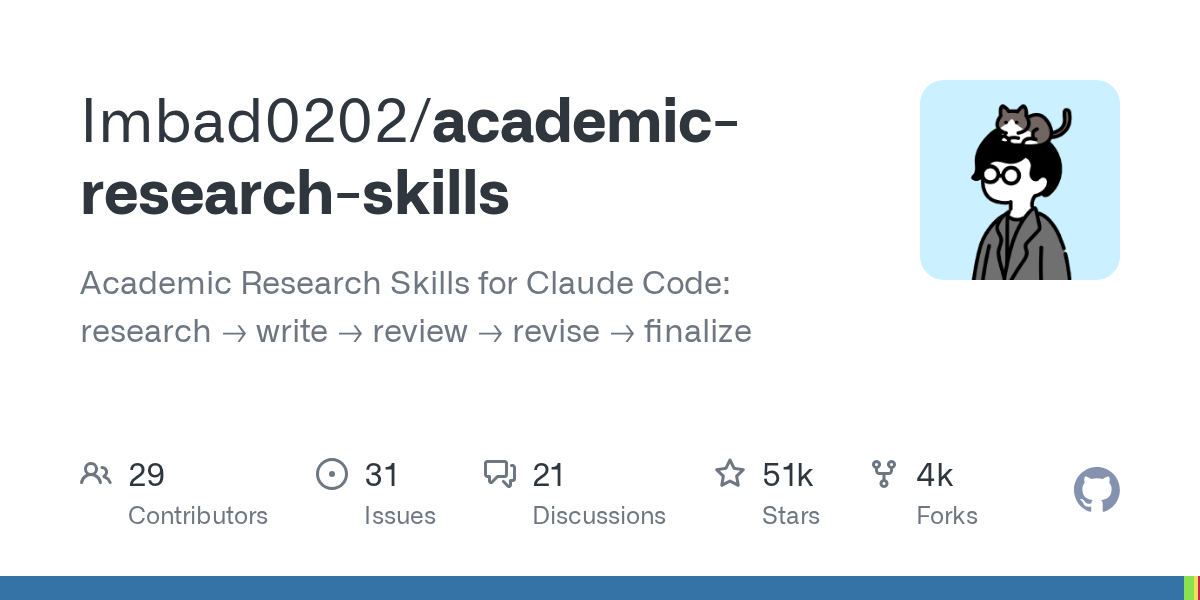
Academic Research Skills (v3.21.2), an open-source research toolkit structuring the scientific investigation workflow into a multi-agent collaborative pipeline, has gained significant traction across the research and developer communities. Amassing more than 48,000 stars and 3,700 forks on GitHub alongside a persistent Zenodo DOI archive, the project provides end-to-end support from literature exploration to drafting, peer critique, and final manuscript formalization within coding agent runtimes such as Claude Code CLI and Codex.
Conventional one-shot prompt workflows frequently struggle under expansive academic context, generating hallucinated references and abrupt logical leaps. Academic Research Skills addresses this limitation by reframing scholarly writing as a rigorous, phased engineering cycle. By positioning dedicated specialized agents and strict validation gates across each distinct stage, it delivers a verifiable and grounded environment for academic assistance.
A Five-Stage Progressive Research Pipeline and Four Core Modules
The architecture of Academic Research Skills divides the comprehensive research lifecycle into five structured operational stages:
- Research: Exploring problem domains, indexing relevant literature, and cataloging prior foundational works.
- Write: Outlining the structural narrative, framing hypotheses, and authoring manuscript sections through evidence-driven section loops.
- Review: Evaluating argument coherence, auditing claim-evidence alignment, and conducting simulated adversarial peer reviews.
- Revise: Integrating critique feedback, reinforcing empirical claims, and refining methodology and experimental descriptions.
- Finalize: Standardizing citation schemas, validating mathematical equations, and preparing manuscripts for formal submission.
To drive this lifecycle, the repository organizes capabilities across four top-level modular packages, led by two specialized agent clusters:
- deep-research module: A team of 13 dedicated exploration agents providing granular operational modes, including comprehensive analysis (
full), rapid reconnaissance (quick), Socratic critique (socratic), literature synthesis (lit-review), factual auditing (fact-check), and formal systematic reviews (systematic-review). - academic-paper module: A specialized manuscript drafting team comprising 12 agents. Rather than generating an entire manuscript in a single pass, it relies on evidence audits and section-by-section loops to ensure every included paragraph is backed by verifiable data.
Countering 'The AI Scientist' Seven Failure Modes with Hard Gates
The core engineering philosophy of Academic Research Skills rests on a firm premise: "AI is a co-pilot, not the pilot." Problem definition, methodology selection, and the interpretation of experimental findings remain strictly within the domain of the human researcher, while agents handle data indexing, citation formatting, and consistency auditing.
This discipline directly tackles the seven critical failure modes highlighted in the 2026 Nature study on 'The AI Scientist' by Lu et al. (Sakana AI):
- Defense Against Seven Core Failure Modes: The toolchain actively targets recurring automation hazards, including implementation bugs, hallucinated experimental results, misidentifying code bugs as scientific discoveries, methodology fabrication, and phantom citations.
- Two-Stage Integrity Checkpoints: Two distinct validation gates are positioned between data extraction and manuscript drafting to block unsubstantiated claims from entering the text.
- Strict Hard Gates: Each writing section is bounded by hard gates. If preliminary evidence audits fall below established thresholds, the pipeline halts progression or downgrades the certainty of narrative claims until verified evidence is provided.
Style Calibration and Mitigating System Prompt Overload
To enhance usability in authentic research environments, the toolkit introduces practical editorial and quality control mechanisms:
- Style Calibration: The system can analyze a researcher's previously published papers to emulate their unique cadence, formal vocabulary, and narrative structure, avoiding the generic syntax typical of standard LLM generations.
- Writing Quality Check: Built-in linting scans for common machine-generated clichés and overly decorative prose. The goal is not to obscure AI assistance, but to ensure manuscripts maintain the rigorous, concise tone demanded by journal reviewers.
Practical Recommendations for System Prompt Management
When integrating Academic Research Skills into Claude Code (v3.7.0 or higher recommended) or Codex environments, developers should be mindful of context constraints:
Loading too many agent skills simultaneously can rapidly bloat the model's system prompt, degrading reasoning depth and instruction compliance. Community practitioners advise against mass-loading skills, recommending instead that researchers dynamically inject only two to three core skills aligned with the immediate task (for example, pairing two literature tools during background review, then transitioning to writing skills during draft assembly).
Furthermore, all generated citations, DOIs, and numerical results must always be cross-referenced by the primary researcher against verified primary literature.