50 Useful GitHub Repositories for Developers and AI Engineers
A curated list of 50 essential GitHub repositories covering AI alignment testing (iFixAi), free APIs (public-apis), local LLM runtimes, and agent workflows.
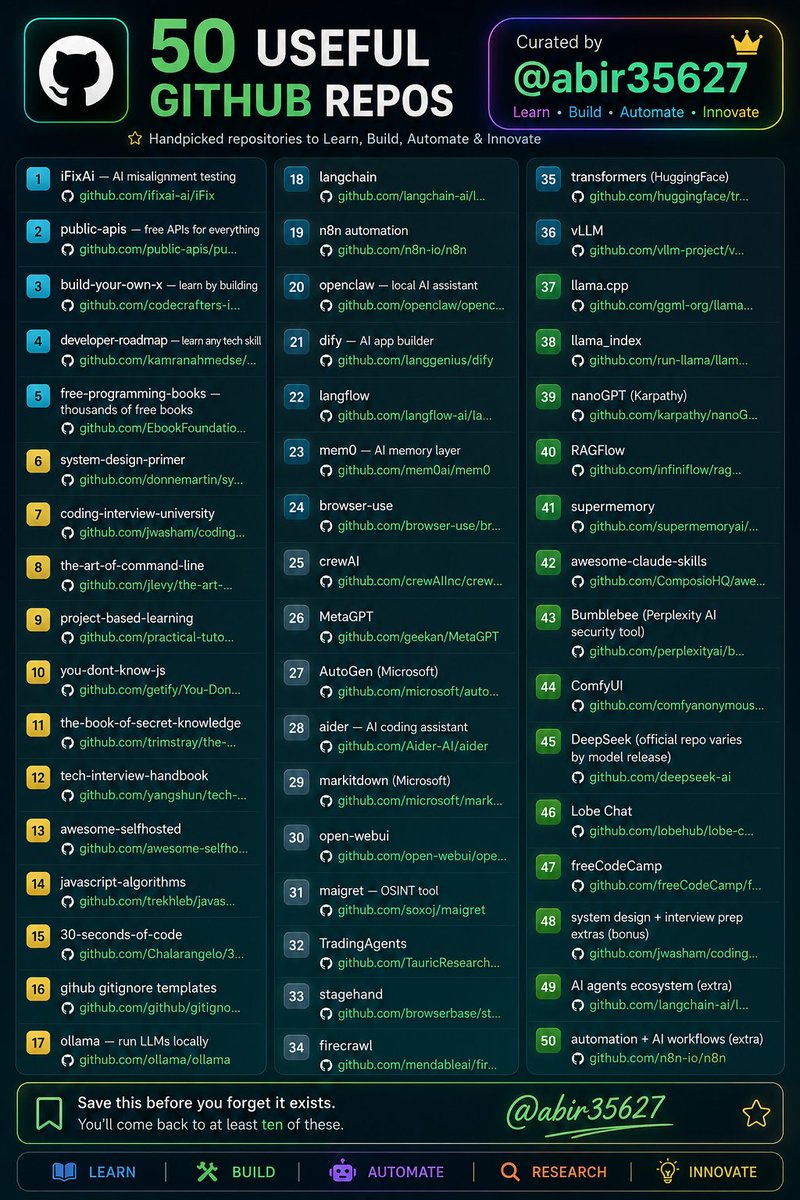
Tech curator Sanzida (@abir35627) published a curated selection of 50 high-utility open-source GitHub repositories on October 7, 2026, assembling practical tools and foundational study collections for software engineers, AI developers, and system architects.
Image source: @abir35627 on X
The compilation bridges classic computer science fundamentals—spanning distributed system design, coding interview preparation, and comprehensive programming books—with the modern generative AI stack, including local LLM runtimes like Ollama and llama.cpp, autonomous agent frameworks like CrewAI and AutoGen, and emerging AI alignment evaluation tools such as iFixAi. Below is the full breakdown of all 50 repositories categorized by technical domain for bookmarking and engineering reference.
1. Core Computer Science, Learning Roadmaps, and Developer Fundamentals (Items 1–16)
Foundational repositories designed to strengthen engineering fundamentals, master terminal workflows, and structure technical career roadmaps.
- iFixAi: Open-source diagnostic tool for AI agent misalignment testing. Audits autonomous agents for prompt injection vulnerabilities, policy compliance, and tool invocation boundaries.
- public-apis: A collective, community-maintained list of free public APIs covering diverse categories for development projects.
- build-your-own-x: Hands-on recreation tutorials teaching computer science concepts by building databases, compilers, and operating systems from scratch.
- developer-roadmap: Interactive visual roadmaps guiding developers through frontend, backend, DevOps, and related career paths.
- free-programming-books: An extensive community collection offering thousands of freely available programming books and learning resources.
- system-design-primer: A comprehensive guide to large-scale distributed system architecture and technical interview preparation.
- coding-interview-university: A structured self-study computer science syllabus tailored for passing competitive software engineering interviews.
- the-art-of-command-line: A consolidated guide to mastering terminal and command-line workflows across Linux and macOS.
- project-based-learning: A curated directory of step-by-step tutorials building practical applications from scratch across various programming languages.
- you-dont-know-js: Kyle Simpson's renowned book series diving deep into the core mechanics and subtle behaviors of JavaScript.
- the-book-of-secret-knowledge: A cheat sheet and tool manual collecting essential CLI commands, network utilities, and security references for sysadmins.
- tech-interview-handbook: Practical interview guidance covering algorithm patterns, behavioral answer frameworks, and technical resume optimization.
- awesome-selfhosted: A curated catalog of self-hostable open-source software and network services that can be deployed on personal hardware.
- javascript-algorithms: Implementations of fundamental algorithms and data structures written in JavaScript with clear explanations.
- 30-seconds-of-code: Bite-sized, reusable code snippets for common programming tasks, designed to be understood in thirty seconds or less.
- github gitignore templates: GitHub's official repository of
.gitignoretemplates tailored for different programming languages and project environments.
2. AI Agents, Automation, and Workflow Tooling (Items 17–34)
Essential frameworks for orchestrating multi-agent systems, automating web interactions, and streamlining AI application development.
- ollama: A lightweight, efficient local runtime for easily downloading and serving open-source large language models.
- langchain: A modular development framework for connecting language models with external data sources and application logic.
- n8n automation: A self-hostable, node-based workflow automation tool connecting web services, APIs, and AI models on a visual canvas.
- openclaw: A local personal AI assistant project designed to operate directly on the user's workstation.
- dify: An open-source LLM application development platform integrating visual prompt orchestration, RAG pipelines, and agent workflows.
- langflow: A drag-and-drop web graphical interface for visually assembling and testing LangChain and generative AI pipelines.
- mem0: A long-term memory layer enabling AI assistants and agents to retain context across disparate user sessions.
- browser-use: An open-source automation library that enables AI agents to visually navigate and interact with web browsers directly.
- crewAI: A multi-agent orchestration framework where specialized, role-playing AI agents collaborate to execute complex objectives.
- MetaGPT: A multi-agent framework simulating software company roles—product managers, architects, and engineers—to transform user briefs into executable code.
- AutoGen (Microsoft): Microsoft's multi-agent conversational framework enabling cooperative LLM workflows through structured agent dialogue.
- aider: A terminal-based pair programming assistant that inspects local Git repositories and directly applies code edits and commits.
- markitdown (Microsoft): A Microsoft utility for converting complex documents (Office formats, PDFs, images) into clean Markdown for LLM ingestion.
- open-webui: A feature-complete, self-hosted web chat UI with native support for Ollama and OpenAI-compatible API endpoints.
- maigret: An open-source intelligence (OSINT) utility for investigating usernames across hundreds of online platforms and public registries.
- TradingAgents: A specialized multi-agent framework tailored for financial market research, quantitative analysis, and trading simulations.
- stagehand: An AI-assisted web automation and extraction library engineered for reliable browser actions.
- firecrawl: A crawler and scraper that converts entire websites into clean, structured Markdown ready for language model context windows.
3. Foundation Models, Inference Engines, and Generative Infrastructure (Items 35–47)
High-performance inference servers, model weight repositories, RAG pipelines, and generative media toolsets.
- transformers (HuggingFace): The standard library for downloading, training, and deploying transformer-based machine learning architectures.
- vLLM: A high-throughput, memory-efficient LLM serving engine powered by PagedAttention algorithms.
- llama.cpp: Pure C/C++ inference implementation delivering fast, lightweight LLM execution on CPUs, GPUs, and Apple Silicon.
- llama_index: A data and context-augmentation framework connecting enterprise files and databases to language models for reliable RAG pipelines.
- nanoGPT (Karpathy): Andrej Karpathy's clean, minimalist implementation for training and finetuning medium-sized GPT models in PyTorch.
- RAGFlow: An open-source retrieval-augmented generation engine grounded in deep document layout analysis and multi-format parsing.
- supermemory: A personal bookmarking and memory indexing engine that builds a secondary brain for AI models.
- awesome-claude-skills: A community-driven collection of specialized skills, prompts, and practical workflows for Anthropic Claude.
- Bumblebee (Perplexity AI security tool): An AI security and penetration testing toolkit released by Perplexity for auditing agent guardrails.
- ComfyUI: A modular, node-based graphical interface for constructing precise image and video generation pipelines.
- DeepSeek: The official model repository for DeepSeek's open-weights architecture releases (official repo varies by model release).
- Lobe Chat: A modern, open-source AI chat client supporting multiple provider endpoints, plugin extensions, and custom agent personalities.
- freeCodeCamp: An open-source interactive learning platform offering free software development certifications and coding curriculum.
4. Bonus Track: System Architecture and Agent Ecosystem Extensions (Items 48–50)
Supplementary learning collections highlighting advanced system patterns and expanding agent infrastructure.
- system design + interview prep extras (bonus): Advanced architectural references covering distributed resilience, caching strategies, and technical interview scenarios.
- AI agents ecosystem (extra): A curated directory tracking the rapidly evolving landscape of autonomous agent tooling and libraries.
- automation + AI workflows (extra): Practical templates and case studies integrating business automation tools with language models.
The author concluded with a pragmatic reminder: "Save this before you forget it exists. You'll come back to at least ten of these." In an era of rapid AI tooling evolution, maintaining a catalog of verified open-source building blocks helps engineering teams avoid reinventing existing patterns while accelerating development cycles.
Original source
- Sanzida Official X (@abir35627): 50 USEFUL GITHUB REPOS
- iFixAi Official Repository: ifixai-ai/iFixAi
- Public APIs Official Repository: public-apis/public-apis