Keep the Memory When You Swap the LLM: Walrus Memory's Portable Context
Walrus introduced the Walrus Memory concept on August 14, 2026: agent memory that lives at the storage layer rather than inside one app, readable by any tool-ca
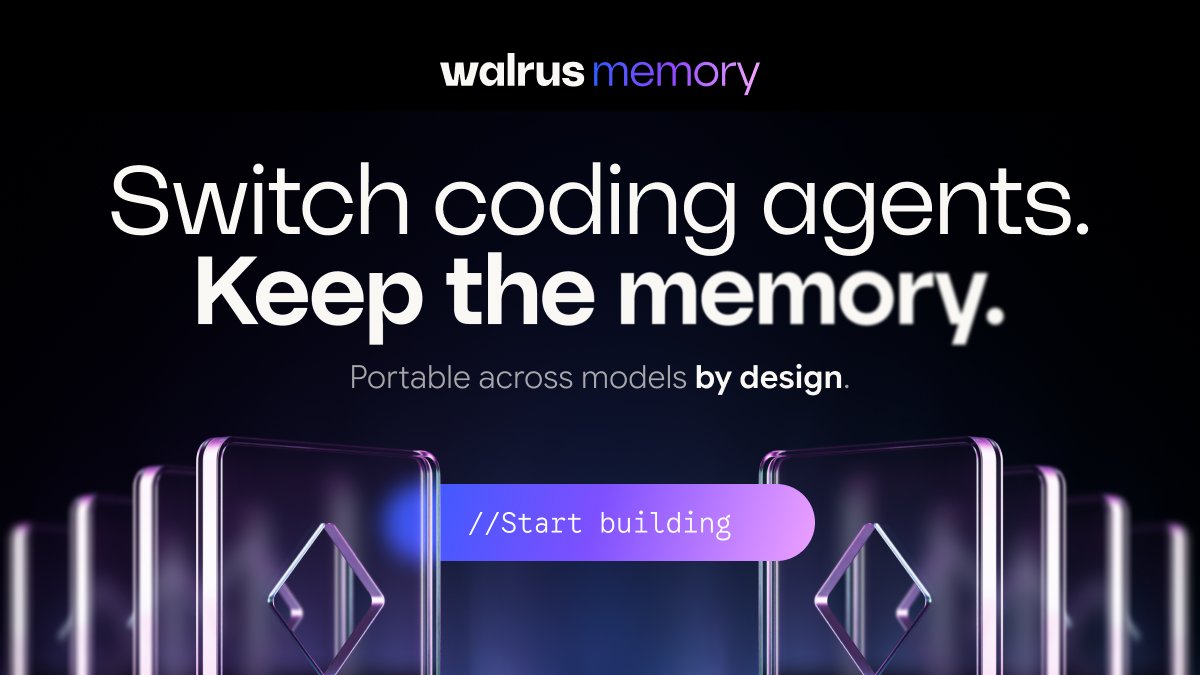
Decentralized storage project Walrus introduced an agent-memory concept called Walrus Memory in an X post dated August 14, 2026. The problem statement is simple: when an agent swaps from one LLM to another, the context it built does not come along, and the new model starts from zero. Walrus claims it keeps that memory portable across models, in the author's words: "Switch the LLM, keep everything it learned."
Image source: Walrus (@WalrusProtocol) X post
The announcement consists of a single marketing statement plus a follow-up reply thread. No standalone technical documentation, release version number, or benchmark figures were included in this bundle. Everything below summarizes only what the official Walrus account (@WalrusProtocol) itself stated, including its own caveats, and does not assert implementation status or a supported-model list.
Memory at the Storage Layer, Read via Tool Calling
The biggest differentiator stated in the author's follow-up replies is where memory lives. According to the author, existing memory products rely on centralized storage and API keys, while Walrus Memory places memory at the storage layer rather than inside a specific app.
Per the author, any model with tool-calling capabilities can fetch and read from that same context layer. Asked specifically about Grok compatibility, the author replied that models with tool calling, including Grok, can read from the same context layer. The design is therefore framed around a shared interface — tool calling — rather than per-model adapters.
- Where memory lives: at the storage layer, not inside a specific app, per the author's claim.
- Read condition: any model with tool-calling capabilities can read the same context layer, per the author.
- Practical effect: tasks can be routed to whatever model fits best without forcing the agent to relearn the stack, per the author.
Model Reasoning Differences Remain, per the Author's Own Caveat
Walrus also stated the limits of portable memory directly in the same reply thread. Model reasoning differences still have to be accounted for, the author wrote. Keeping the underlying facts, history, and state portable means never starting from a blank slate — not eliminating reasoning differences between models.
The author's own metaphor: "The intelligence can be swapped out, but the context stays with you." In another reply, the author framed persistent context as the difference between a novelty chatbot and a true autonomous agent. Both are marketing framings and should be read as the author's claims until independently verified.
- What travels: facts, history, and state, in the author's wording.
- What remains: model reasoning differences still need to be considered, per the author's caveat.
- What is unverified: performance figures, a formal release version, and a full supported-model list are absent from this material.
Why It Drew Attention
The thread stayed active for over a month after the August 14, 2026 original post, with follow-up Q&A continuing into late September. Questioners asked how it compares with existing memory products such as Honcho and supermemory, whether it works with Grok, and what portable memory is worth if model-specific assumptions break on the next LLM. The author's repeated answer was decentralized infrastructure with storage-layer access.
From an agent-workflow perspective the stakes are clear. If every model swap loses context, model selection itself becomes a risk. If facts, history, and state persist outside any single model, per-task routing to the best model becomes plausible — that is Walrus's proposal. How far that proposal is backed by actual storage implementation and tool-calling specifications cannot be judged without technical documentation or a demo.
Sources
- Walrus Official X (@WalrusProtocol): August 14, 2026 Walrus Memory Introductory Post
- Walrus Official X (@WalrusProtocol): Storage-Layer and Grok Compatibility Reply
- Walrus Official X (@WalrusProtocol): Model Reasoning Difference Caveat Reply