Structuring a Solo Motion Design Studio Pipeline with 10 Open Source Repositories
Explore a complete ten-step motion design production pipeline connecting 10 leading open-source repositories from storyboarding and vector optimization to code-
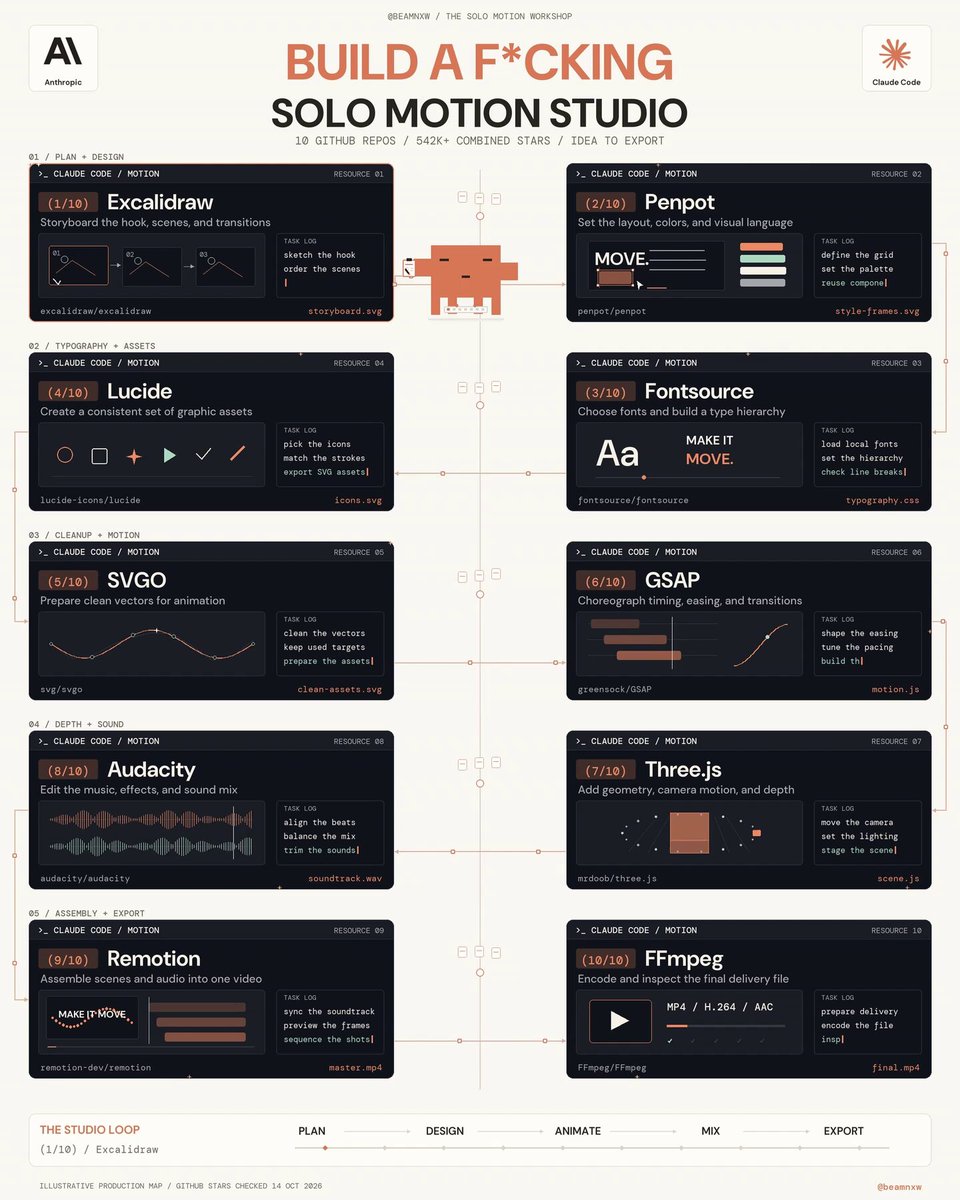
Building an independent motion graphics production environment requires establishing an integrated pipeline that seamlessly connects disparate creative and technical tools. Tech curator @beamnxw highlighted ten prominent open-source GitHub repositories, boasting over 542,000 combined stars, to construct a self-contained solo motion design studio workflow. Rather than relying on closed commercial application suites, this pipeline outlines a continuous loop covering project briefing, visual system structuring, typographic hierarchy, asset cleanup, motion choreography, 3D depth, sound editing, video assembly, and final stream verification.
1. Conceptualization and Asset Preparation: From Storyboard to Clean Vectors
The pipeline begins with Excalidraw, where the initial client or creative brief is translated into a structured storyboard featuring a distinct hook, scene sequence, and transition logic. Once the narrative structure is anchored, the second step employs Penpot to design style frames, layout grids, color palettes, and reusable design components, establishing the overarching visual system. The third step introduces Fontsource to pull required typefaces and organize typographic hierarchies across every sequence. Following typography, the fourth step integrates the Lucide icon library to generate a consistent set of vector glyphs. Before entering the animation environment, the fifth step utilizes SVGO to sanitize and optimize SVG code, deliberately stripping extraneous attributes while preserving the critical node hierarchy and elements targeted for programmatic manipulation.
2. Dynamic Choreography and Spatial Depth: Code-Driven Animation
With optimized assets ready, the sixth step introduces GSAP to choreograph the primary motion. This phase governs kinetic pacing, easing curves, execution timing, and inter-scene transitions with sub-frame accuracy. When compositions require spatial perspective and dimensional fidelity, the seventh step incorporates Three.js. Within this stage, creators build 3D scenes, coordinate virtual camera paths, configure directional and ambient lighting, and generate depth layers that integrate seamlessly alongside 2D graphic assets. By treating animation parameters as programmatic declarations, this approach facilitates systematic adjustments and repeatable timing logic across complex procedural sequences.
3. Acoustic Balancing, Programmatic Assembly, and Stream Validation
Visual momentum requires acoustic grounding. The eighth step deploys Audacity to edit musical stems, place targeted sound effects, and balance the overall mix. As collaborator Diam (@diamai_) noted in the discussion, creators frequently over-index on visual animation while neglecting necessary audio passes, making dedicated sound engineering indispensable. Once audio and animated components are finalized, the ninth step utilizes Remotion to programmatically assemble individual scenes, graphics, and audio layers into a cohesive video timeline. The final tenth step leverages FFmpeg to encode the finished delivery package and thoroughly inspect underlying video and audio streams for container compliance and bitrate integrity. The author notes this systematic sequence forms a reproducible foundation suitable for automated execution by AI workers. Practitioners should recognize that bridging disparate web, audio, and CLI environments demands rigorous pipeline glue code and structured asset management to prevent translation errors between independent tools.