Deconstructing an End-to-End AI Content Factory Built from 10 Open-Source Repositories
An architectural review of the 10 open-source repositories proposed by RoundtableSpace for an automated content pipeline, covering workflows, technical benefits
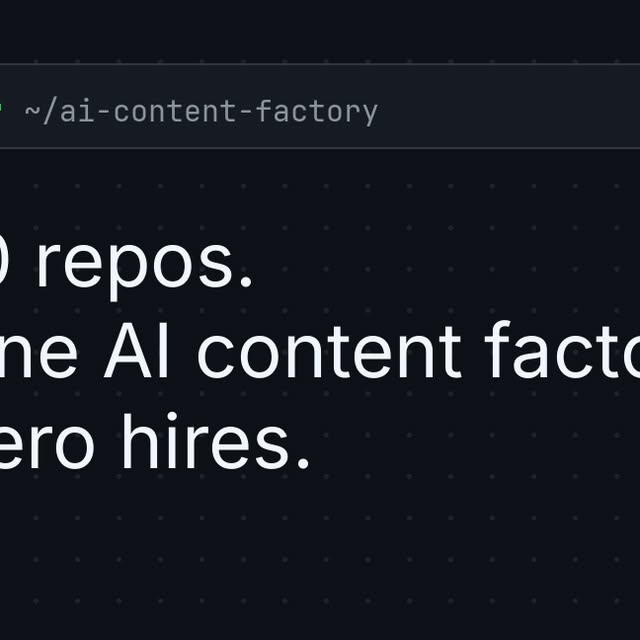
Image source: https://www.instagram.com/p/Deipa5nj-Rz/
Transitioning artificial intelligence from isolated prompt tinkering to an automated production line remains one of the foremost operational goals for modern digital creators seeking scalable workflows. Social media researcher and creator RoundtableSpace outlined an end-to-end AI content factory architecture that relies entirely on 10 free open-source GitHub repositories. By mapping individual tools across the entire trajectory of creation—specifically structured as Research, Script, Visuals, Voice, Edit, and Publish—the proposed workflow attempts to replace fractured, expensive software-as-a-service subscriptions with a modular and self-directed assembly line for diverse digital media formats.
The 10-Repository Workflow Architecture
The pipeline begins at the research and ideation stage with two distinct analytical repositories. 'Social Media Research Skills' is utilized to uncover viral posts, monitor competitor engagement patterns, and extract winning narrative hooks, while 'Local Deep Research' transforms broader topic inquiries into comprehensive background research reports. Building upon these insights, 'OpenCreator' serves as an integrated workspace managing script composition, graphics, voiceovers, multi-language translations, and baseline video editing. For standalone visual production, 'FLUX.2' generates and edits high-resolution graphics suited for video thumbnails and social content. Audio assets are produced using 'Kokoro' for running local voiceover synthesis directly on local hardware without cloud latency, coupled with 'ACE-Step 1.5' for generating original instrumental tracks and thematic background music. Moving into specialized assembly, 'Short Video Factory' automates short-form video generation by stitching scripts, visuals, synthesized voice, and subtitles. Alternatively, 'AI YouTube Shorts Generator' extracts highlights from existing long-form footage with automatic reframing and cropping, while 'Podcastfy' converts long-form text articles into conversational audio podcasts. Finally, 'Social Media Agent' digests web URLs to draft tailored posts for X and LinkedIn, facilitating queue review and schedule management.
Practical Implications for Modular Production
The strategic advantage of combining distinct repositories lies in component modularity and infrastructure sovereignty. Rather than being confined to the pricing tiers and proprietary formatting of unified commercial platforms, creators can tailor each node to specific output goals. Utilizing Kokoro for local speech generation mitigates recurring per-character API costs and external dependency risks. Similarly, coupling automated highlight extraction through the YouTube Shorts generator with multi-platform scheduling allows single source assets to cascade across platforms with minimal duplicate effort. The clean separation between topic discovery, media synthesis, and distribution offers an adaptable blueprint that can be selectively integrated depending on whether an operator produces audio, visual, or written output.
Operational Realities and Maintenance Bottlenecks
Despite the architectural elegance of chaining ten independent open-source projects, running such a multi-stage system in unattended daily production poses severe operational vulnerabilities. As software engineer Luke Jarocki noted in response to the blueprint, stitching ten separate repositories together makes for an impressive demonstration video, but relying on unattended daily execution introduces frequent breaking points. Primary operational risks include strict API rate limits across external endpoints, authorization tokens expiring silently without automated alerts, and flawed or hallucinatory outputs propagating downstream without human editorial oversight. Without robust error handling, automated retry strategies, and dedicated human-in-the-loop inspection gates, an unmonitored ten-repo chain risks compounding failure states rather than delivering reliable automation.