SK hynix Unveils 3D FeNAND-Based Analog Compute-in-Memory (A-CiM) Research: Computing AI Directly Inside NAND
SK hynix has revealed research on 3D FeNAND-based analog compute-in-memory (A-CiM) technology, enabling direct AI matrix operations inside NAND flash to mitigat
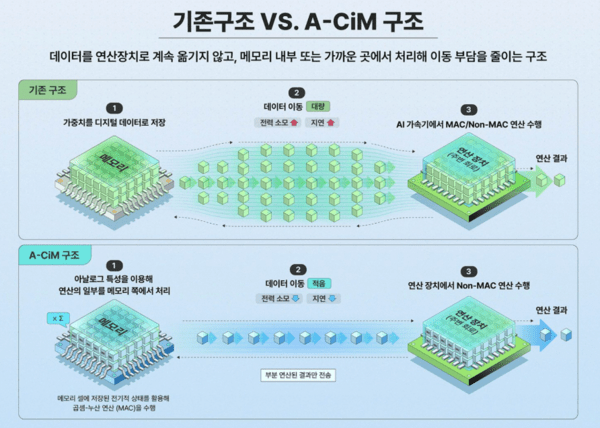
On October 14, 2026, SK hynix unveiled research achievements in 3D FeNAND (ferroelectric NAND flash)-based analog compute-in-memory (A-CiM) technology, designed to execute artificial intelligence (AI) computations directly inside memory silicon. The approach tackles the conventional von Neumann architecture bottleneck—data transfer latency and energy consumption between processors and storage—by enabling 3D NAND flash to directly perform AI matrix calculations.
Image source: https://www.thelec.kr/news/articleView.html?idxno=63722
The newly disclosed work marks an effort to transform non-volatile memory from a purely passive, high-capacity storage device into active computing silicon, broadening the functional footprint and value proposition of memory semiconductors into the in-memory computing domain.
Addressing the Von Neumann Bottleneck: AI Computations Inside Memory
As AI models scale exponentially, the primary constraint in modern computing architectures is increasingly recognized not as processing core throughput, but as the persistent bottleneck of moving massive volumes of data between processors and memory—the classic von Neumann bottleneck.
During large-scale model inference, transferring weight matrices from memory arrays to external accelerators like GPUs and NPUs consumes substantial time and electrical energy.
- Minimizing Data Movement: A-CiM technology bypasses the bus interface by performing analog matrix-vector multiplication directly within the NAND flash array, processing data where it is physically stored.
- Energy Efficiency Potential: By eliminating high-frequency bus transactions between compute units and memory chips, this architecture offers substantial theoretical gains in overall system-level energy efficiency.
3D FeNAND Architecture and Expanding the Role of NAND Flash
The foundational hardware in this research, 3D FeNAND, leverages the spontaneous polarization characteristics of ferroelectric materials integrated into three-dimensional stacked NAND structures.
SK hynix demonstrated how ferroelectric cell characteristics can enable analog in-memory computing while maintaining the high storage density inherent to 3D stacked NAND arrays.
- Transitioning Storage to Active Compute: While the memory industry historically focused on raw storage capacity, read/write speeds, and cost-per-bit metrics, this A-CiM demonstration illustrates a shift toward embedding computational capabilities directly into storage silicon.
- Diversifying Advanced Memory Portfolios: Alongside its high-bandwidth memory (HBM) leadership and Compute Express Link (CXL) developments, this research reflects a long-term strategy to expand next-generation in-memory computing architectures into non-volatile storage.
Research Stage Status and Production Milestones Ahead
The disclosed findings represent advanced exploratory research, and significant engineering hurdles remain before this technology can transition to commercial production chips.
- Cell Reliability and Endurance: Sustained analog computation requires rigorous validation against cell degradation, data retention limits, and write/erase cycle endurance to meet enterprise storage standards.
- Quantifiable Benchmark Metrics: Chip-level compute efficiency figures (such as TOPS/W), analog computation precision, and manufacturing yields must be established through subsequent peer-reviewed technical papers and formal commercial roadmaps.
Sources
- The Elec: SK hynix Unveils 3D FeNAND A-CiM Research: NAND Computes AI
- Kreia Notes on X (@kreia): SK hynix unveils 3D FeNAND tech that computes AI inside NAND