REA: Open-Source MCP Bridging Ghidra and Hopper into AI Agents for Reverse Engineering
From sourceless native binaries to Electron app IPC flows, REA (Reverse Engineer Anything) connects decompiler engines like Ghidra and Hopper directly to AI age
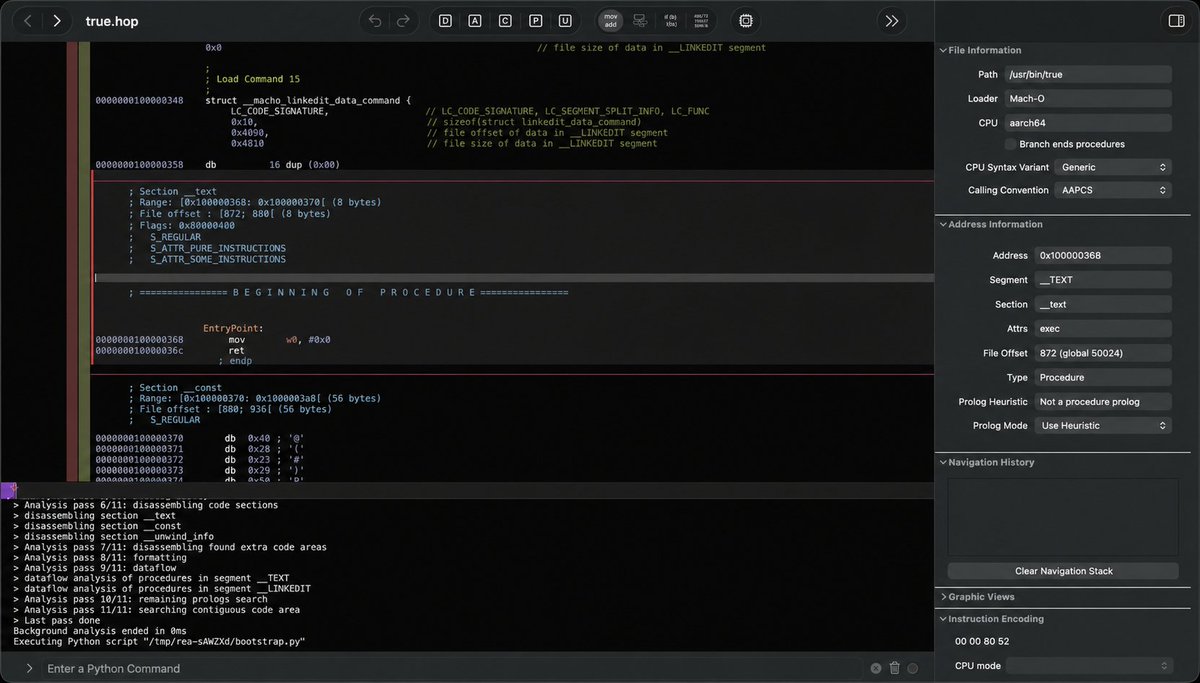
Inspecting compiled binaries and executables has traditionally required launching dedicated decompilers such as Ghidra, Hopper, or IDA and manually tracing tens of thousands of lines of assembly code. In October 2026, an open-source tool named 'REA (Reverse Engineer Anything)' emerged to automate and bridge these reverse engineering pipelines directly into AI coding agents.
Image source: @Dontgiveup_26 (X)
Built around the Model Context Protocol (MCP) standard, REA operates as a local MCP server that enables AI agents like Cursor and Claude Code to drive decompiler engines programmatically, automating binary analysis, pseudocode translation, and logic reconstruction entirely within a local environment.
Bridging Decompiler Engines (Ghidra, Hopper, IDA) to AI Agents via MCP
REA's foundational architecture abstracts proven binary analysis engines into direct tool interfaces for AI agents.
- MCP Tool Integration: AI agents programmatically control Ghidra, Hopper, and IDA decompilation routines through the standard MCP interface.
- Automated Pseudocode Translation: Instead of requiring human engineers to manually inspect raw disassembly, the agent navigates control flow graphs and call hierarchies to produce clean, readable C-level pseudocode.
- Broad Target Support: Accommodates sourceless native executables, .NET assemblies, embedded firmware images, and runtime I/O process interactions.
Instead of manually navigating registers and memory offsets in a GUI, developers can prompt an agent in natural language to locate specific operational logic, identify function entry points, and trace data flow.
Tracing Electron App IPC and Reconstructing Legacy C++ Logic
Beyond traditional native binaries, REA provides verified workflows across desktop web runtime applications and legacy software architectures.
- Electron and JavaScript IPC Tracing: In complex Electron applications such as Notion or Slack, the tool enables end-to-end tracing across renderer processes, preload scripts, and main process IPC layers to uncover internal API handlers and complex rich-text clipboard bridge behaviors.
- Evidence-Driven Logic Reconstruction: Extracts algorithmic evidence from classic binaries—such as panning math in DX-Ball or angular trajectory calculations in 16-bit DOS titles—allowing engineers to regenerate functionally identical modern C/C++ source code matching the original compiled behavior.
100% Local On-Device Analysis and Intellectual Property Considerations
Key technical boundaries and ethical factors governing REA deployments include:
- 100% Local Execution: Target binaries, intermediate disassembly, and decompilation outputs remain strictly on the user's local machine without transmitting files or code to third-party cloud infrastructure, ensuring safe inspection of sensitive proprietary binaries.
- Intellectual Property (IP) and Security Considerations: As AI lowers the barrier to rapidly inspecting and duplicating proprietary business logic, developers and teams must navigate intellectual property rights responsibly and safeguard against unauthorized cracking or malicious exploitation.
Sources
- Original Announcement (X @Dontgiveup_26): REA (Reverse Engineer Anything) Open-Source MCP Reverse Engineering Tool Overview
- REA Feature & Architecture Thread: REA Core Capabilities and Decompiler Agent Integration Workflow