Turn Prompts into Reusable Assets: Workflow Tips with 170k-Star prompts.chat
Instead of writing LLM prompts from scratch, use prompts.chat to discover category-tested templates, build collections, and self-host a private open-source prom
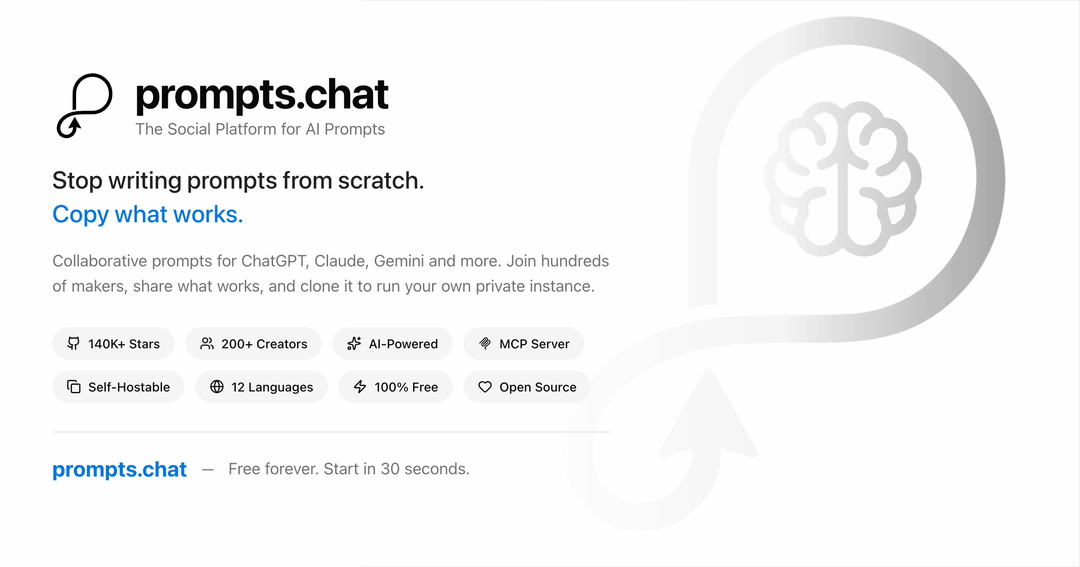
AI developer and practitioner @0xJokker shared actionable workflows for transforming prompt engineering from disposable, ad-hoc chat sessions into structured, reusable assets using 'prompts.chat'. Surpassing 170,000 stars on GitHub and cited in academic materials from institutions such as Harvard and Columbia, the project stands as the world's largest open-source prompt catalog, helping creators and developers systematically discover, organize, and self-host battle-tested prompt templates.
Image source: prompts.chat
Five Core Workflows for Discovering and Managing Tested Prompts
Most AI users write disposable prompts on the fly every time they open ChatGPT or Claude, leading to inconsistent outputs and repetitive manual phrasing. @0xJokker highlights that prompts.chat is not merely another static list of suggestions, but an active, structured system designed to streamline real-world prompt workflows through five essential mechanics:
- Category-Based Discovery of Working Prompts: Users can browse thousands of copy-and-paste ready prompts organized across specialized categories, such as coding assistance, persona simulation, data analysis, and technical drafting. Starting from templates already verified by a large community dramatically reduces hallucination risks and vague responses.
- Curated Personal Collections: You can save proven prompts directly into personal collections, eliminating the friction of rummaging through past chat histories or re-typing complex instructions.
- Collaborative Improvements: Community members can submit refinements and propose adjustments to keep prompts updated as underlying model behaviors shift.
- Community Voting on Optimal Prompts: Built-in upvoting allows practitioners to quickly identify which prompt variants deliver the highest reliability and output quality across actual production tasks.
- Private Library Self-Hosting: Because prompts.chat is 100% free and open-source, teams bound by internal compliance or data governance policies can clone the repository and run their own private prompt hub internally.
Multi-Model Portability and Practical Production Deployment Tips
A primary strength of prompts.chat in production environments is its cross-model adaptability. Rather than locking workflows into a single vendor interface, the repository provides templates tested across Claude, ChatGPT, Google Gemini, and open-weight models like Meta Llama.
- Modular Placeholder Integration: Prompts in the catalog feature bracketed variables such as
[TARGET]or[ROLE]. Standardizing these placeholders turns static prompts into reusable, parameterized templates suitable for automated API scripts or team knowledge bases. - Git-Backed Prompt Version Control: By deploying the open-source repository (
https://github.com/f/prompts.chat), organizations can manage proprietary system instructions and domain-specific personas under standard Git versioning, maintaining a verifiable history of prompt revisions. - Model-Specific Calibration: While top-voted prompts provide an excellent foundation, practitioners should calibrate them for specific model strengths. For example, adding explicit Chain-of-Thought directives benefits Claude reasoning tasks, while strict JSON output syntax guards remain essential when deploying smaller local Llama checkpoints.
Original source
- Original thread: @0xJokker on X (Twitter)
- Official repository: prompts.chat GitHub Repository
- Academic and community reference: The open-source prompt engineering catalog with over 170,000 GitHub stars, cited in coursework and research at Harvard and Columbia
- Supported environments: Native compatibility across OpenAI ChatGPT, Anthropic Claude, Google Gemini, and open-weight models including Meta Llama