OpenRouter Launches Armor Beta: Agent Tool-Call Guardrails Powered by TypeSafe Jev
OpenRouter has launched OpenRouter Armor in beta, an agent guardrail system powered by TypeSafe AI's Jev 1.13 to block out-of-policy tool calls before execution
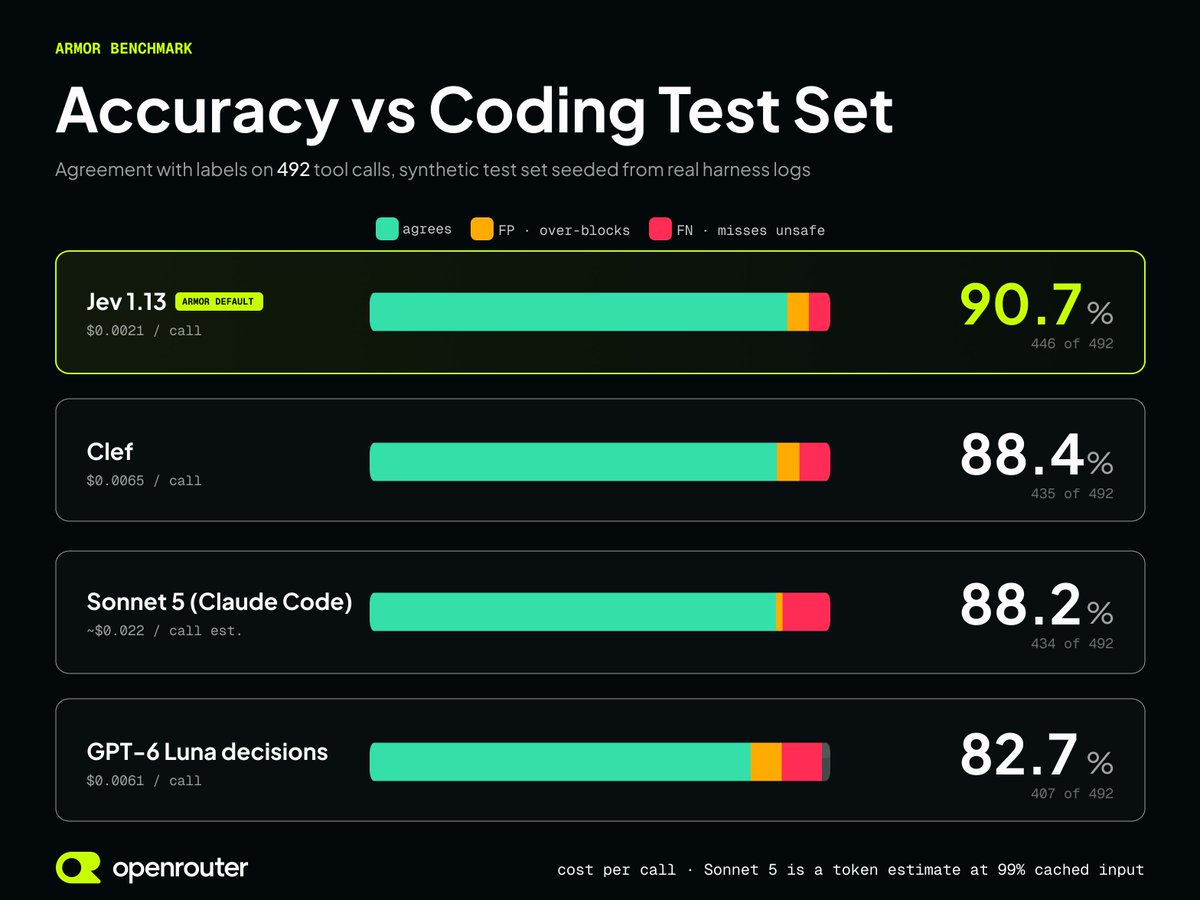
On October 16, 2026, unified AI model routing platform OpenRouter officially rolled out the public beta of 'OpenRouter Armor,' a dedicated guardrail system designed to preemptively intercept out-of-policy and potentially dangerous agent tool calls before they are executed.
Image source: @OpenRouter on X
In autonomous agent architectures and software engineering workflows, tool calling enables language models to interact with the external world by running shell commands, editing files, or calling remote APIs. However, traditional regex-based filtering has proven inadequate for discerning nuanced, context-dependent risks or preventing unintended commands during complex agent runs. OpenRouter Armor addresses this vulnerability by placing a specialized decision model directly in the execution path.
Context-Aware Scoring via TypeSafe Jev 1.13 Prioritizing User Intent
At the core of OpenRouter Armor is the integration of TypeSafe AI's Jev 1.13 foundation decision model as its backend verification engine.
Rather than relying on static string pattern matching, Armor evaluates each proposed tool call by scoring it against a defined set of security rules alongside a slice of the recent conversation transcript. Throughout this evaluation, the primary arbiter of safety is explicit user intent.
- Permitting Authorized Actions: When a user explicitly directs an agent to "Push our work," a bash tool call invoking
git pushaligns directly with the stated objective and is permitted without friction. - Flagging Unrequested Destructive Commands: Conversely, if an agent attempts an unprompted file deletion, unauthorized system configuration change, or external network exfiltration not requested in the conversation context, Armor flags the call as hazardous and halts it before execution.
According to OpenRouter's internal evaluation on a custom benchmark test set built for this task, Jev 1.13 demonstrated higher classification accuracy and lower inference costs when compared against competing decision models as well as Claude Code's native permission classifier utilizing Claude Sonnet 5.
Broadening Claude Code Auto Permissions and Universal Ori CLI Setup
Beyond securing generic tool calls, Armor expands automated permission workflows across the broader multi-model ecosystem.
Anthropic's Claude Code coding assistant features an automated permission mode (--permission-mode auto) to streamline continuous terminal execution, but it has historically been coupled with Anthropic's own classifier. OpenRouter Armor decouples this mechanism, enabling full compatibility between Claude Code's auto permissions workflow and any foundation model hosted on OpenRouter.
Developers can immediately spin up Claude Code with their model of choice via the Ori CLI wrapper:
$ ori claude --model moonshotai/kimi-k3 -- --permission-mode auto
Furthermore, any autonomous agent routing inference through OpenRouter can opt in to Armor protection by including a single plugin configuration parameter alongside custom policy rules:
[{ "id": "armor" }]
Comprehensive configuration options, custom rule schemas, and onboarding workflows are detailed in the official documentation at https://openrouter.ai/docs/guides/features/plugins/armor.
Beta Considerations, Latency Overhead, and Gateway Boundary
Engineering teams evaluating OpenRouter Armor for production pipelines should account for several architectural trade-offs:
- Evaluation Latency and Compute Cost: Because Armor dispatches a transcript slice to Jev 1.13 for semantic evaluation rather than applying instant regex checks, guarded tool calls incur modest additional network latency and plugin token costs per evaluation turn.
- Gateway Pipeline Scope: Armor operates as an inline plugin within the OpenRouter inference gateway. Consequently, it provides robust defense for traffic routed through OpenRouter, but cannot govern standalone local inference environments (such as Ollama) or direct provider connections that bypass OpenRouter's proxy.
- Beta Phase Verification: As an early beta release, development teams should validate false-positive rates across specialized developer tool suites before deploying Armor widely across critical automated production pipelines.
Sources
- OpenRouter Official X (@OpenRouter): OpenRouter Armor Beta Announcement
- OpenRouter Official Guide: OpenRouter Armor Plugin Documentation