OpenMed 3.0 Released: An Open-Source Framework for Linking and Preserving Conflicting Healthcare Data Across Heterogeneous Systems
OpenMed 3.0 introduces a Patient Journey framework that resolves and links conflicting clinical data across clinic notes, hospital FHIR, external HL7, lab CSVs,
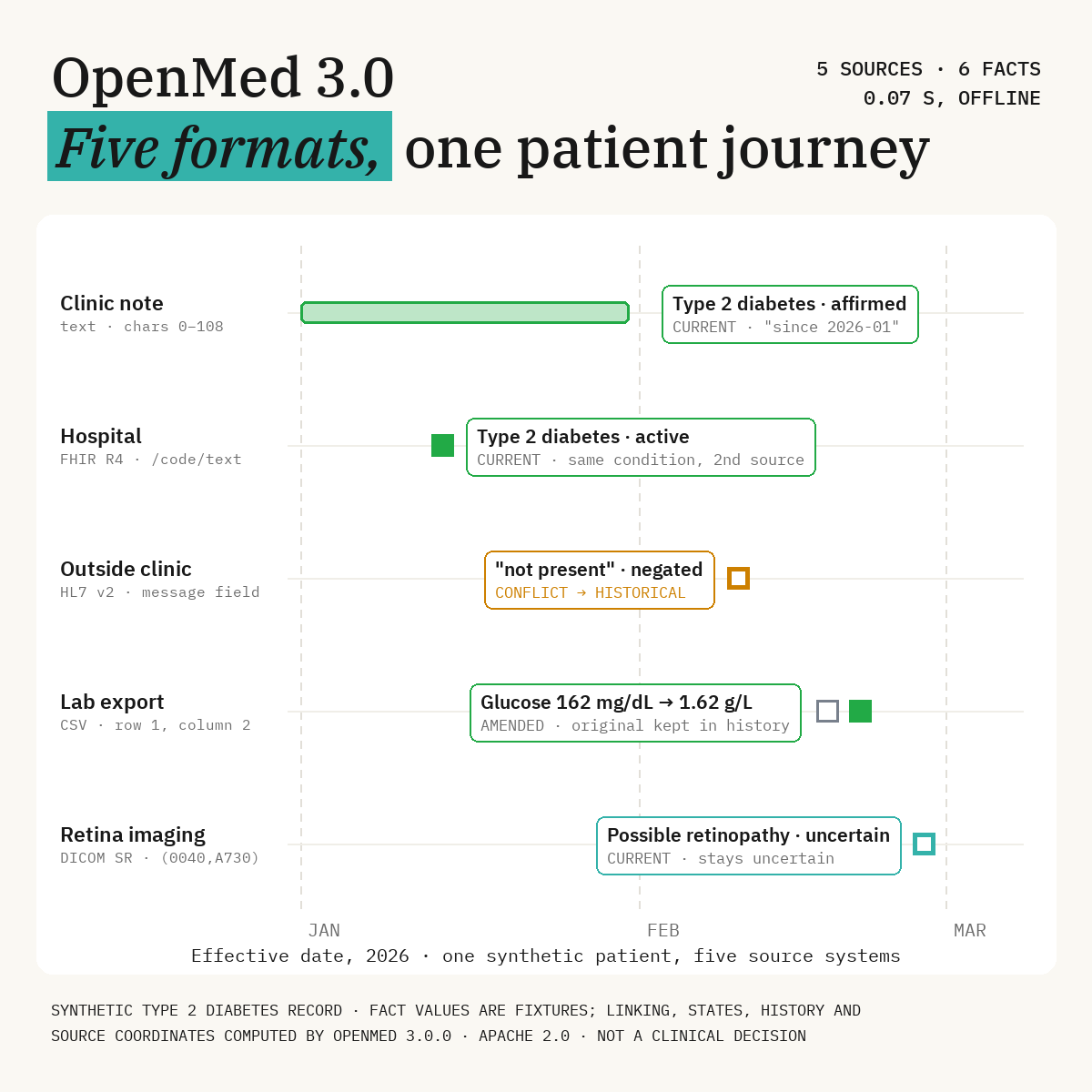
OpenMed, the open-source healthcare data engineering framework, officially released its major version "OpenMed 3.0 (openmed 3.0.0)" on October 8, 2026. Released under the Apache 2.0 license, this update introduces the "Patient Journey" architecture designed to track, link, and preserve conflicting clinical records across heterogeneous medical systems without overwriting original data.
Image source: @OpenMed_AI
In production clinical and healthcare data pipelines, inconsistencies frequently arise when patient records are generated across multiple institutions and diagnostic modalities. Rather than forcibly collapsing conflicting values or erasing past entries, OpenMed 3.0 provides a core computational engine for data linking, state tracking, and historical lineage that preserves open conflicts while maintaining transparent connections to exact source origins.
Synthetic Patient Scenario Across Five Disparate Medical Data Systems
The OpenMed 3.0 release demonstrates its data reconciliation workflow using a single synthetic patient profile evaluated across five distinct clinical standards and formats:
- Clinic Note: Text-based primary care clinical documentation
- Hospital FHIR (Fast Healthcare Interoperability Resources): Modern hospital standard data resources
- External Clinic HL7 (Health Level Seven): Legacy interoperability messaging from outside clinics
- Lab CSV: Tabular lab and blood panel diagnostic values
- Retina DICOM Report: Ophthalmology imaging and interpretation reports
When conflicting diagnostic impressions or lab values emerge across these five distributed systems for the same patient, OpenMed 3.0 preserves individual source coordinates rather than arbitrarily prioritizing a single value or overwriting earlier records.
History-Preserving Amendments and Conflict Tracking Engine
Unlike traditional healthcare integration pipelines that rely on destructive overwrite rules, OpenMed 3.0 operates on three foundational principles:
- Source Coordinates Linking: Maps every clinical fact and measurement 1:1 to its exact origin within source files and emitting systems.
- Open Conflict Preservation: Keeps data disagreements explicitly documented across systems instead of forcing premature reconciliation.
- Amending Without Erasing: Appends updates, revisions, and new clinical measurements into an immutable audit trail without discarding historical records.
Migration Guide and Open-Source Distribution
OpenMed 3.0 is distributed freely under the Apache 2.0 license.
The complete source code and release notes are available on GitHub (maziyarpanahi/openmed), accompanied by a comprehensive migration guide for engineering teams transitioning from OpenMed 2.5 to 3.0. In the demonstration pipeline, fact values originate from synthetic test fixtures, while linking logic, state resolution, history tracking, and source coordinate computations are executed directly by the openmed 3.0.0 core engine.
Sources
- GitHub Release: openmed v3.0.0 Release Notes and Migration Guide
- GitHub Repository: maziyarpanahi/openmed
- OpenMed Official X (@OpenMed_AI): OpenMed 3.0 Patient Journey Announcement