OpenDesign Releases 'OpenDesign Motion': Open-Source Claude Motion Alternative Supporting Custom Models and Agents
OpenDesign has officially released OpenDesign Motion as an open-source alternative to Anthropic's Claude Motion, breaking lock-in to proprietary models like Opu
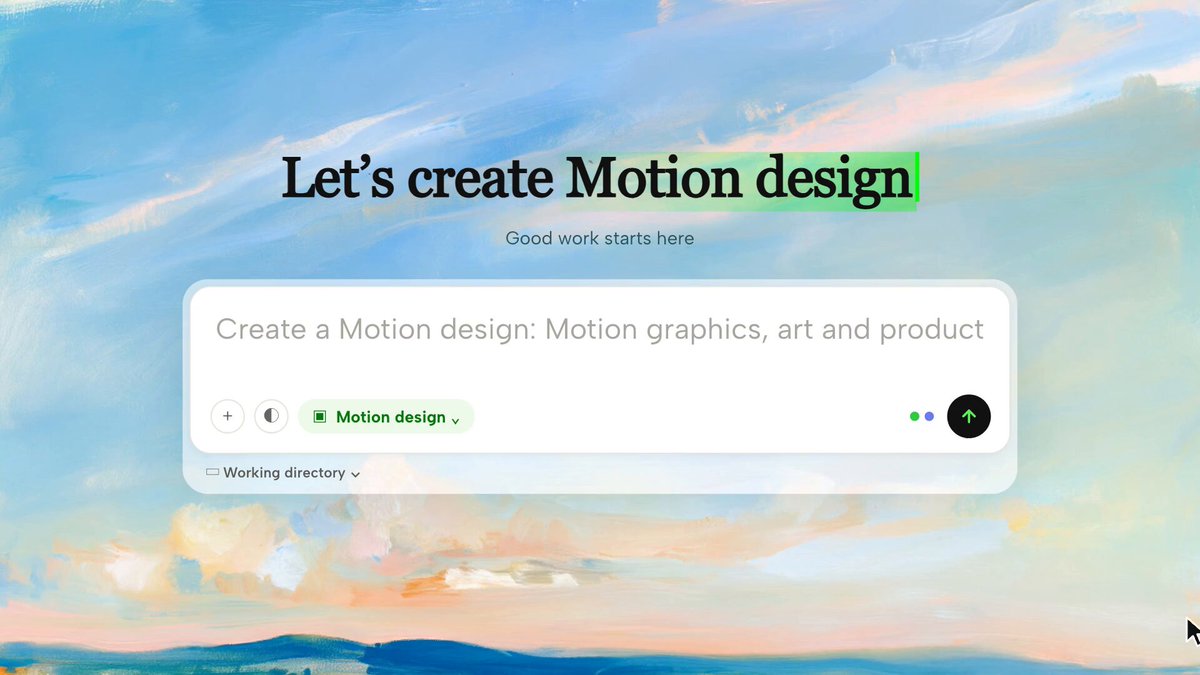
On October 16, 2026, OpenDesign developer Tom Huang (@tuturetom) and the official team account (@OpenDesignHQ) officially announced OpenDesign Motion, an open-source motion video creation tool positioned as an alternative to Anthropic's Claude Motion, alongside the public release of its GitHub repository (nexu-io/open-design).
Image source: OpenDesign / Tom Huang (@tuturetom) via X
The release focuses on dismantling vendor lock-in within generative motion graphics workflows, allowing creators to connect their preferred large language models (LLMs) and autonomous AI agents directly inside OpenDesign rather than relying solely on proprietary frontier models.
Breaking Free from Proprietary Lock-In: Custom Models and Agent Integration
Generative motion graphics and interactive video workflows have increasingly centered around high-cost proprietary frontier models, such as Anthropic's Claude Opus 5.5. While capable, exclusive reliance on high-tier commercial APIs introduces steep inference costs and ecosystem restrictions for production teams.
OpenDesign Motion addresses these constraints by structuring the workflow engine as an open, modular framework.
- Model and Agent Independence: Rather than restricting users to a single vendor API, creators can integrate their own choice of local or cloud-hosted LLMs, as well as custom AI agent harnesses, to orchestrate motion generation inside OpenDesign.
- Open-Source Repository: Released publicly via the
nexu-io/open-designGitHub repository, the codebase provides developers and motion designers with direct visibility into the tool's architecture, enabling local deployment, modification, and pipeline extension. - Cost-Optimized Production: By decoupling motion orchestration from top-tier proprietary APIs, production teams can deploy cost-efficient lightweight or mid-tier models suited to specific tasks, dramatically lowering operational overhead.
DeepSeek v4.1 Flash Validation: Launch Video Rendered on a Lightweight Model
To demonstrate the viability of cost-conscious alternatives, the OpenDesign team confirmed that their official product announcement video was generated entirely using DeepSeek v4.1 Flash integrated into OpenDesign.
- Lightweight Flash-Tier Execution: By powering the agent backend with DeepSeek v4.1 Flash—a model with substantially lower API token costs than top-tier frontier options—the team rendered complete motion graphics and visual sequences without relying on Opus 5.5.
- Native Tooling Pipeline: The release video was orchestrated and produced directly within the OpenDesign environment using prompt-driven agent workflows.
- Democratizing Motion Production: The demonstration highlights that compelling motion video outputs do not strictly demand high-end commercial API subscriptions or massive compute clusters, drawing significant attention across the open-source creator community.
Practical Implementation Considerations: Camera Parameters and Workflow Tuning
While OpenDesign Motion provides welcome architectural freedom and substantial cost-reduction potential, early community discussions highlight several practical challenges that teams must address during production rollout:
- Variance in Natural Language Camera Control: While using lightweight models like DeepSeek Flash reduces compute costs by orders of magnitude, community discussions and practitioner feedback note that natural language descriptions for camera kinematics—such as "slow push-in" or "rapid horizontal pan"—can exhibit noticeable interpretation variance across different models. Structuring camera parameters into explicit fields (direction, velocity, duration) is recommended to prevent ambiguous agent execution and wasted prompt tokens.
- Timeline Coherence and Keyframe Iteration: If an AI agent fails to accurately resolve multi-layer keyframe spacing and timeline pacing on its initial pass, iterative manual corrections may disrupt overall composition tempo. Maintaining a balance between automated agent generation and granular manual control remains essential.
- Distinguishing Marketing Demos from Standardized Benchmarks: The launch video showcases a carefully curated demonstration of what DeepSeek v4.1 Flash can achieve inside the harness. Standardized cross-model benchmark evaluations and controlled stress-tests under varying creative constraints have yet to be established independently.
Sources
- Tom Huang on X (@tuturetom): OpenDesign Motion Launch and DeepSeek v4.1 Flash Video Announcement
- OpenDesign Official on X (@OpenDesignHQ): OpenDesign Motion Official Launch Post
- OpenDesign GitHub Repository: nexu-io/open-design