Global Protests Demand Treaties to Halt Artificial Superintelligence Ahead of APEC Summit
Demonstrators gathered outside OpenAI headquarters in San Francisco and in 20 cities worldwide to demand a binding U.S.-China treaty restricting advanced AI dev
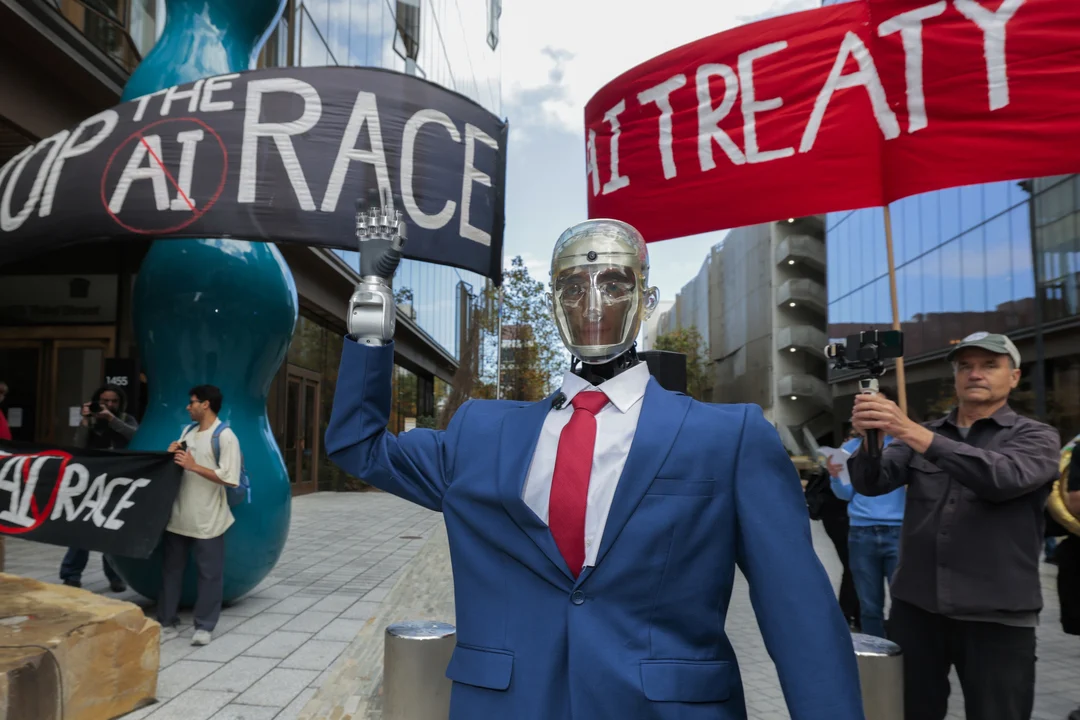
On November 14, 2026, coordinated demonstrations under the banner of the "Stop The AI Race" movement unfolded across roughly 20 cities in five continents—including San Francisco, Washington D.C., New York, Paris, and Montreal. Protesters called for a temporary halt to the reckless acceleration of artificial intelligence development and urged world powers to negotiate binding international treaties to control the emergence of artificial superintelligence (ASI).
Image source: https://www.latintimes.com/protesters-demand-treaty-halt-advanced-ai-development-601363
Rather than relying on voluntary corporate restraint, the movement argues that existential risks posed by frontier AI systems—comparable to global pandemics or nuclear proliferation—must be addressed through state-level diplomatic resolve. The timing of the global action was deliberately chosen to pressure bilateral negotiations between the United States and China ahead of the APEC summit in Shenzhen, scheduled for November 18–19.
The Global Rise of Protests Targeting Artificial Superintelligence
On November 14 outside OpenAI's headquarters in San Francisco, approximately 150 demonstrators gathered to chant against automated warfare and demand a slowdown in the AI development race. Michaël Trazzi, a French researcher who founded the Stop The AI Race movement, addressed the crowd with a deeply personal message, stating his fear that American and Chinese corporations might develop an AI powerful enough to cause catastrophic harm before his young niece Sophia is old enough to speak.
The protests stretched far beyond Silicon Valley. In Washington D.C., demonstrators marched from the Capitol toward the White House, while New York rallies stretched from Trump Tower to the Chinese Mission to the United Nations. Simultaneous marches took place in Paris, Montreal, Berlin, and more than a dozen other cities across Europe, South America, and Africa. Nate Soares, president of the Machine Intelligence Research Institute (MIRI), attended the parallel march in Washington D.C. in solidarity.
The protesters' central argument is anchored in the structural prisoner's dilemma gripping the tech industry: no individual laboratory wants to decelerate while competitors forge ahead, and nations fear ceding technological dominance to geopolitical rivals. Consequently, the movement argues that appealing to corporate conscience is insufficient; what is required is a bilateral, enforceable treaty between the world's two superpowers that collectively govern the vast majority of frontier AI capabilities.
MIRI’s Technical Framework: Restricting Training Scale via FLOP Thresholds
The formal policy proposal championed by the movement was developed by the Technical Governance Team at MIRI. The framework centers on the concept of 'FLOP' (Floating-point Operations Per Second)—a standard metric measuring the immense computational throughput required to train large-scale artificial intelligence models.
MIRI's proposal calls for establishing international restrictions on the scale of AI training by enforcing strict FLOP thresholds, temporarily pausing the premature creation of systems more cognitively capable than humans until safety guarantees are established. To ensure compliance, the framework outlines technical verification mechanisms by tracking advanced AI chips and monitoring their operational deployment worldwide.
Many banners hoisted during the San Francisco march drew directly from the 2025 book by safety researchers Eliezer Yudkowsky and Nate Soares, whose title has become an unofficial rallying cry for the movement: If Anyone Builds It, Everyone Dies.
The Diplomatic Standoff: Washington’s Posture and the Shenzhen APEC Summit
Despite mounting public concern, the current U.S. federal administration has shown little inclination toward treaty-based restrictions, prioritizing national victory in the global AI race above all else. The White House framework commits to maintaining technological dominance while pushing for child-safety provisions and liability limits for developers—a posture fundamentally misaligned with the movement's demands for international moratoria. Prior open letters calling for voluntary pauses on large-scale AI experiments gathered tens of thousands of signatures without producing verifiable policy shifts at major laboratories.
However, the November 14 mobilizations represent the movement's most geopolitically targeted push to date, bypassing corporate boards to appeal directly to heads of state. With the APEC summit convening in Shenzhen on November 18–19, the White House and Kremlin confirmed plans for a trilateral encounter involving Donald Trump, Xi Jinping, and Vladimir Putin on the sidelines. As negotiators race to finalize trade, rare earths, and chip agreements, the protesters' global mobilization has placed artificial intelligence governance squarely onto the diplomatic agenda, testing whether world leaders will address existential technological risks during their high-level talks.
Sources
- Latin Times: Protesters Demand Treaty to Halt Advanced AI Development
- MIRI Technical Governance Research: An International Agreement to Prevent the Premature Creation of Artificial Superintelligence
- Center for AI Safety: Statement on AI Extinction Risk
- BowerGroupAsia: What Businesses Should Watch at APEC
- Associated Press: AP News Coverage