Digital Footprint Self-Check: 5 Open-Source OSINT Tools to Audit Your Online Exposure
A practical guide to 5 open-source OSINT tools (Blackbird, Maigret, SpiderFoot, theHarvester, Shodan) to trace exposed credentials and audit personal privacy.
On October 5, 2026, tech creator Xavier (@Xaviercoderx) published a curated overview of five prominent free and open-source OSINT (Open Source Intelligence) tools designed to help users track and audit their own digital footprints across individuals, corporate domains, and connected devices. Rather than encouraging intrusive surveillance into others' private lives, the guide positions these tools as an essential defensive playbook, enabling individuals and organizations to identify exposed usernames, leaked credentials, neglected accounts, and vulnerable hardware before malicious actors can exploit them.
Image source: Xavier (@Xaviercoderx) via X
In an interconnected digital landscape, fragmented breadcrumbs—such as legacy social handles, corporate email addresses, overlooked subdomains, and factory-default hardware—frequently linger online long after users have moved on. Defensive OSINT provides a systematic framework to discover what information about yourself is publicly indexed. The five highlighted tools span entry-level username cross-referencing, recursive profile exploration, modular multi-source threat intelligence, domain harvesting, and programmable device scanning.
1. Username and Email Discovery: Blackbird and Maigret
The most common starting point for personal digital footprint tracking involves shared usernames and email addresses reused across multiple digital platforms. Within this category, entry-level reconnaissance and deep recursive profiling address different stages of investigation:
-
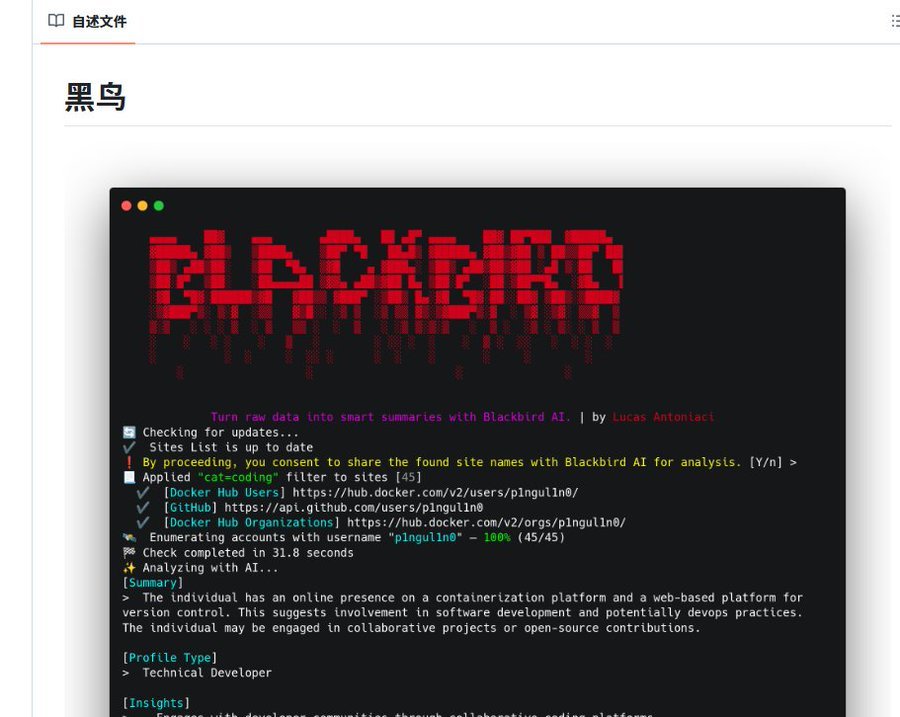
1️⃣ Blackbird (GitHub 7.3k Stars): Ingests a single username or email address and queries over 600 online platforms in parallel to detect matching registered accounts. Beyond simple account discovery, Blackbird offers a built-in feature that compiles the aggregated findings into a clean, AI-powered profile summary exported directly as a structured PDF document. It serves as an accessible starting tool for beginners seeking a quick overview of their public account visibility.
🔗 GitHub Repository -
2️⃣ Maigret (GitHub 35.6k Stars): An advanced username reconnaissance engine that expands search coverage across more than 3,000 web services. Maigret's defining feature is its "recursive chasing" capability: whenever it discovers an alternate username, secondary identifier, or linked profile on a target service, it automatically branches out and drills down through that new lead. This allows users to uncover forgotten legacy profiles and sprawling account trails that simple keyword queries would overlook.
🔗 GitHub Repository
2. Domain Intelligence and Correlation: theHarvester and SpiderFoot
When assessing organizational exposure, corporate domain boundaries, and external data breach repositories, multi-vector intelligence gathering becomes necessary.
-
3️⃣ SpiderFoot (GitHub 22k Stars): A heavy-duty automated reconnaissance framework designed for broad target scanning. SpiderFoot accepts diverse target inputs—including phone numbers, email addresses, corporate domains, and IP subnets—and triggers over 200 analytical modules simultaneously. It searches data breach dumps, dark web leak indexes, subdomains, and DNS infrastructure records, finally synthesizing the findings into an interactive visual relationship map that highlights potential attack vectors.
🔗 GitHub Repository -
4️⃣ theHarvester (GitHub 17k Stars): Given a domain name, theHarvester systematically pulls employee email addresses, subdomains, public IP addresses, and URLs in bulk. It gathers data from more than 40 public search indexes and registries, including Google, Bing, LinkedIn, and DNS records. It is widely utilized by security practitioners to audit what corporate contact lists and internal subdomains are exposed to potential spear-phishing campaigns or external reconnaissance.
🔗 GitHub Repository
3. Exposed Hardware and Device Auditing: Shodan Python
Beyond web accounts and domains, physical hardware connected directly to the internet often presents the most immediate risk of compromise.
- 5️⃣ Shodan Python (GitHub 2.4k Stars): The official Python client library for Shodan, the global search engine indexing internet-connected hardware. It allows developers and administrators to programmatically query Shodan's vast database for open ports, exposed webcams, industrial control systems (ICS), routers, and remote access servers.
🔗 GitHub Repository
In practice, numerous small businesses and personal home offices operate network-attached storage (NAS) units, security cameras, and network printers with untouched factory-default passwords and default network configurations. These devices are continuously indexed by automated internet-wide scanners. Querying your own public IP addresses and perimeter equipment via Shodan helps verify that private internal management interfaces are not unintentionally exposed to the open web.
4. Practical Rules for Conducting a Personal Security Audit
Xavier (@Xaviercoderx) emphasizes that the primary objective of these tools is proactive self-defense:
- Audit Yourself First: Begin by scanning your own primary and secondary handles, personal domains, and public network IP addresses to establish a factual baseline of what is visible to the public.
- Decommission Abandoned Accounts: Review outdated profiles discovered during the search, delete personal identification data, and formally close accounts on services you no longer actively use.
- Reset Default Hardware Credentials: Ensure that any internet-accessible devices—such as home routers, NAS units, or cameras—have factory-default passwords replaced with robust credentials, and disable unnecessary port forwarding rules.
- Adhere to Legal and Ethical Standards: While open-source intelligence relies on publicly available information, attempting unauthorized penetration or conducting intrusive snooping against systems you do not own carries serious legal and ethical consequences. OSINT tools should be deployed strictly for authorized security posture assessments and personal privacy protection.
Original source
- Xavier (@Xaviercoderx) Post on X: 5 Free and Open-Source OSINT Tools Guide