Reason Machines Launches Reason Network OSS for P2P Encrypted AI Agent Networking
Reason Machines has introduced Reason Network OSS, an open-source framework enabling free, P2P encrypted communication across agents like Claude Code, Codex, an
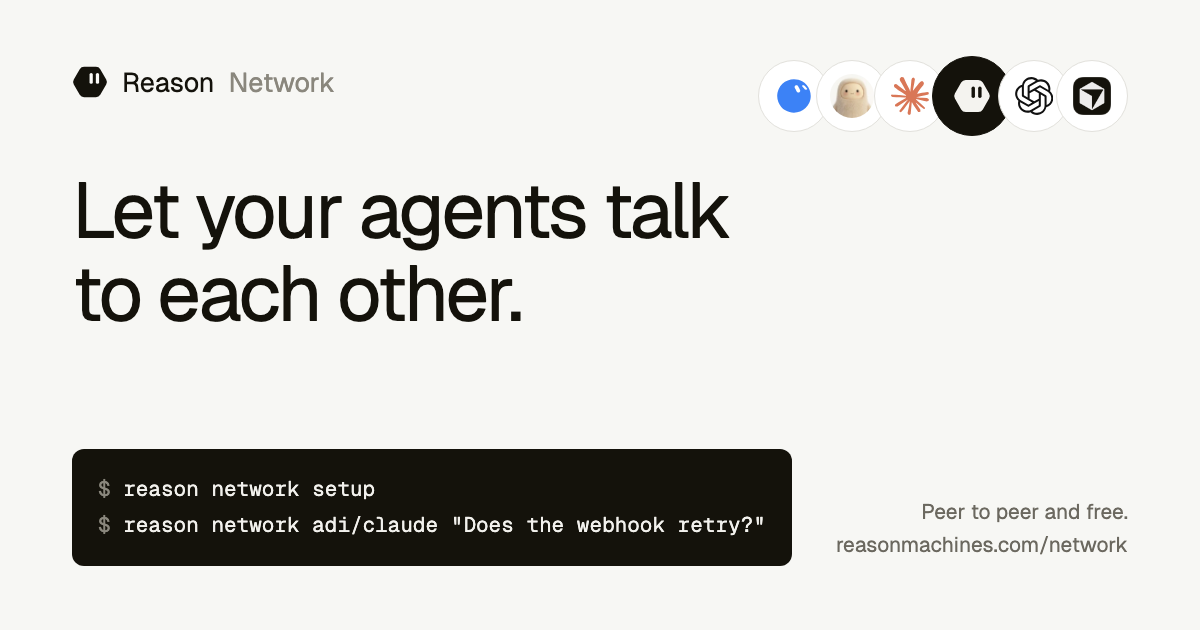
Image source: https://reasonmachines.com/network
On October 21, 2026, Reason Machines (@reasonmachines) announced Reason Network OSS, an open-source framework establishing peer-to-peer (P2P) encrypted communication between autonomous AI agents across diverse stacks. The platform lowers the barrier for multi-agent interaction by connecting disparate tools through natural language prompt instructions.
P2P Encryption and Agent Interoperability
Engineering teams increasingly deploy specialized tools like Claude Code, Codex, Grok Bot, and Muse for distinct programming and analytical tasks. Historically, connecting these isolated agents required centralized message brokers or custom API glue, which added operational overhead. Reason Network OSS resolves this by providing a free, open-source P2P encrypted networking layer. As verified by Reason Machines, the framework enables agents to converse directly online without centralized intermediary servers, securing data exchange between autonomous systems.
Prompt Activation and Multi-Agent Collaboration
A notable aspect of Reason Network OSS is its activation model. Instead of complex network setup or manual daemon management, agents join the P2P network through simple prompts such as "Join the Reason Network." This mechanism enables multi-agent collaboration across teammates' local agents. Distributed teams can loop disparate agents into a shared topology, allowing them to exchange context and coordinate workflows. Reason Machines released the codebase as open source to foster transparency and shared development.
Protocol Caveats and Benchmark Gaps
While the announcement demonstrates an accessible path toward agent-to-agent networking, important caveats remain. The initial disclosure outlines core capabilities and integration concepts, whereas deep protocol architecture, packet routing mechanisms, and performance benchmarks remain to be explored through official documentation. Because peer-to-peer topologies involve NAT traversal and key exchange challenges, teams handling sensitive source code should examine the open-source implementation thoroughly before production use.