Ant Open-Sources Ming-3.0 Audio Suite: 0.5B Zero-Shot Voice Model and Local Pipeline
Ant has open-sourced the Ming-3.0 audio suite, featuring a 0.5B dense voice model ranked #1 on Artificial Analysis at 1069 Elo and a full local interaction stac
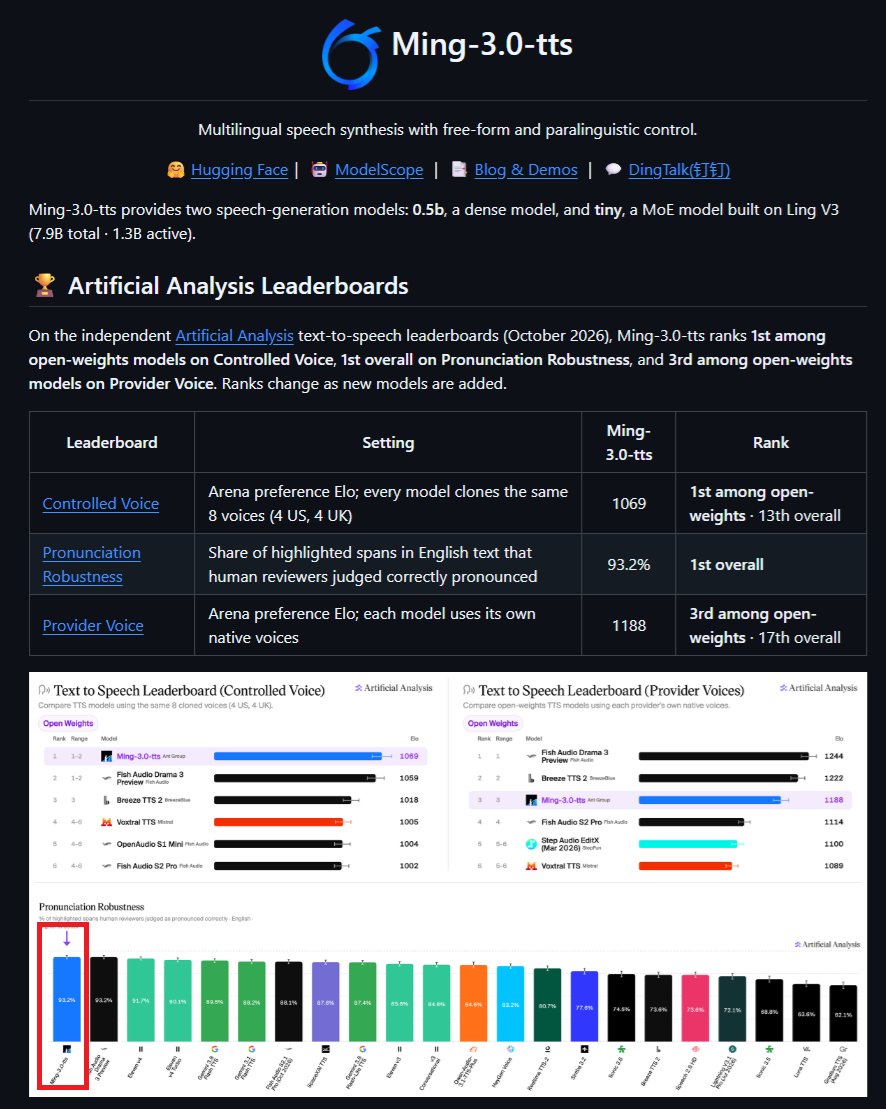
Image source: @TeksEdge via X
On October 20, 2026, tech analyst David Hendrickson (@TeksEdge) reported that Ant open-sourced the Ming-3.0 audio suite. The headline release is Ming-3.0-TTS-0.5B, a 0.5B dense voice synthesis model ranked #1 open-weight on the Artificial Analysis Controlled Voice leaderboard at 1069 Elo. The broader release includes Mixture of Experts (MoE) models for full local speech pipelines.
Ultra-Compact TTS: Natural Voice Design and Expressive Nuance
Ming-3.0-TTS-0.5B delivers broad vocal control despite its small 0.5B dense parameter footprint. It supports zero-shot voice cloning alongside prompt-based voice creation via natural-language instructions. It enables direct control over emotion, pace, pitch, and emphasis.
Crucially, the architecture synthesizes non-verbal vocal cues that smaller open models historically struggle to produce. These include laughter, sighs, breaths, coughs, and hesitation sounds. Generating 44.1 kHz audio across 7 languages, the model offers studio-grade acoustic fidelity for interactive agents.
MoE Audio Models: Building a Fully Local Speech Pipeline
Ant also released specialized MoE architectures to enable an end-to-end local voice loop. Ming-3.0-TTS-Tiny (7.9B total / 1.3B active) handles multi-speaker dialogue and long-form speech.
For perception, Ming-3.0-ASR-Tiny (8.6B total / ~2B active) transcribes speech with regional accents, dialects, and contextual hotwords. Ming-3.0-Audio-Tiny (9.3B total / 2.7B active) comprehends speech, music, and ambient noise for spoken dialogue. For heavier workloads, Ming-3.0-Audio-Flash scales to 126B total (6.5B active) parameters. Together, the stack lets an agent hear locally, comprehend context, decide, and speak in a cloned voice without cloud roundtrips.
Deployment Constraints and Pending Hardware Benchmarks
Despite the technical progress, significant practical hurdles remain for local deployment. GGUF format quantization and llama.cpp runtimes are not yet available, limiting immediate drop-in adoption within lightweight local inference ecosystems.
Furthermore, consumer-GPU performance and latency benchmarks have not yet been provided. While active parameter counts between 1.3B and 6.5B suggest viable resource requirements, real-time interactive viability depends on confirmed latency figures. These characteristics remain subject to empirical verification once community benchmarks appear.