DeepSeek-V4.1-Flash-1017 Released: Open Weights and Agent Evaluation Metrics
DeepSeek launched V4.1-Flash-1017 on web, app, and API interfaces, releasing open weights on Hugging Face and ModelScope alongside new agent evaluations.
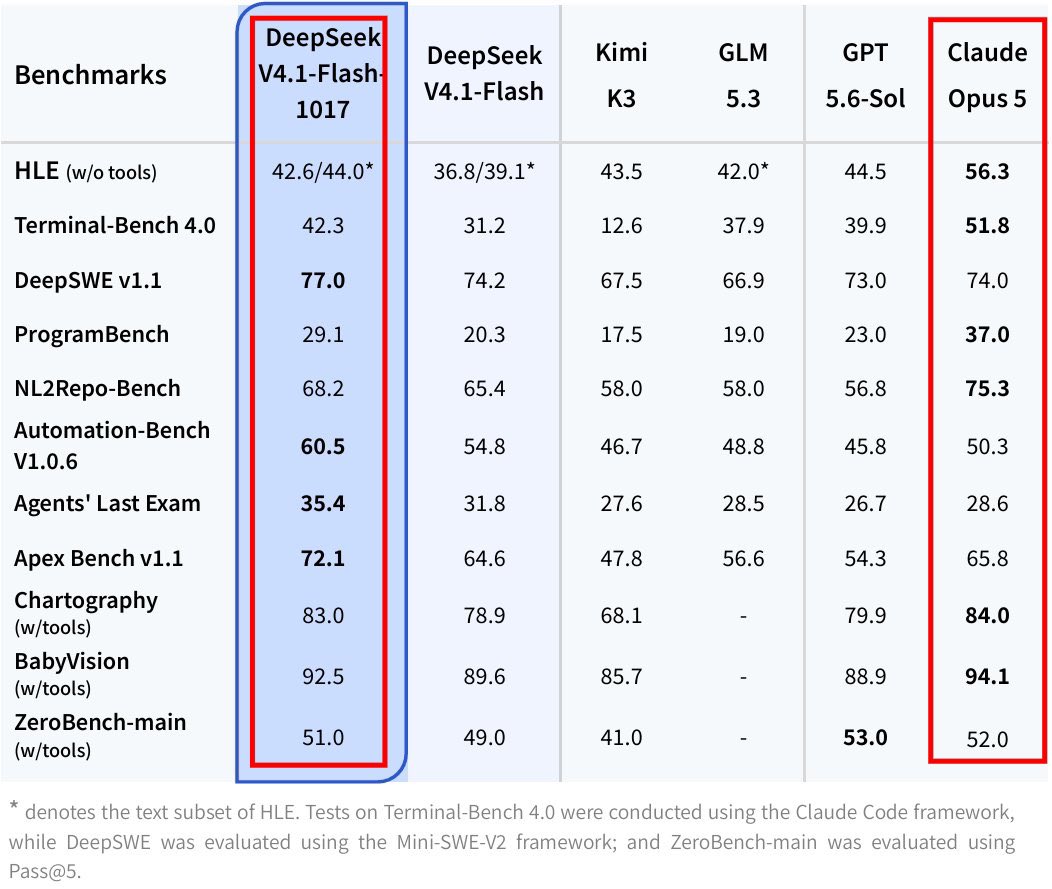
On October 17, 2026, DeepSeek officially launched DeepSeek-V4.1-Flash-1017 across web, mobile, and API platforms. Concurrently, the organization published open weights on Hugging Face and ModelScope, combining hosted access with open artifacts for the developer community.
Multi-Platform Delivery and Open Weights
DeepSeek-V4.1-Flash-1017 launched with immediate multi-surface availability. Users can access the model via web and mobile interfaces, while teams can connect via API. Concurrently, weights were released on Hugging Face and ModelScope, enabling direct inspection and private self-hosting without proprietary lock-in.
The release also introduced a Search & Fetch API for dynamic web retrieval in autonomous systems. Observers noted that the model produces shorter, more concise outputs, curtailing decorative verbosity to conserve tokens and accelerate automated tool execution.
Agent Benchmarks and RL Self-Feedback
Announced metrics centered on agentic execution and coding. DeepSeek-V4.1-Flash-1017 posted 77.0 on DeepSWE v1.1 for software engineering, 42.3 on Terminal-Bench 4.0, 60.5 on Automation-Bench, and 35.4 on Agents’ Last Exam, indicating targeted optimization for automated programming workflows.
Architecturally, the release highlights reinforcement learning (RL) self-feedback loops for end-to-end execution. By observing environment responses and correcting errors during generation, the model supports complex multi-turn tasks such as game development and 3D modeling pipelines.
Technical Implications and Verification Caveats
Distributing open weights alongside search APIs offers practical architectural flexibility. Engineering teams can host models locally for compliance or leverage APIs for elastic workloads, while concise responses help control token budgets in high-throughput agent loops.
Nonetheless, teams must exercise caution. All benchmark scores reflect vendor-reported metrics announced at launch. Independent third-party evaluations remain essential to verify performance across real-world enterprise codebases before production deployment.