Tencent Releases Hy-Memory-30B-A3B: Dedicated Open-Weights MoE for Agent Memory
Tencent has released Hy-Memory-30B-A3B, an Apache 2.0 open-weights sparse MoE model with 3B active parameters engineered as a persistent memory writer for AI ag
Tencent has released Hy-Memory-30B-A3B, an open-weights sparse Mixture-of-Experts model under the Apache 2.0 license, designed specifically as a long-term memory writer for AI agents rather than a general chatbot. The release aims to address common failures in autonomous workflows where agents either lose critical context when a session concludes or repeatedly stuff raw transcripts back into context windows, introducing a dedicated specialist model to curate persistent memory.
Specialized Sparse MoE Architecture for Agent Memory
Autonomous agents often struggle with persistent retention: they either discard essential facts when a session closes or continuously stuff raw transcripts back into context windows. Rather than using large general-purpose models for memory extraction, Hy-Memory-30B-A3B features 30B total parameters with roughly 3B active parameters per token.
Instead of answering user prompts, the model analyzes conversation logs, decides what is worth remembering, and converts evidence into persistent memories. When facts change, it updates existing records while ignoring irrelevant noise, maintaining a persistent memory bank across sessions.
Reported Benchmark Results and Inference Support
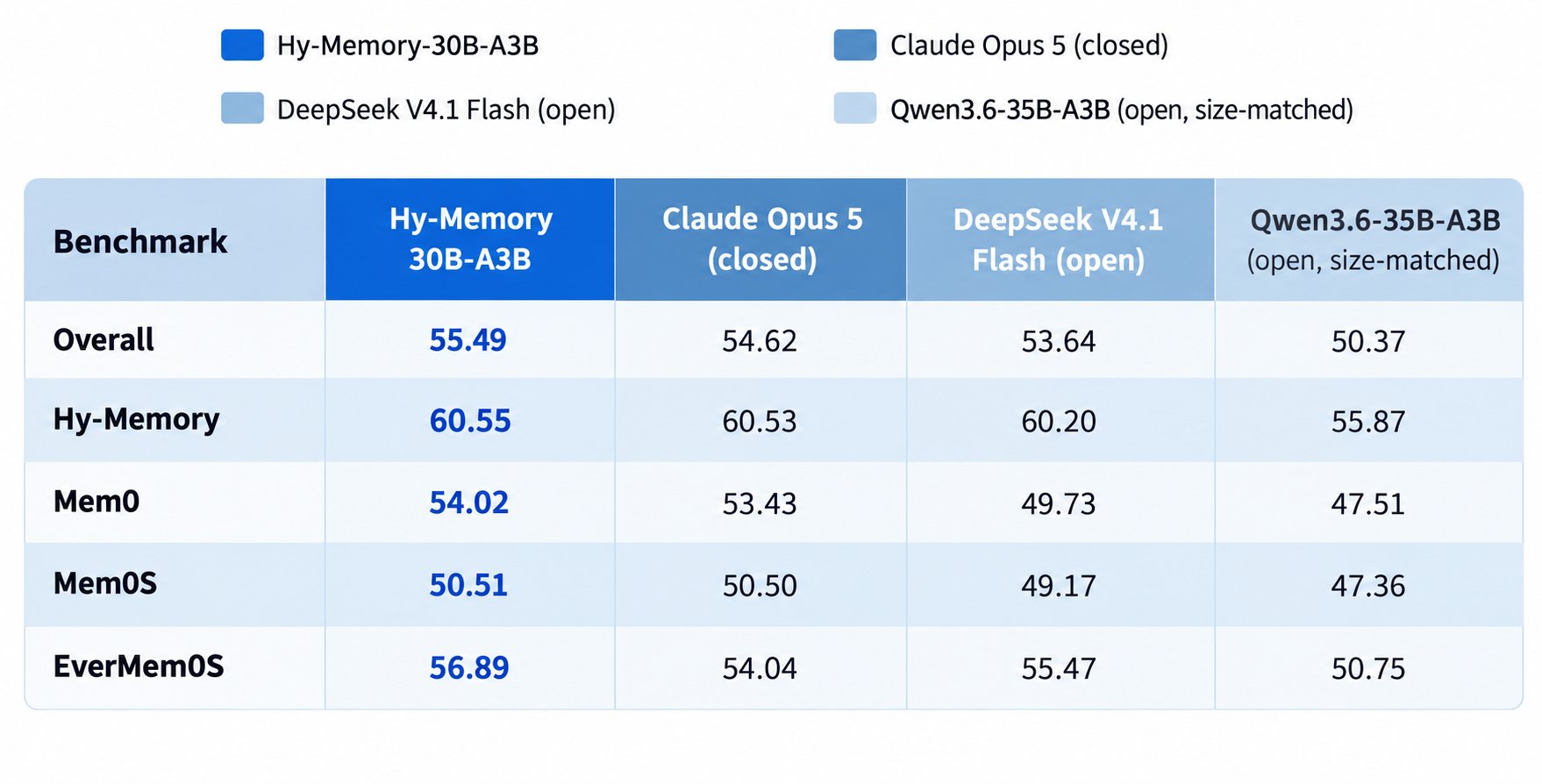
In Tencent's reported evaluation benchmark, Hy-Memory-30B-A3B scored 55.49, ranking behind EverMemOS (56.89) but outscoring Claude Opus 5 (54.62), DeepSeek V4.1 Flash (53.64), and Qwen3.6-35B-A3B (50.37).
On the infrastructure side, the model supports vLLM and SGLang inference engines and offers an OpenAI-compatible API. Community-provided Q4 builds (such as Q4_K_M) size around 17GB, allowing local execution alongside primary models.
Practical Implications and Limitations
The sparse MoE design allows developers to pair this dedicated writer with local models such as Qwen3.8-27B without prohibitive VRAM costs, activating only ~3B parameters per token for background indexing.
Important caveats remain: all benchmark scores were reported by Tencent and lack independent validation. Additionally, the ~17GB Q4 builds are community-provided artifacts, so teams must verify quantization stability before production deployment.