MiniCPM5-2B Released: Lightweight Open-Source Model Running Offline Agents on 2GB RAM
OpenBMB, Tsinghua University, and ModelBest have released MiniCPM5-2B, an open-source 2.52B on-device model running offline agents and 128K context within 2GB R
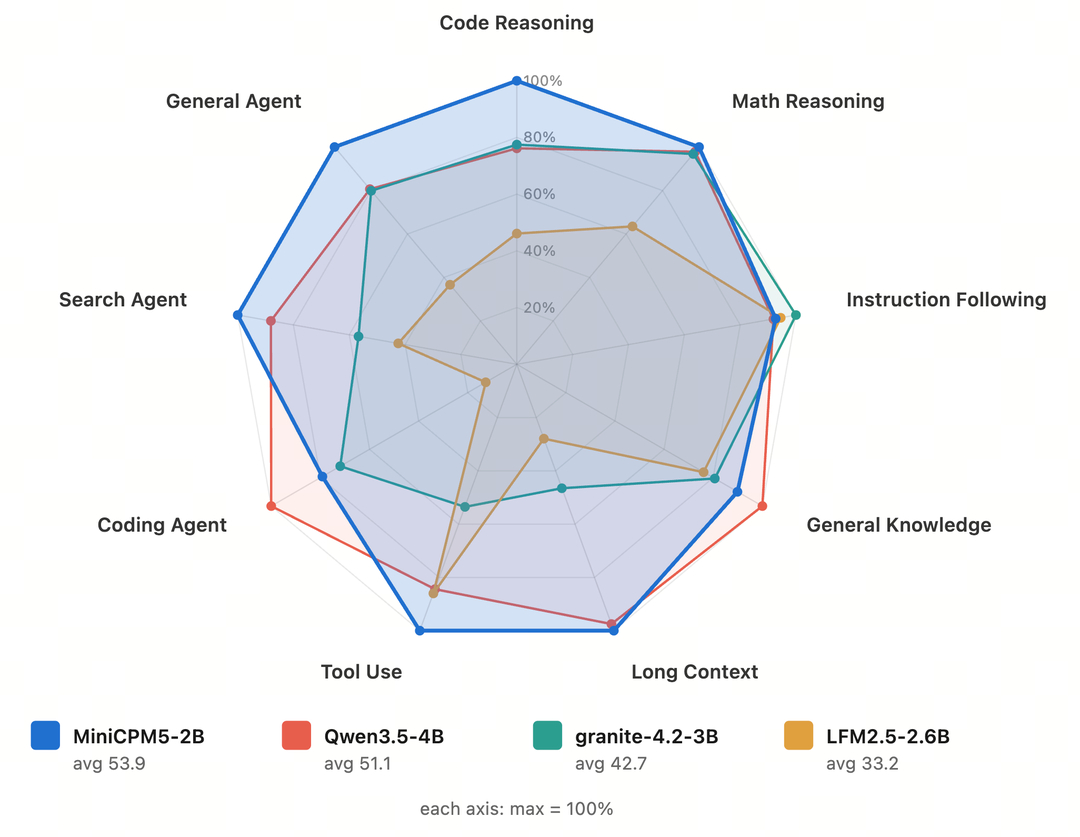
OpenBMB, Tsinghua University, and ModelBest have jointly released MiniCPM5-2B, an open-source on-device language model with approximately 2.52B parameters. Engineered to operate comfortably within a modest 2GB RAM envelope, this lightweight model functions as an edge development tool capable of executing independent autonomous agent workflows locally—without requiring continuous cloud connectivity or expensive remote GPUs.
Image source: OpenBMB / Tsinghua University / ModelBest
As small language models (SLMs) increasingly establish presence on edge hardware, MiniCPM5-2B targets more than conversational queries: it is purposefully optimized for local coding, structured tool-calling, and autonomous agent tasks (such as Hermes agent) directly on user endpoints.
Operating on 2GB RAM with Native 128K Context Support
The primary architectural achievement of MiniCPM5-2B lies in handling extended context lengths and tool executions under stringent memory constraints.
- On-Device 2GB RAM Optimization: Deployable on memory-constrained devices such as smartphones and energy-efficient laptops, enabling end-to-end offline workflows where sensitive data remains securely on the local device.
- Native Context Support up to 128K Tokens: Despite its compact parameter size, the model natively processes context windows reaching approximately 128K tokens, facilitating long-form document review, extensive agent trajectory logs, and multi-step code reasoning.
The model also maintains out-of-the-box compatibility with the Hugging Face ecosystem and vLLM serving infrastructure. In vLLM, developers can initialize a local OpenAI-compatible inference endpoint with a single command:
vllm serve openbmb/MiniCPM5-2B --port 8000
Benchmark Leadership Under 4B Parameters and Full Training Stack Release
To validate its real-world capability among lightweight architectures, MiniCPM5-2B accompanied its release with empirical evaluations and fully open training resources.
On the Artificial Analysis Intelligence Index v4.1.1, MiniCPM5-2B achieved an overall score of 23, securing first place among open-source models under 4B parameters. Across a comprehensive evaluation suite spanning 34 distinct benchmarks, it recorded an average score of 53.9 points, demonstrating balanced reasoning accuracy and parameter efficiency.
Crucially, the release extends well beyond model weights alone, making the underlying training and inference toolchains openly accessible:
- Meshy: The reinforcement learning (RL) framework used throughout development.
- JustRL II: An on-device inference and optimization stack.
- UltraData-SFT-Agent-2609: A curated supervised fine-tuning (SFT) dataset containing 500,000 high-quality agent interaction records.
By publishing the complete training pipeline, the developers enable teams to adapt, fine-tune, and align the architecture for specialized enterprise domains and constrained edge deployments.
Practical Use Cases and On-Device Deployment Caveats
MiniCPM5-2B offers immediate utility for developers constructing edge automation pipelines, though practical deployment demands clear architectural boundaries tailored to small model characteristics.
Given its ultra-compact scale, the model is best deployed for discrete, deterministic agent tasks—such as predefined tool calling, structured JSON extraction, and single-workflow script execution—rather than broad open-ended general-knowledge queries.
Furthermore, achieving interactive token throughput and minimal memory footprints on low-power smartphones or budget laptops typically requires applying standard quantization schemes (such as Q4 or Q8) alongside dedicated local runtimes configured specifically for target client hardware.
Sources
- OpenBMB GitHub Repository: OpenBMB/MiniCPM — Official repository hosting MiniCPM5-2B weights, evaluation radar comparisons, and deployment guides.
- Paul Couvert (@itsPaulAi) on X: MiniCPM5-2B Technical Overview — Practitioner analysis detailing 2GB RAM offline agent execution, benchmarks, and edge device performance.
- Hugging Face Model Hub: openbmb/MiniCPM5-2B — Model card, tokenizer configuration, and official pre-trained checkpoint distributions.