Laminar Releases 'flow-1': An RL Model for Agent Trace Error Detection at 23x Lower Cost
Laminar has unveiled flow-1, an RL model specialized in AI agent trace analysis and error detection. It matches GPT-6-sol in diagnostic quality while processing
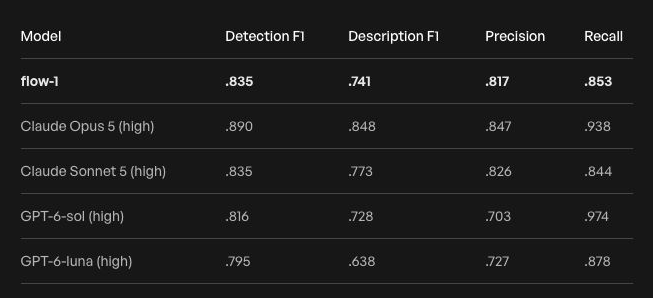
On October 5, 2026, Robert (@skull8888888888) at Laminar, an AI observability and evaluation platform, officially unveiled 'flow-1', a specialized model trained with reinforcement learning (RL) engineered specifically to detect and diagnose errors across autonomous AI agent execution traces.
Image source: @skull8888888888 (Laminar)
The release addresses a critical operational bottleneck in production agent systems: diagnosing complex logical errors and tool-call failures across multi-step execution traces has historically required expensive frontier LLM calls. In evaluations on traces under 100k total tokens, flow-1 delivers diagnostic intelligence comparable to OpenAI's frontier GPT-6-sol while drastically reducing execution costs by a factor of 23.
Comprehensive Trace Monitoring and Cost Efficiency: 23x Cheaper Than GPT-6-sol
As autonomous agents expand across software development, legal workflows, CRM operations, and customer support, execution traces with dozens of iterative tool calls and deep context windows have grown substantially larger. Engineering teams attempting to spot logical pitfalls or silent execution loops have typically relied on general-purpose frontier models like GPT-6-sol or GPT-6-luna as trace evaluators. However, prohibitive token pricing has forced teams to inspect only a small, randomly sampled fraction of production runs.
Laminar designed flow-1 to make comprehensive, 100% trace monitoring economically viable without resorting to lossy sampling.
- Dramatic Cost Reduction: In evaluation runs across traces under 100k total tokens spanning various difficulty levels, flow-1 processes 23 times more traces per dollar compared to GPT-6-sol while maintaining comparable diagnostic fidelity.
- Cheaper Than Efficient Frontier Tiers: In terms of runtime execution expense, flow-1 costs 25% less to run than GPT-6-luna.
- Evaluation on Complex Workflows: On Laminar's 'Signals' benchmark—comprising 523 difficult agent execution traces drawn from software coding, legal compliance, healthcare, and customer support—flow-1 matches GPT-6-sol in analytical quality.
Laminar noted a meaningful qualitative distinction in evaluation behavior: while GPT-6-sol tends to flag a broader volume of traces as potential defects, flow-1 demonstrates higher precision in identifying actual, actionable failures without flooding logs with false positives.
Signals Agent Harness: Treating Traces as Repositories and Spans as Files
A defining aspect of flow-1 is that it is not deployed as a standard zero-shot prompting classifier. Instead, it operates inside the 'Signals agent'—an execution harness deeply optimized for navigating and evaluating complex agent traces.
Within the Signals agent, flow-1 behaves similarly to a specialized coding agent:
- Repository and File Abstraction: The harness models each agent trace as a code repository, treating each constituent execution span as an individual file.
- Active Tool-Driven Investigation: Rather than ingesting hundreds of thousands of tokens into a single prompt window, the model actively investigates traces by grepping span contents, reading tool execution outputs, and inspecting candidate failures step by step.
- Structured Diagnostic Outputs: When given a high-level instruction—such as "find logical errors in this trace"—alongside an expected JSON schema and the target trace, flow-1 traverses the spans and returns clean, structured findings strictly compliant with the target schema.
This file-and-grep metaphor allows engineering teams to pin down root causes in deeply nested agent trajectories without incurring massive full-context re-ingestion costs.
Synthetic SFT, In-Harness RL Training, and Domain-Specific Boundaries
The training pipeline for flow-1 combined supervised imitation with targeted reinforcement learning to instill domain-specific diagnostic behavior.
Laminar began with supervised fine-tuning (SFT) across synthetic investigations of realistic workflows in software engineering, legal services, CRM data management, and customer support. The model was then trained using reinforcement learning directly within the Signals agent harness. This second phase systematically optimized the model's tool usage efficiency, structured schema adherence, and multi-hop root-cause isolation across messy traces.
Alongside these capabilities, the release notes outline key boundaries and operational constraints:
- Dedicated Domain Specialization: In community discussions, Robert clarified that flow-1 is explicitly not a general-purpose reasoning model. It is purpose-built for trace analysis and functions primarily within the Signals harness.
- Benchmark Scope: The reported 23x cost advantage and diagnostic parity reflect evaluations conducted on Laminar's 523-trace Signals benchmark with runs under 100k total tokens.
By lowering the cost curve of trace intelligence, Laminar positions flow-1 to convert chaotic production traces into high-quality evaluation datasets, creating closed-loop feedback for refining downstream autonomous agents.
Sources
- Laminar Official Engineering Blog: Introducing flow-1: RL for agent trace error detection
- Robert Official Announcement on X (@skull8888888888): flow-1 Release Thread and Benchmark Details