Boosting LLM Readability: Karpathy's ASD-STE100 Prompting and 4-Tier Output Ladder
Andrej Karpathy shares tips to speed up reviewing AI outputs, using aerospace controlled English (ASD-STE100), diagrams, interactive HTML, and explainer videos.
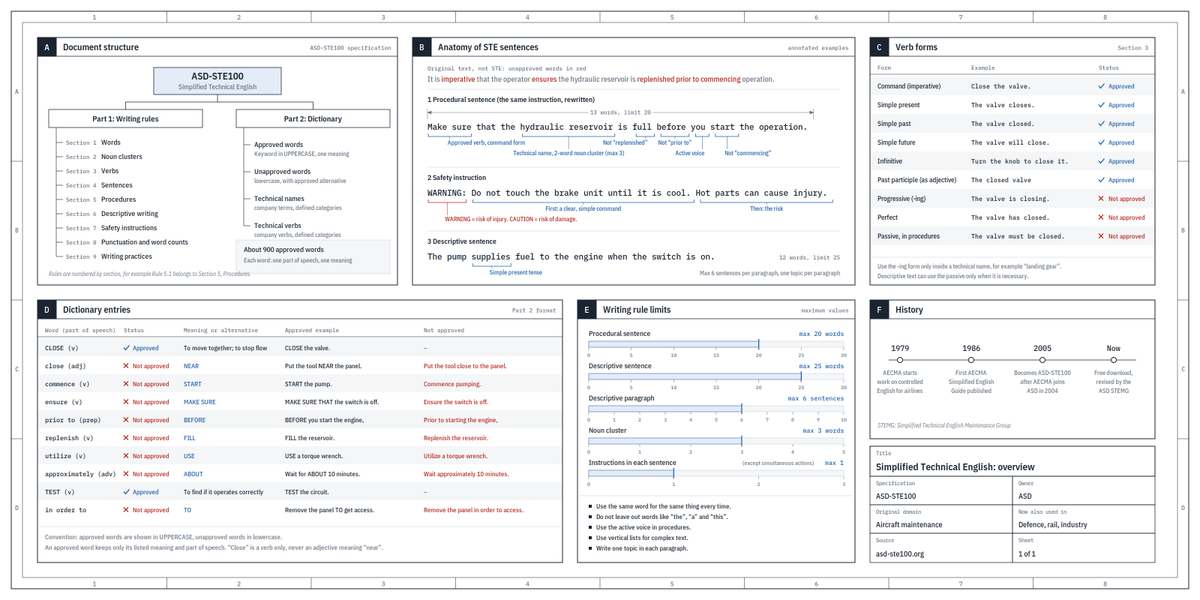
Image source: https://twiscan.com/en/x/karpathy/2105819303471976479
AI researcher Andrej Karpathy (@karpathy) shared practical tips for speeding up the review and comprehension of large language model (LLM) outputs. Analyzing Karpathy's insights, tech commentator Kai (@hqmank) pointed out that as AI handles more autonomous execution, human work increasingly shifts toward reading, parsing, and verifying generated output.
To eliminate cognitive fatigue from bloated, ambiguous AI text, Karpathy highlighted prompting models with ASD-STE100—an aerospace maintenance language standard—alongside a four-tier output ladder that moves from controlled prose to interactive software artifacts.
The 4 Core Rules of Aerospace Controlled English (ASD-STE100)
ASD-STE100 (Simplified Technical English) is a controlled language specification originally developed for aerospace maintenance documentation. Its purpose is to ensure that a technician anywhere in the world can read an instruction once and execute it correctly without misunderstanding.
When you ask a model to "explain something in ASD-STE100", it drops unnecessary adjectives, filler phrases, and convoluted grammatical structures in favor of concise, direct instructions.
Kai (@hqmank) highlighted four essential rules derived from the ASD-STE100 standard:
- Keep sentences short: Use clear, concise statements rather than compound sentences to eliminate misinterpretation.
- One action per step: Structure tasks so each step contains only a single actionable command.
- Say who does what: State the subject and action explicitly in active voice rather than using ambiguous passive phrasing.
- Give each thing one name and stick to it: Never alter terminology for the same entity across the explanation.
The fourth rule directly addresses a persistent flaw in generative AI outputs. LLMs frequently refer to the same component interchangeably as a "worker," an "agent," or an "executor" within a single paragraph, leaving the reader unsure whether the text describes three separate components or just one.
Because the full ASD-STE100 standard is rigorous and constrained, Karpathy recommends a practical daily alternative: asking the model for "80% of the way to ASD-STE100" to balance readability with natural technical explanations.
Karpathy's 4-Tier Output Ladder
Karpathy described a progressive four-step ladder for consuming model output, with each tier offering higher information density and faster comprehension:
- Tier 1: Controlled Writing: Use ASD-STE100 constraints to strip away fluff and enforce strict terminology.
- Tier 2: Diagrams and Visuals: Ask the model to produce a diagram instead of plain prose to clarify architectural flows and entity relationships.
- Tier 3: Interactive Web Pages: Request output
"in HTML"to generate a lightweight, self-contained interactive web page complete with visual layout and animations. - Tier 4: Bespoke Explainer Videos: The format Karpathy expressed the highest enthusiasm for—directing models to create custom, 3Blue1Brown-style explainer videos with narration generated via an ElevenLabs API key or local speech engines.
Practical Integration in Agent Workflows
With code generation and intelligence becoming abundant, developers can now request discardable software artifacts—such as custom HTML interfaces, diagrams, and video explainers—that would previously have taken too much effort to produce for single-use tasks.
- System Prompts and Agent Guidelines: Adding ASD-STE100 principles (short sentences, consistent terminology, active voice) to
agents.mdor system instructions significantly improves the legibility of tool descriptions and error logs across autonomous agent networks. - Managing Tradeoffs: While controlled English enhances precision, overly rigid constraints may increase response latency or restrict open-ended brainstorming. Teams should apply controlled formats when accuracy and fast verification are paramount.
Original source
- Kai (@hqmank) on X: https://x.com/hqmank/status/2105949373532119324
- ASD-STE100 Official Specification (Issue 9): https://asd-ste100.org/assets/files/ASD-STE100_ISSUE9.pdf
- Andrej Karpathy (@karpathy) on X: https://twiscan.com/en/x/karpathy/2105819303471976479