Ultra-Lightweight 1M Parameter OCR Model 'Indra' Released: 49 Pages per Second on CPU
Vik Paruchuri has released Indra, an ultra-lightweight 1M parameter OCR model capable of processing 49 pages per second on CPU. Delivering 11x faster speeds tha
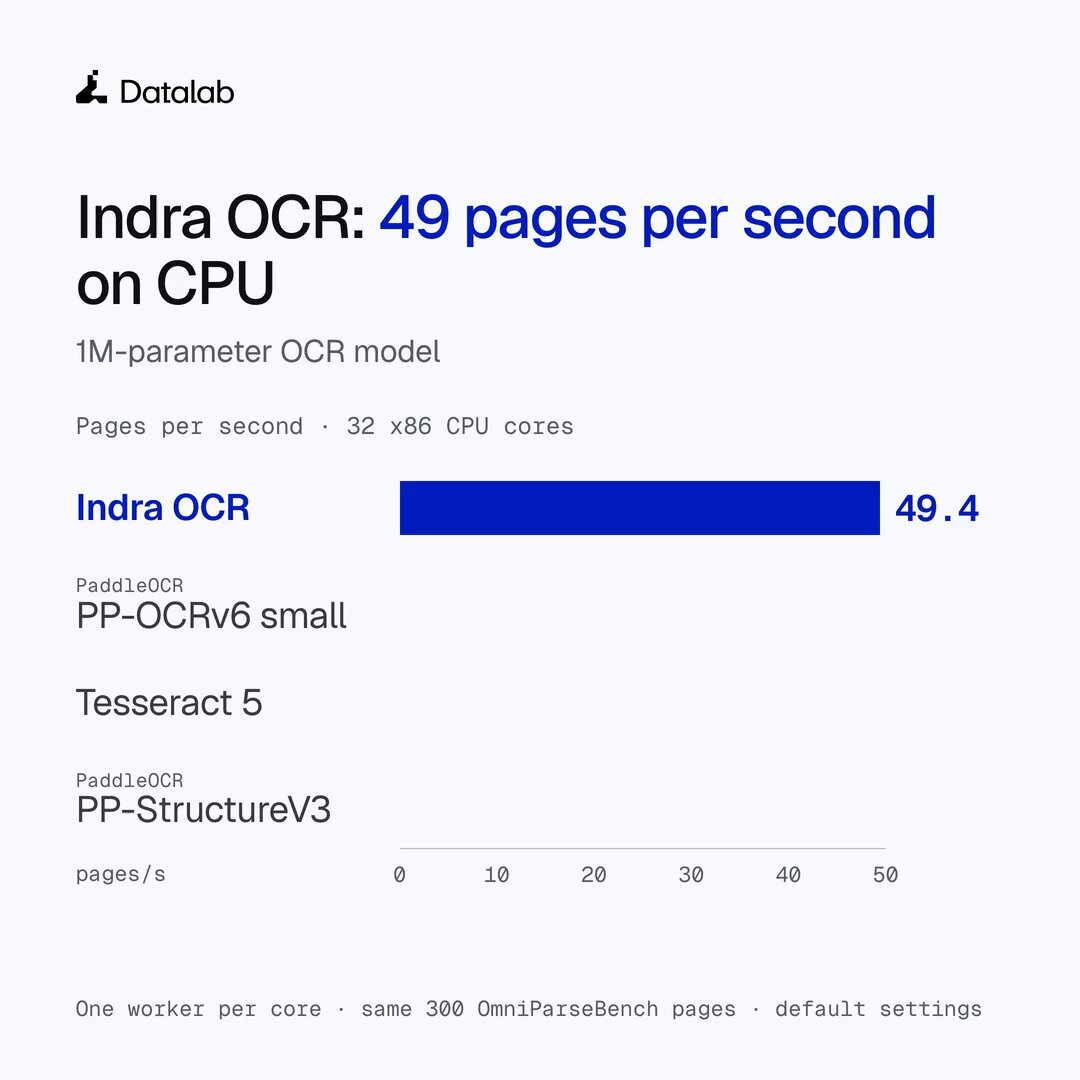
On October 14, 2026, machine learning developer and researcher Vik Paruchuri officially open-sourced Indra, an ultra-lightweight optical character recognition (OCR) model operating at a parameter scale of just 1 million (1M). Designed specifically for cost-efficient execution on standard CPU hardware without requiring dedicated GPU infrastructure, Indra achieves an inference throughput of 49 document pages per second.
Image source: @VikParuchuri (X)
Indra is engineered primarily for latency-critical production environments, such as Retrieval-Augmented Generation (RAG) ingestion, real-time search indexing, and front-line document triage prior to invoking larger vision-language models (VLMs). Weights and implementation code have been made publicly available under open-source terms on Hugging Face and GitHub.
49 Pages per Second on CPU: 11x Faster Than PaddleOCR for Low-Latency Workloads
Indra's defining technical advantage lies in the extreme inference efficiency enabled by its compact 1M parameter footprint.
According to benchmark evaluations published by Paruchuri, Indra processes 49 pages per second (49 pages/s) on a standard CPU. This performance represents an 11-fold speed advantage over PaddleOCR, a widely adopted open-source OCR standard, and a 17-fold acceleration compared to Tesseract.
- Inference Speed: 49 pages/s on CPU (11x faster than PaddleOCR, 17x faster than Tesseract)
- Text Recognition Accuracy (OmniParseBench Text): Scored 41.3 points, outperforming PaddleOCR (35.8 points) and Tesseract (19.3 points)
- Document Structure Extraction: Extracts both full document layout structures and precise line-level bounding box coordinates alongside text content
This combination of low resource overhead and high throughput allows engineering teams to ingest massive volumes of PDFs and scanned documents into vector databases with minimal CPU footprint, significantly reducing bottlenecks in automated data pipelines.
Multilingual Recognition Across 60 Languages and Dedicated Math Mode
Despite its compact architecture, Indra provides broad multilingual coverage and support for specialized document notations.
The model handles text recognition across 60 languages spanning 6 primary scripts: Latin, Cyrillic, Greek, Devanagari, Bengali, and Chinese. Additionally, it can ingest and parse arbitrary scripts embedded directly within the text layer of digital PDF documents.
- Script and Language Breadth: 60 languages supported across Latin, Cyrillic, Greek, Devanagari, Bengali, and Chinese scripts
- Dedicated Math Mode: Tailored tokenization and parsing routines designed to accurately extract mathematical expressions and equations in technical publications
- Local Tooling and CLI Setup: Installable in Python environments via
pip install indra-ocr, with an interactive desktop viewer launched viaindra-ocr-viewerto test latency and parameter configurations locally
Practical Boundaries of a 1M Model and Production Pipeline Guidance
While a 1M parameter footprint delivers unprecedented processing speeds, it also introduces clear operational boundaries that developers must account for in production architectures.
Paruchuri emphasized that Indra is not intended as a universal replacement for heavy document foundation models across complex visual tasks.
- Challenging Modalities: Handwritten text, dense multi-column tables with merged cells, and large pages may experience reduced recognition accuracy due to the constrained model capacity.
- Single-Page Context Scope: The model operates strictly on isolated individual pages and does not maintain cross-page continuity, such as continuing table headers spanning multiple pages.
- Two-Stage Triage Strategy: The recommended deployment pattern uses Indra on CPU as a high-speed primary filter for routine text, standard layouts, and high-volume document streams. High-complexity pages or items with lower recognition confidence can then be routed to heavier models, such as Chandra-OCR-2 or multimodal VLMs.
The model weights and source code are available immediately via Hugging Face (datalab-to/indra-ocr) and GitHub (datalab-to/indra), with the development team planning ongoing enhancements to language coverage and recognition fidelity.
Sources
- Vik Paruchuri on X (@VikParuchuri): Indra OCR Release Announcement
- DataLab Blog: Indra OCR Announcement
- Hugging Face Repository: datalab-to/indra-ocr
- GitHub Repository: datalab-to/indra
- Advanced Complex Document Model: datalab-to/chandra-ocr-2