Graphify Converts Codebases into Queryable Knowledge Graphs Without Vector Stores
Graphify provides local tree-sitter AST parsing to turn code and docs into deterministic knowledge graphs with labeled edges for AI coding tools.
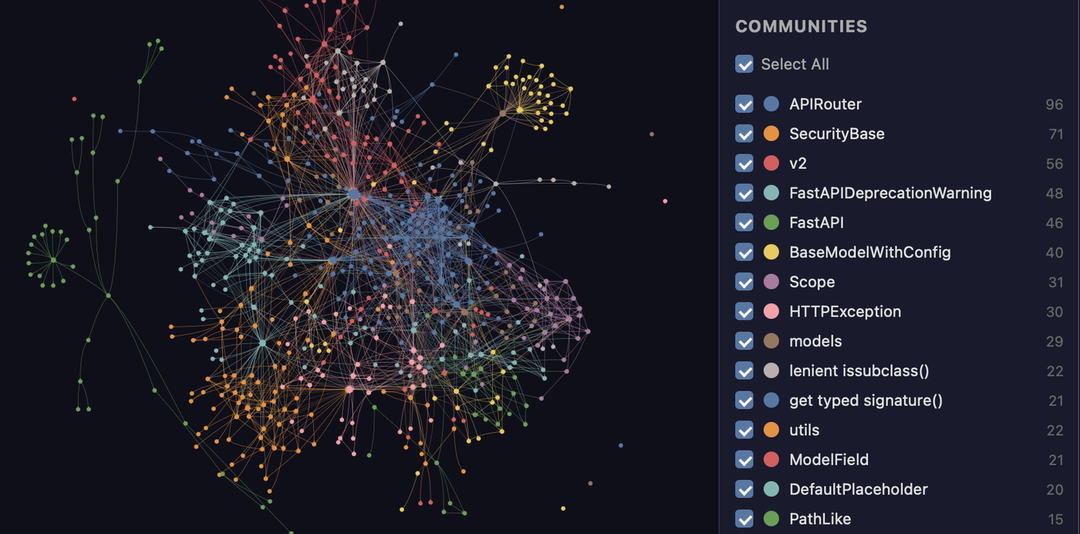
Image source: Graphify-Labs
Deterministic AST Parsing for Codebases
Graphify by Graphify-Labs converts codebases, project documentation, PDFs, images, and audio or video files into a queryable knowledge graph without relying on vector stores. Rather than computing embeddings or storing vectors in an external index, Graphify generates an actual traversable graph structure that developers can navigate directly instead of grepping through files. Code mapping is executed fully locally and deterministically using tree-sitter abstract syntax tree (AST) parsing across roughly 40 programming languages. Because local code parsing does not use large language models (LLMs), source code does not leave the local machine and incurs no token costs. For non-code assets such as documents, PDFs, images, and media files, Graphify utilizes the connected coding assistant's model or a configured external API key to perform an optional semantic analysis pass.
Assistant Workflows and Graph Queries
Operating under the Apache-2.0 license and requiring Python 3.10+ with uv or pipx, Graphify registers as a /graphify skill across development platforms. Supported tools include Claude Code, Cursor, Codex, Gemini CLI, and GitHub Copilot, covering more than 20 assistant environments across macOS, Linux, and Windows. Running the /graphify . command produces an output directory named graphify-out/ containing three core files: an interactive browser-based visualization file graph.html for searching and filtering nodes, GRAPH_REPORT.md summarizing key architectural concepts and unexpected connections, and graph.json containing the entire persisted graph. This persisted JSON file records both graph.schema_version and graph.graphify_version to help integrations identify format updates and software releases. Developers can explore the resulting graph using dedicated CLI commands, such as graphify explain to inspect a node, graphify path to trace connections between two concepts, or graphify query to return a scoped subgraph for natural language inquiries. Every edge within the graph carries an explicit confidence tag, marked as EXTRACTED when directly read from source code or INFERRED when derived through resolution.
Benchmark Performance and Cloud Caveats
Regarding quantitative performance, the project reports benchmark metrics directly within its README, though these figures represent self-reported evaluations that lack third-party independent verification and do not detail complete test conditions or comparative methodologies. According to these self-reported figures, Graphify achieved a recall@10 of 0.497 on the LOCOMO benchmark (n=300) alongside a question-answering accuracy of 45.3%, while scoring 76% accuracy on LongMemEval-S (n=50) and 82.0% key-fact coverage on the ERPNext cross-tool benchmark (n=6). Beyond tree-sitter AST link resolution for function calls, module imports, inheritance, and mixins, Graphify identifies high-degree "God nodes" and partitions subsystems into communities via the Leiden algorithm without LLM intervention. Comments such as # NOTE: and # WHY: along with ADR or RFC citations are also indexed as first-class nodes. Commercial features, such as cross-repository tracking, continuous SDLC monitoring, and formal verification claims, belong to the hosted Graphify Cloud subscription rather than the open-source CLI.