Google Gemma 4 and BOTANIC-1 Pinpoint Key Melon Mutation #1 Out of 2,494 Candidates
Google DeepMind and Living Models paired Gemma 4 E4B with plant genome model BOTANIC-1, compressing years of crop genetics into minutes of compute to rank a key
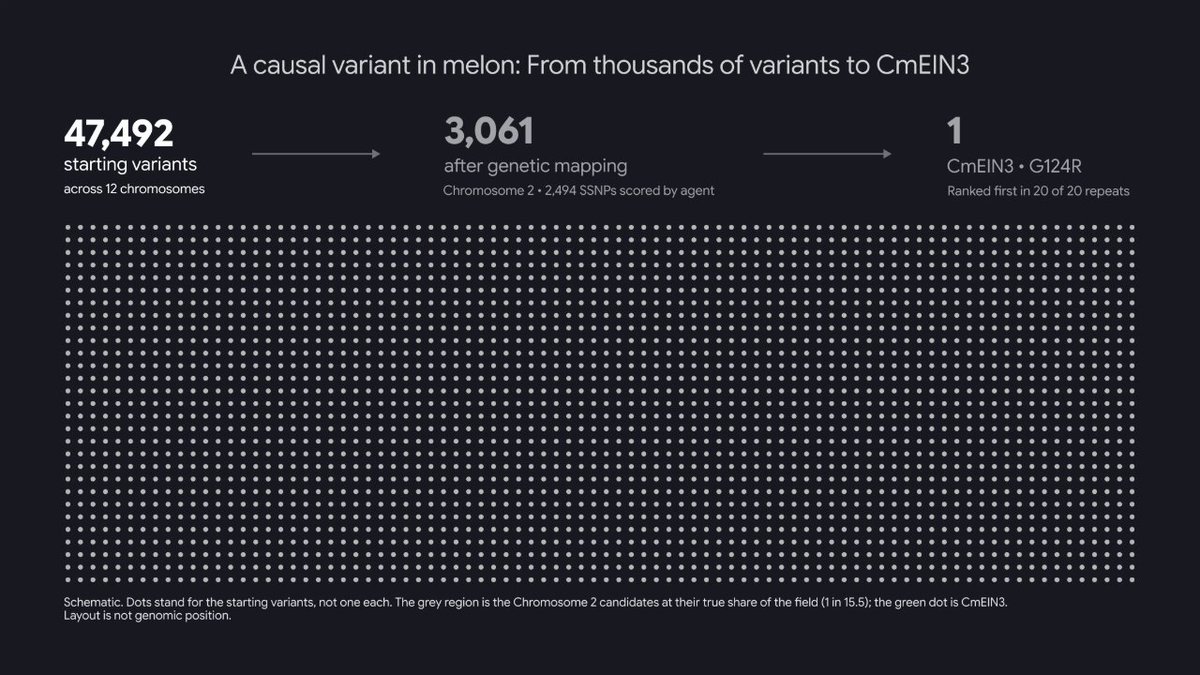
Google DeepMind and Paris-based AI biology lab Living Models officially unveiled an agentic genomic pipeline on October 7, 2026, pairing the open-weights language model Gemma 4 E4B with BOTANIC-1, a foundation model specifically trained on plant genomes. The collaborative system demonstrated that searching for causal genetic mutations behind climate-resilient crop traits—a task that historically required years of physical breeding and greenhouse screening—can be compressed into mere minutes of computation.
As global food security faces intensifying pressure from climate shocks, drought, and emerging crop diseases, accelerating the breeding of resilient and high-yielding cultivars has become an urgent challenge in agricultural biotechnology. By dividing analytical responsibilities between a compact general-purpose language model adept at code orchestration and data hygiene, and a specialized genomic language model (gLM) trained on a massive plant corpus, the team demonstrated a new workflow to isolate the pivotal causal mutations governing target phenotypes from thousands of background genetic variants.
Gemma 4 E4B and BOTANIC-1: An Agentic Pipeline for Genomic Discovery
The technical core of the system lies in a two-stage agentic pipeline linking generalist reasoning with deep domain-specific biological modeling.
In traditional crop genetics, even after researchers isolate a broad chromosomal locus associated with a favorable agronomic trait, large contiguous blocks of DNA tend to inherit together due to linkage disequilibrium. This makes it difficult to separate true causal mutations from non-functional passenger mutations. The collaborative pipeline addresses this bottleneck through distinct operational roles:
- Gemma 4 E4B (Project Manager Role): The lightweight open model ingests unstructured biological literature and sequence data, writes analytical scripts, orchestrates pipelines, and filters out experimental noise before handing off refined candidates.
- BOTANIC-1 (Genomic Domain Specialist Role): The plant foundation model evaluates candidate sequences, scoring evolutionary conservation and the functional severity of nucleotide substitutions to rank causal mutations responsible for phenotypic shifts.
BOTANIC-1 was trained on an unprecedented plant corpus spanning 320 embryophyte species across 102 families and 48 orders, totaling 314.6 billion single-nucleotide tokens. Built upon a bidirectional Mamba-2 (BiMamba2) encoder architecture, the model operates with an 8,192-token context window and is released in three research sizes spanning 300M to 2B parameters.
Pinpointing a Target Melon Mutation: Compressing Years of Breeding into 4 Minutes
To validate the pipeline's real-world utility, the researchers tested it on melon (Cucumis melo) yield genetics, targeting known mutations governing floral architecture and commercial fruit yield.
Historically, identifying why specific vine varieties survive drought or produce dramatically higher yields required crossing thousands of individual plants over multiple growing seasons, followed by labor-intensive greenhouse screening.
Presented with a complex candidate pool containing 2,494 possible mutations, the Gemma 4 E4B and BOTANIC-1 pipeline successfully ranked the single verified causal yield mutation as #1 in approximately four minutes of computational time. The experiment demonstrated that evolutionary impact scoring can rapidly cut through dense genomic noise without requiring immediate preliminary field crosses.
Retrospective Nature of the Benchmark and the Ongoing Need for Field Trials
While the computational speedup marks a notable advancement for computational plant biology, the experimental scope and practical caveats remain clear.
First, this demonstration was a retrospective validation: the target melon mutation was already established as the causal variant through prior empirical molecular biology. The AI demonstrated that it could reconstruct and prioritize known biological ground truth from sequence data, rather than discovering an entirely uncharacterized agricultural trait or creating a new commercial cultivar out of whole cloth.
Second, in silico prioritization cannot replace physical field validation. Predicting that a specific nucleotide swap confers drought tolerance or yield advantages still requires empirical confirmation through seed development, greenhouse cultivation, and multi-year field trials under real-world climate stress. The primary value of the pipeline lies in narrowing down hundreds or thousands of prospective variants into a tight, testable priority list, significantly lowering the time and capital required for physical trials.
Model Release and Research Resources
Living Models and Google DeepMind have made the core assets publicly available for the broader agricultural research community:
- BOTANIC-1 Model Weights: Pretrained research checkpoints (300M to 2B parameters) are accessible via the Living Models repository on Hugging Face.
- Interactive Web Demo: A Hugging Face Space demonstrates the Gemma 4 and BOTANIC-1 collaboration pipeline in action.
- Preprint Paper: A bioRxiv research paper details the BiMamba2 gLM architecture, the 320-species pretraining corpus, and benchmark evaluation methodologies.
Sources
- Google DeepMind Gemmaverse: Living Models pairs Gemma 4 with BOTANIC-1 to help decode plant DNA
- Google Gemma Official X (@googlegemma): Gemma 4 E4B and BOTANIC-1 Announcement
- Living Models Substack: Introducing BOTANIC-1, a New State-of-the-Art Plant Genomic Language Model
- bioRxiv Preprint: BOTANIC-1: a series of long-context plant genomic foundation models in the agentic era
- Hugging Face Space Demo: living-models/gemma-botanic
- Hugging Face Model Repository: living-models/Botanic1-M