Orchestrating Autonomous AI Agents Like Kubernetes: Architecture and Lifecycle Tips for Google's Open-Source 'AX'
A practical guide to Google's open-source agent orchestrator AX, exploring its architectural design, single-YAML declarations, core CLI commands (ax apply, ax s
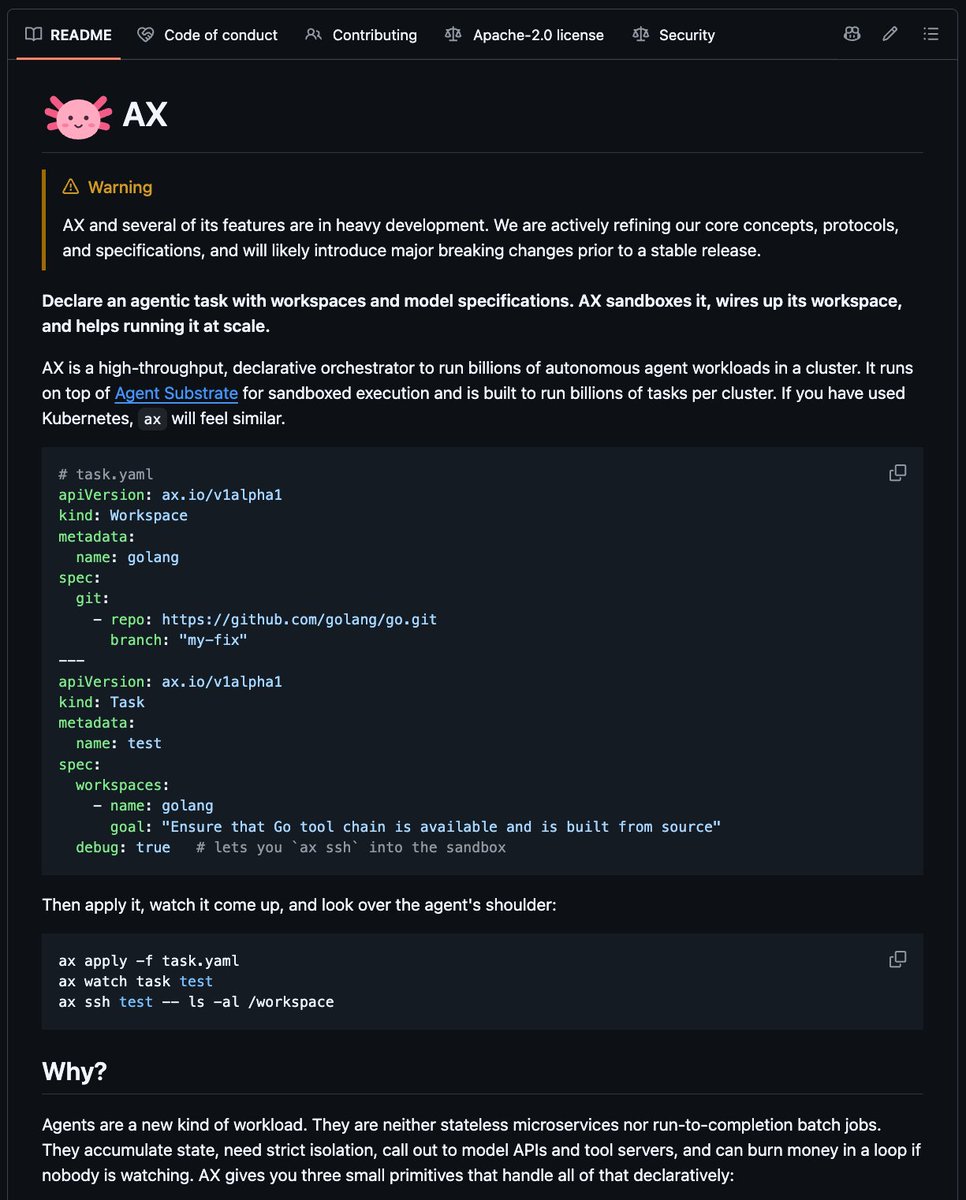
On October 16, 2026, AI engineer and creator Ryan Hart (@thisdudelikesAI) shared a practical breakdown on X detailing the architectural principles and operational lifecycle of 'AX', an open-source AI agent orchestrator built on Google's Agent Substrate. Hart characterized AX as purpose-built infrastructure designed to coordinate autonomous AI agent tasks at scale, porting the proven orchestration mindset of Kubernetes from containerized microservices to autonomous agent workloads.
Image source: X @thisdudelikesAI
As autonomous systems evolve from single prompt-response interactions toward multi-agent networks that execute arbitrary tools and maintain continuous state, isolating and orchestrating those processes has become a critical operational hurdle. This practical tip breaks down why agent workloads demand dedicated infrastructure, how single-YAML declarations drive execution, and how familiar CLI lifecycle primitives allow developers to supervise agents efficiently.
Why Agent Workloads Require Dedicated Infrastructure
Autonomous agents represent an entirely distinct category of computational workload compared to traditional web services, microservices, or stateless batch jobs.
- Persistent State: Agents must hold state, memory context, and intermediate artifacts across multiple reasoning steps until a designated objective is fulfilled.
- Strict Sandbox Isolation: Because agents execute shell commands, touch file systems, and run dynamic code, host environments require hardened isolation layers to prevent unintended side effects.
- Continuous Model and Tool Invocations: Agents operate through uninterrupted loops of foundation model inference, external API queries, and Model Context Protocol (MCP) server calls.
- Guardrails Against Runaway Costs: In the absence of centralized runtime supervision, an agent caught in an unhandled logic loop can rapidly burn through token budgets and cloud infrastructure expenditures.
Single-YAML Declarations and Core CLI Lifecycle Primitives
AX translates Kubernetes' declarative management model directly into agent runtime orchestration. Developers define the task objective, target workspace, and designated foundation model within a single YAML file, leaving environment provisioning to the orchestrator.
- Automated Warm-Start Sandbox Provisioning: Once declared, AX spins up a secure sandbox, automatically mounting specified Git repositories, MCP servers, and skill packages so the agent boots in a warm, fully operational state.
ax apply: Submits and executes the agent declaration against the cluster, functioning with the familiar mental model ofkubectl apply.ax ssh: Provides interactive shell access directly into a running agent container, enabling operators to inspect reasoning traces, active tool calls, and local workspaces in real time.ax suspendandax resume: Pauses an idle agent to stop unnecessary compute and token burn, and later resumes execution exactly where the agent left off without dropping prior context.
A 4-Step Kubernetes Onboarding Path for the Weekend
For developers and platform engineers looking to evaluate agent infrastructure firsthand, Hart outlined a straightforward four-step roadmap suitable for a weekend lab session.
- Spin Up a Lightweight Kubernetes Cluster: Initialize a lightweight test Kubernetes cluster in a local or cloud environment.
- Deploy Agent Substrate: Install Agent Substrate, the foundational execution layer on top of which AX operates.
- Run the Official Demo Script: Execute the packaged demo walkthrough to verify end-to-end lifecycle transitions across deployment, shell inspection, suspension, and resumption.
- Target a Real Repository with a Concrete Goal: Attach an agent to a genuine code repository and assign an explicit deliverable to evaluate practical performance.
Licensing and Early Development Caveats
The AX project has quickly garnered significant attention across the open-source developer community, surpassing 13,500 stars. Distributed under the permissive Apache 2.0 license, the software is free forever for developers to adopt and customize.
However, prospective adopters should keep operational maturity in mind. As Google has stated, the project is currently in early development, and breaking changes across core APIs and configuration schemas are expected ahead of any stable release. Rather than deploying AX immediately into mission-critical production pipelines, teams should treat it as an essential preview of future infrastructure patterns—laying the groundwork to coordinate 1,000 autonomous agents rather than micromanaging one at a time.
Original source
- Ryan Hart (@thisdudelikesAI) official X post: Google AX Agent Orchestration Guide