Elon Musk's Vision for Humanity's Future: Superintelligence, Brain Chips, and Space Data Centers
A summary of Elon Musk's recent interview outlining humanity's future outlook, including the advent of superintelligence, Neuralink brain chip implants, shiftin
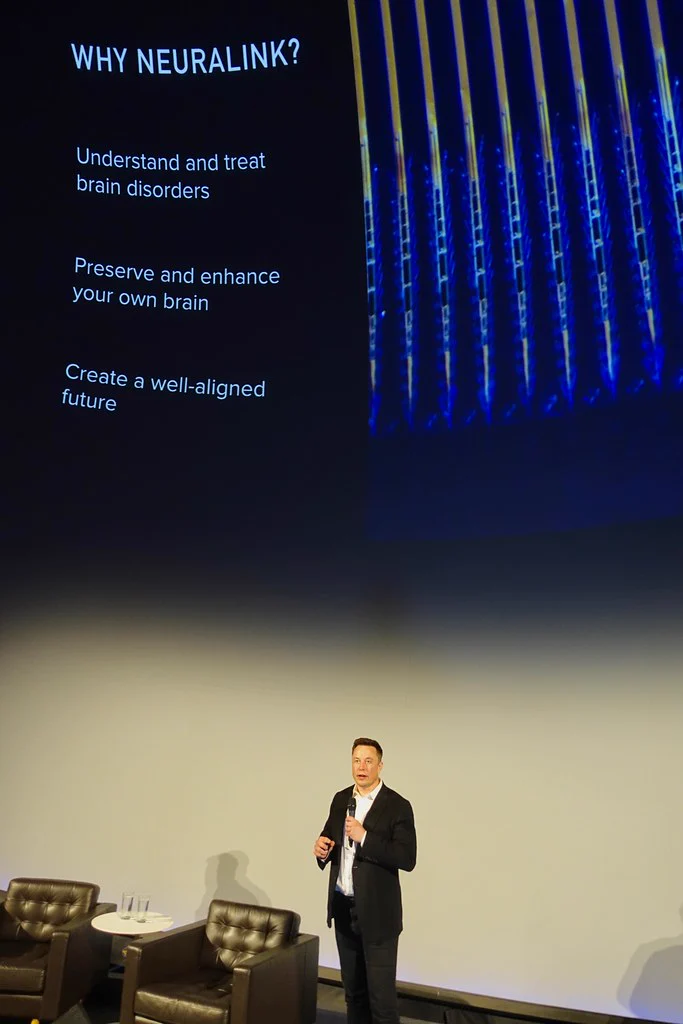
Tesla Chief Executive Officer Elon Musk shared a bold vision for the future of humanity during an interview on November 18, 2026. According to summaries shared across social media platforms, Musk emphasized that the rapid advancement of artificial intelligence (AI) will fundamentally alter Earth's ecosystem, pushing humanity toward critical crossroads involving brain implant technology and interplanetary expansion to ensure survival and evolution.
Image source: jurvetson 쨌 Elon Musk presenting the Neuralink master plan 쨌 CC BY 2.0 쨌 https://creativecommons.org/licenses/by/2.0/ 쨌 https://www.flickr.com/photos/44124348109@N01/48309245662
This future outlook goes beyond simple technological forecasting, offering a sweeping examination of how core pillars of human civilization—such as intelligence, labor, economics, and space exploration—are set to be restructured. As technological acceleration brings both unprecedented benefits and severe risks, examining the specific contours of Musk's envisioned future provides crucial context for the changes ahead.
The Dawn of Superintelligence and the Shift in Human Status
The foundational premise of Musk's future outlook is the inevitable emergence of 'superintelligence'—a state where artificial intelligence surpasses all human cognitive capabilities across every domain.
Historically, humanity has driven civilization as the most intelligent species on Earth. However, Musk warned that as AI continues to mature, humanity may face its first historical era of coexisting with an entity vastly superior in intelligence, potentially stepping down from its dominant position. In this context, he stressed that designing AI to pursue truth and respect humanity is paramount, noting that whether superintelligence becomes a blessing or a disaster for civilization depends entirely on how it is engineered.
Upgrading Cognitive Capacity via Neuralink Brain Chips
To enable humans to coexist without being overwhelmed by machines in the age of superintelligence, Musk points to brain-computer interface (BCI) technology. This aligns with the ultimate objective of Neuralink, the neurotechnology startup he leads.
By implanting micro-chips directly into the human brain, the initiative aims to fundamentally enhance biological cognitive capabilities and match the communication speeds of digital superintelligence. Beyond medical rehabilitation for disabilities, this is presented as a strategic measure to self-upgrade humanity so it retains agency in upcoming technological hegemony contests. Nevertheless, because these devices interface directly with the neural system, critical technical and ethical challenges—such as cybersecurity vulnerabilities and bidirectional access control—remain subjects of intense debate.
The Dissolution of Labor and a Paradigm Shift in Capitalism by 2035
Technological progress is also poised to reshape the agents of intellectual and physical output. Musk projects that a division of labor will solidify where AI handles intellectual tasks and humanoid robots take over physical labor.
Such a transformation would fundamentally destabilize existing labor-centric social structures. The paradigm of mandatory work required for survival could dilute, shifting society toward an environment where individuals work strictly by choice. Furthermore, if robots and AI produce goods and services on a scale that surpasses human consumption capacity, modern capitalist economic systems anchored in scarcity will face profound shocks. Musk noted that by as early as 2035, traditional monetary and economic frameworks could undergo dramatic shifts and be replaced by entirely new foundations.
Space Data Centers and Evolution into a Multi-Planetary Species
To manage massive computational demands and power consumption for AI, Musk plans to expand infrastructure beyond Earth's surface. Utilizing the massive Starship rocket, the strategy involves deploying large-scale data centers in space, harnessing unlimited solar energy to sustain continuous AI computation.
The fragility of concentrating all human civilization and infrastructure on a single planet was also highlighted. By evolving into a 'multi-planetary species' with established settlements across multiple worlds, humanity can secure its survival even against catastrophic end-of-earth scenarios—a goal that serves as the driving force behind his rigorous research efforts.
These insights illustrate how concepts once confined to science fiction are converging with real-world capital and engineering efforts into concrete timelines and objectives. However, these projections remain summaries of Musk's long-term personal visions and hypotheses at this stage, with experts holding diverse interpretations regarding exact realization schedules and socio-technical fallout. As the pace of change accelerates, maintaining a balanced perspective on both the potential windfalls and existential hazards of advanced technology is essential.
Sources
- X (formerly Twitter) @Kevin_wisdom_ Post: Summary of Elon Musk's Interview Outlook on November 18, 2026