Sakana AI Introduces QD-Rec: Quality-Diversity Evolutionary Recommendation Framework
Sakana AI unveiled QD-Rec, combining Quality-Diversity evolutionary search with LLMs to discover diverse, high-value candidate hypotheses under limited evaluati
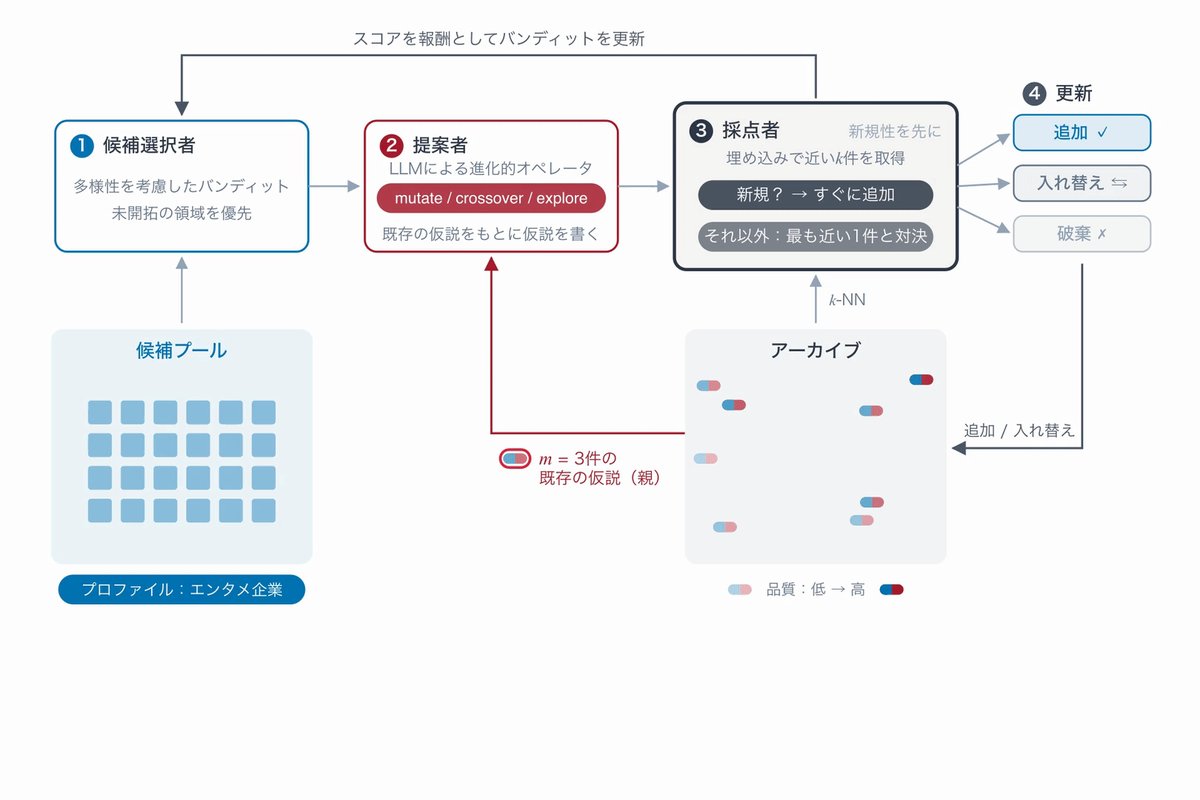
Image source: Sakana AI
Sakana AI has introduced QD-Rec, a recommendation framework combining Quality-Diversity (QD) evolutionary search with LLMs to discover diverse, high-value candidates and reasoning hypotheses. Rather than ranking items by a single score, it supports complex evaluations where decision-makers require distinct viewpoints and well-grounded rationales.
Beyond Scalar Ranking: Open-Ended Recommendation
Strategic decisions—such as corporate M&A screening, product targeting for synthetic personas, or academic paper selection—cannot be resolved by one-dimensional ranking. A single option often holds multiple distinct justifications, and evaluators need to compare why an option works and what possibilities follow. Yet generating and testing hypotheses across thousands of candidates is cost-prohibitive. Sakana AI frames this as open-ended recommendation: discovering candidate-hypothesis pairs under a fixed evaluation budget to build high-quality, diverse proposal sets.
Evolving Proposals with Quality-Diversity and LLMs
QD-Rec brings Quality-Diversity evolutionary algorithms from open-ended exploration into recommender systems. Guided by prior evaluations, the framework selects subsequent candidates while LLMs transpose perspectives across candidates or blend multiple hypotheses into new suggestions. Novel viewpoints are retained to protect diversity, while similar proposals are replaced by higher-performing ones. Through this stepping-stone mechanism, accumulated hypotheses continuously evolve into a multifaceted recommendation archive.
Empirical Validation and Practical Caveats
Sakana AI verified QD-Rec on corporate acquisition screening, customer persona targeting, and research paper recommendations. Given equal evaluation budgets, QD-Rec achieved higher evaluation scores and accumulated richer, more varied recommendation pools than baselines. However, Sakana AI emphasizes that QD-Rec is designed to assist human judgment with comparative evidence, not replace human decision-making. In addition, because hypothesis evaluation relies on iterative LLM queries, teams must actively budget model calls across large candidate pools.