Lucian Icons: An Open-Source Pack of 212 Animated UI Icons with Dedicated AI Skills
Explore Lucian Icons by @lucian__03, an open-source collection of 212 interactive, animated icons featuring MIT licensing and dedicated integration skills for C
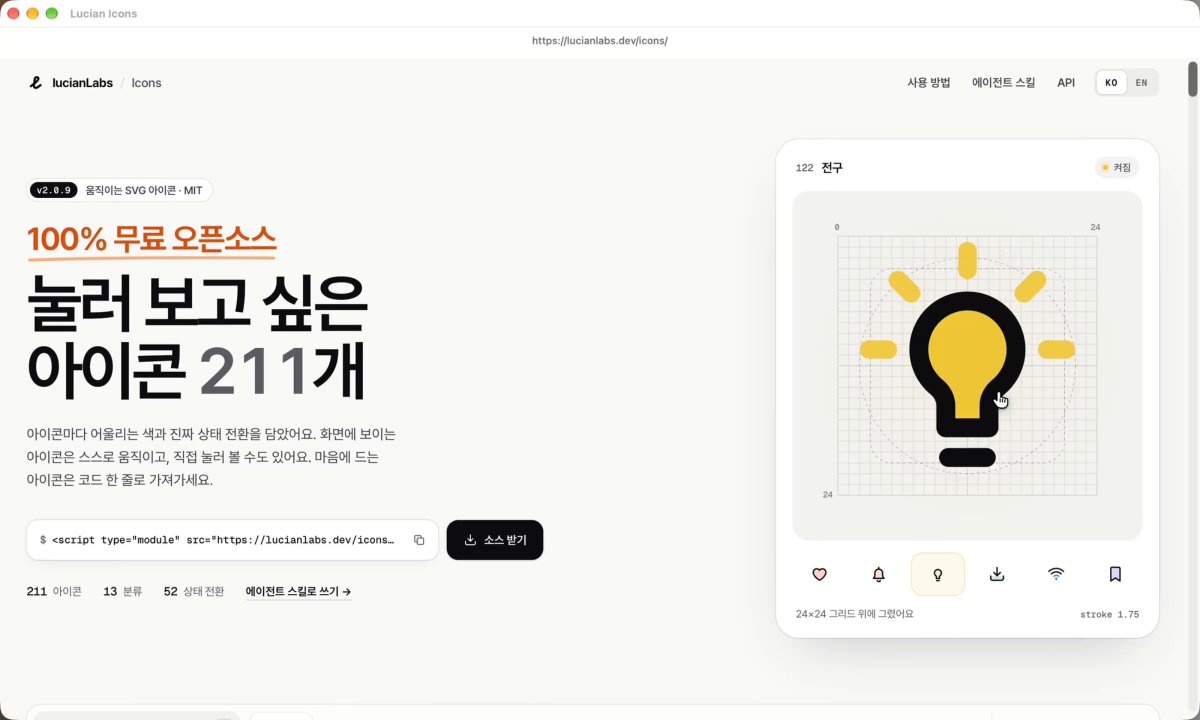
Image source: @lucian__03 on X
In contemporary digital design, interface iconography serves not merely as visual ornamentation but as a fundamental medium for immediate tactile feedback. Released by creator Lucian (@lucian__03), Lucian Icons emerges as a purpose-built open-source suite that departs from conventional static graphics by embedding dedicated hover and click interaction animations directly into 212 distinct UI symbols. Designed to deliver fluid, context-aware visual responses right out of the box, the entire asset library is released under the permissive MIT license, permitting completely free commercial adoption across production applications without licensing overhead or restrictive attribution tiers.
Context-Aware Micro-Interactions and State Progression
The central strength of Lucian Icons lies in its tailored motion behavior designed individually for each icon concept rather than relying on uniform transforms. Instead of applying basic scale shifts or generic opacity fades, every graphic mirrors the state transitions inherent to its real-world interface function. Activating a like control triggers a fluid filling motion within the heart motif, while opening a directory causes the folder envelope itself to visibly swing ajar. The file transfer iconography is engineered around multi-phase progression: a dedicated progress meter fills dynamically during downloads and automatically converts into a validated checkmark upon successful finish, alongside an explicit failure state. This pre-assembled logic enables engineers to deploy rich micro-interactions without manually scripting keyframes or DOM states.
Native AI Agent Skills and Multi-Format Integration Paths
Addressing modern developer paradigms, Lucian Icons provides native compatibility layers for automated development setups. The creator built dedicated integration skills tailored specifically for Claude Code and Codex command environments. By installing these skills into their coding toolchains, developers can prompt their AI assistant to locate relevant animated symbols and integrate them directly into an existing repository. For standard development stacks operating outside these specific AI workflows, the project simultaneously supplies raw SVG, HTML, and JavaScript code snippets along with implementation prompts, ensuring that teams utilizing conventional component frameworks or static site generators can adopt the icons directly into their frontend asset pipelines.
Architecture Caveats and Runtime Environment Demands
Adopting interactive iconography requires teams to evaluate architectural tradeoffs against purely static visual assets. While standard SVG vectors can be referenced through passive image elements or CSS background properties without script execution overhead, interactive motion components demand direct access to runtime execution layers. Hover detection, click binding, and intra-vector path manipulation rely on inlined SVG nodes alongside active JavaScript or advanced CSS support. Consequently, restricted deployment surfaces such as email clients, static documentation viewers, or locked-down applications governed by strict Content Security Policies (CSP) may inhibit script execution, rendering the interactive behaviors inert and necessitating rigorous client compatibility audits.