Open-Source AI Game Development Tools and MCP Bridges: Transforming 3D Workflows
An editorial analysis of open-source repositories and MCP toolkits enabling Claude Code and AI assistants to control Unity, Godot, Unreal, and WebGL game engine
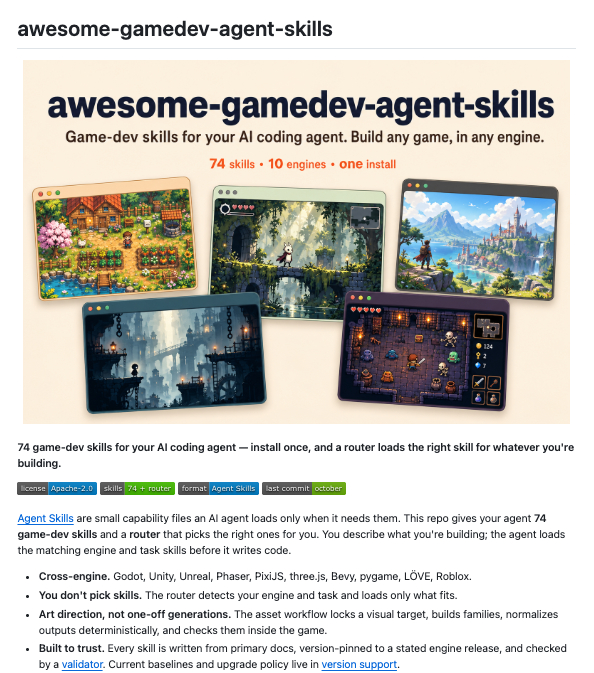
Image source: @jowettbrendan on X
In the modern landscape of software engineering, artificial intelligence coding assistants are rapidly evolving beyond simple text completion into active operators of external runtime environments. According to a curation of open-source repositories shared by software engineer @jowettbrendan, integrating the Model Context Protocol (MCP) with specialized agent skills allows autonomous coding models like Claude Code and Codex to interact directly with major 3D game engines through natural language prompts. This shift bridges the long-standing gap between automated code generation and the complex visual and architectural manipulation required inside interactive game editors.
Direct Engine Automation via MCP Integrations
Traditionally, configuring 3D game scenes demanded meticulous manual intervention within graphical user interfaces, from hierarchy adjustments to component inspector edits. The emergence of MCP Unity fundamentally changes this interaction model by allowing AI agents to create scenes, modify scene objects, assign materials, execute internal test suites, and inspect live console error logs directly through structured prompt commands. Concurrently, Godot MCP provides an equivalent direct operational bridge for the Godot engine, allowing assistants to manage visual scenes, instantiate nodes, launch project runs, and evaluate runtime debug output during development. Supported by Gamedev Agent Skills—which supplies reusable game-development capabilities across Godot, Unity, Unreal, and Three.js—coding assistants gain standard domain knowledge to navigate engine conventions reliably without requiring bespoke scripting from scratch.
Rapid Prototyping Assets and WebGL Toolkits
Beyond editor automation, open-source libraries are streamlining the tedious asset production and runtime mechanics pipelines for developers. TripoSR enables rapid 3D prototyping by reconstructing complete meshes from single reference images, offering an immediate bridge for concept props and preliminary game assets. Within browser-based WebGL environments, Drei delivers ready-made helpers for React Three Fiber, encompassing camera controls, atmospheric skies, shadow systems, and model loading utilities, while React Three Rapier removes the need to build custom physics engines by supplying pre-built rigid bodies, collision listeners, and joint mechanisms. Complementing these are Yuka for steering behaviors, pathfinding, and state-driven NPC artificial intelligence, Three.quarks with its visual particle editor for effects ranging from sparks to smoke, React Postprocessing for visual effects such as bloom and depth of field, and Colyseus for multiplayer room orchestration and automatic state synchronization between client and server.
Architectural Prerequisites and Production Caveats
While these tools present a compelling framework for accelerating interactive development, adopting them introduces distinct constraints that teams must consider. Foremost, engine-level automation strictly requires agent harnesses that support the Model Context Protocol (MCP) standard or engine-specific agent skill frameworks. Furthermore, automated operations executed by coding assistants are not immune to semantic misunderstandings; node trees, scene hierarchies, and physics configurations frequently necessitate human audit and precise manual adjustment. Similarly, 3D meshes produced from single-image generators like TripoSR require topology cleanup and UV inspection before serving as production-ready runtime assets. Consequently, these open-source toolkits should be regarded as high-efficiency prototyping scaffolds and operational accelerators rather than completely autonomous substitutes for professional game engineering.