10 Open-Source Operating System Codebases for Kernel Architecture Analysis
A comprehensive study of curated open-source operating systems covering xv6, SerenityOS, Redox, HelenOS, and ReactOS to analyze microkernels and desktop OS desi
Understanding system architecture requires moving beyond application abstractions to examine how operational kernels coordinate hardware. A curated compilation by Divyansh Tiwari (@DivyanshT91162) highlights open-source operating system repositories that allow engineers to explore low-level systems programming and kernel design directly from source code.
Educational Kernels and Monolithic Foundations
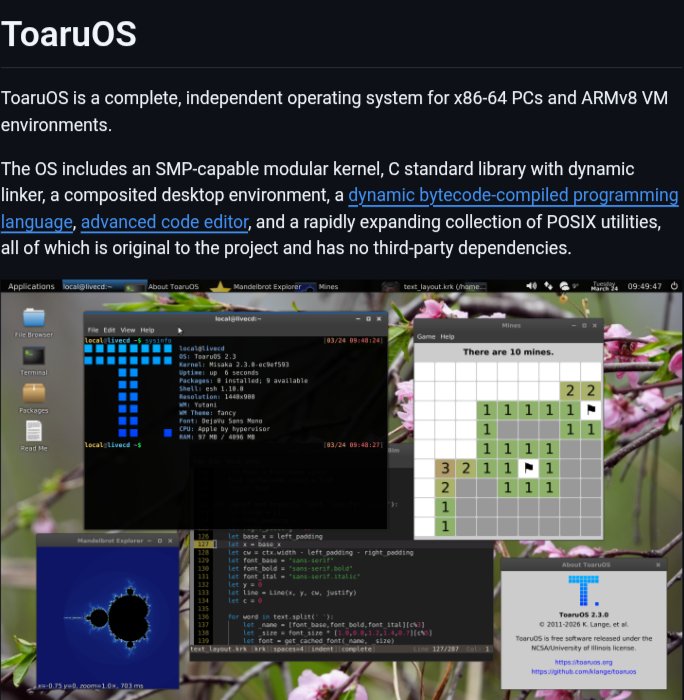
For engineers seeking an accessible entry into Unix mechanics, xv6 provides an essential teaching kernel focused on processes, memory, file systems, and system calls. As developer RyanJ_KOL observed, tracing a single system call from user space into the kernel and back provides a concrete mental model before attempting broader code changes. In contrast, SerenityOS represents a monolithic system built from scratch, encompassing a custom kernel, desktop environment, browser, and native applications. Similarly, ToaruOS demonstrates a complete hobby OS featuring its own kernel, graphical desktop, shell, libraries, and applications. Linux From Scratch (LFS) enables developers to compile a complete system component by component, while the mainline Linux kernel serves as the reference for production scheduling, memory management, and device drivers.
Microkernel Paradigms and Memory Safety
HelenOS demonstrates microkernel design where device drivers, file systems, and services run as distinct components communicating via IPC messages. Redox OS implements a Unix-like microkernel written in Rust, combining modularity with memory safety guarantees. In parallel, Theseus OS rethinks operating-system modularity, using Rust to explore safer and highly modular system architectures. Such implementations address common driver faults and system crashes by decoupling privileged kernel responsibilities into distinct user-space message-passing actors.
Alternative Desktops and Binary Compatibility
Distinct architectures also thrive beyond standard Unix conventions. Haiku continues the BeOS desktop design with an open-source implementation focused on responsiveness and simplicity. ReactOS focuses on binary compatibility with Windows applications and device drivers, reconstructing NT subsystems. Importantly, this list is an educational compilation rather than a single unified tool, varying substantially in maturity from teaching kernels to full desktop operating systems. Systems researchers must critically examine architectural boundaries and tradeoffs rather than treating them as ready-to-deploy platforms.