HeyPCB MCP: Automating PCB, Firmware, and Enclosure Design via AI Coding Agents
An architectural overview of HeyPCB MCP, connecting Claude Code and Codex to full-pipeline hardware workflows with DRC validation, KiCAD CLI, and automated repa
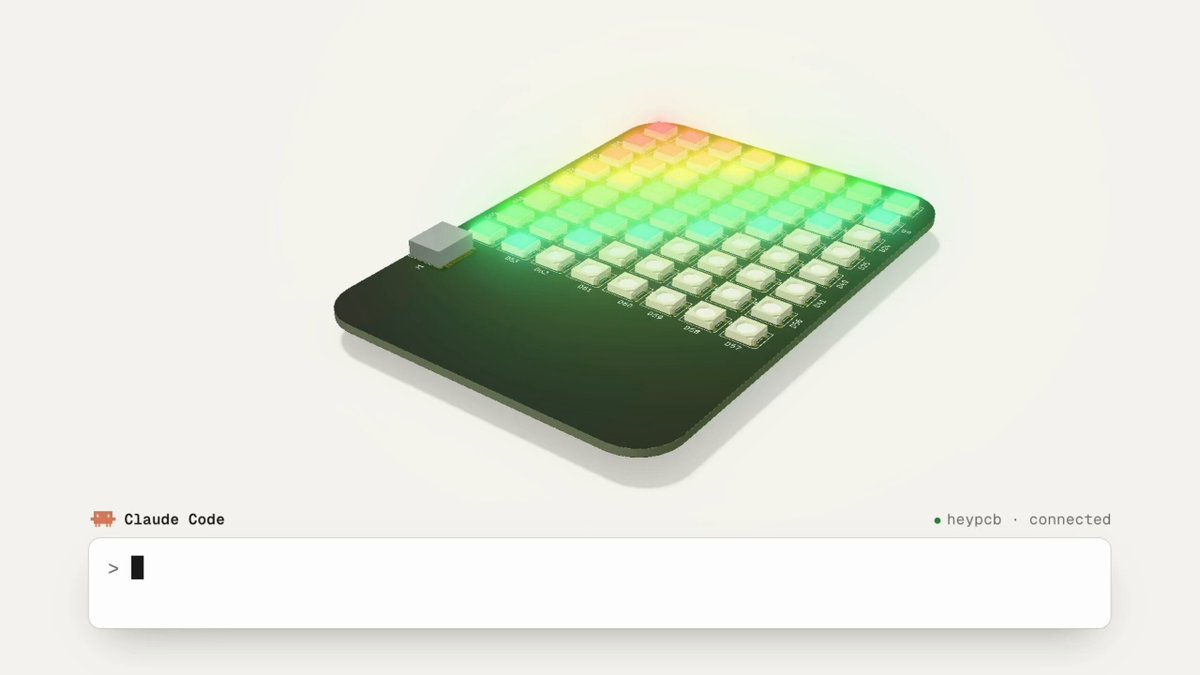
AI coding assistants have transformed software development, but expanding their reach into physical electronics has remained difficult. Introduced by Justin Kim (@justinplaygame), HeyPCB MCP provides a Model Context Protocol bridge connecting tools like Claude Code and Codex to hardware synthesis. Through a single prompt, the system coordinates schematic generation, fully routed PCBs, firmware, and matching enclosures directly within existing agent workflows.
Unified Prompt-to-Hardware Pipeline
Electronics prototyping traditionally demands fragmented design suites, manual trace routing, separate firmware development, and mechanical CAD modeling. HeyPCB MCP consolidates these stages into an automated pipeline driven by AI agents. When given high-level requirements, the agent synthesizes circuit schematics and outputs a fully routed PCB layout. Concurrently, it produces device firmware and a matching enclosure. HeyPCB also ensures that project design files are never used to train public foundation models, protecting proprietary assets.
Automated Rule Checks and fixWith Self-Healing
Generating board geometry differs from ensuring manufacturability. HeyPCB MCP incorporates Electrical Rule Checking (ERC), Design Rule Checking (DRC), component validation, and fab-readiness verification. When rule violations or clearance issues arise, the tool returns a structured 'fixWith' feedback payload. This machine-readable diagnostic enables agents like Claude Code or Codex to identify flaws, reroute traces, and execute autonomous self-repair loops without human intervention.
Offline KiCAD CLI and Real-World Limitations
Alongside its cloud MCP interface, HeyPCB includes an offline KiCAD CLI for local board validation without network access. Nevertheless, deploying AI-generated hardware entails crucial caveats. Passing DRC and ERC does not guarantee thermal stability under electrical loads, signal integrity, or electromagnetic compatibility (EMC) compliance; physical bench testing remains essential before manufacturing. Furthermore, verifying connector alignment and mounting hole tolerances with enclosures across board revisions remains an actively improving feature. Lastly, while free credits support initial evaluation, ongoing use requires paid subscriptions or pay-as-you-go credits.