DeskcommCRM: An Open-Source CRM with Native WhatsApp AI Sales Agents
Explore DeskcommCRM, an open-source self-hosted sales CRM combining Next.js 16, Supabase, and WAHA with native AI agents for WhatsApp-based customer outreach an
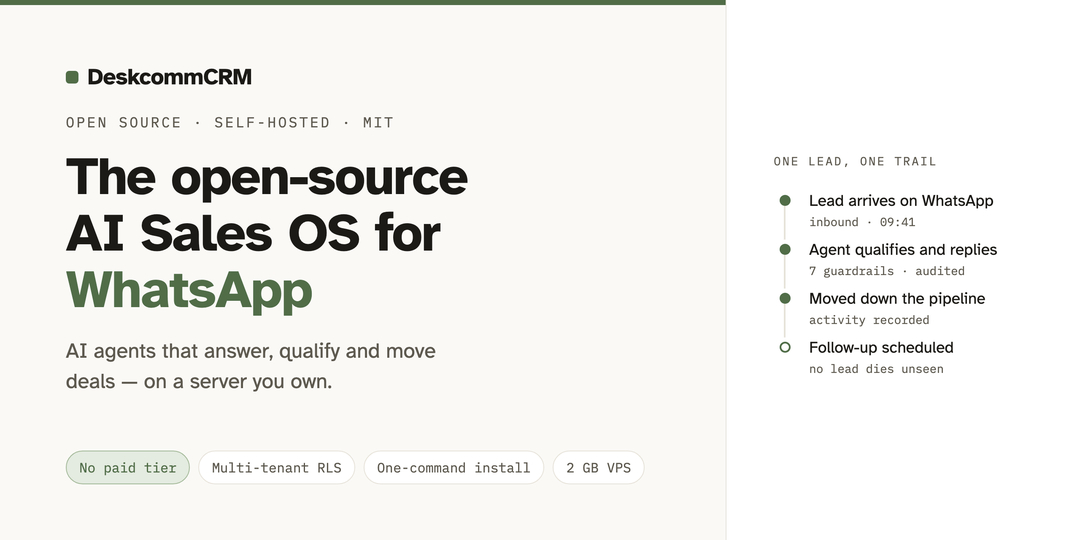
As conversational commerce and messaging-based customer outreach expand, dependence on expensive proprietary CRM platforms creates significant recurring software expenses and data governance challenges. DeskcommCRM is an open-source, self-hosted sales CRM built with Next.js 16, TypeScript, and Supabase under the MIT license, delivering native AI sales agents designed to automate customer support, lead qualification, and sales conversion directly through WhatsApp.
Image source: GitHub melgarafael/DeskcommCRM
Conventional customer engagement stacks often require stitching together third-party messaging connectors with commercial AI chatbot add-ons, increasing operational complexity and monthly subscription overhead. By consolidating messaging connectivity and autonomous agent logic within its core codebase, DeskcommCRM provides an open-source alternative that ensures full data ownership across self-hosted sales funnels.
WhatsApp HTTP API (WAHA) Integration and Native AI Sales Agents
The central technical strength of DeskcommCRM is its direct integration with the WhatsApp HTTP API (WAHA), establishing a bidirectional real-time communication channel with customers over standard messaging interfaces. Incoming conversations directed at official business accounts are captured instantly and processed directly by embedded native AI agents.
- Automated Lead Qualification and Sales Conversion: Departing from static keyword-based rule engines, the built-in AI agent analyzes customer conversation intent, verifies lead qualification criteria, and guides prospects through conversion flows. This automates the early stages of the sales cycle—from preliminary discovery and catalog guidance to lead information enrichment—without requiring constant manual staff intervention.
- RAG Knowledge Retrieval Engine: To maintain factual accuracy and brand context, the system incorporates Retrieval-Augmented Generation (RAG) knowledge retrieval. The AI agent references indexed company documentation, service policies, and product details to deliver grounded answers while minimizing hallucinatory responses.
- Model Context Protocol (MCP) Support: Built-in support for the Model Context Protocol (MCP) establishes standardized tool-calling interfaces, enabling flexible interoperability with modern agent runtimes and developer tooling.
Architecture as an Open-Source Alternative to Proprietary CRMs
The creators of DeskcommCRM position the project explicitly as an open-source, self-hosted alternative to commercial customer support and sales platforms such as Kommo, Octadesk, and Intercom.
- Next.js 16 and Supabase Full-Stack Architecture: The frontend interface and server-side logic are developed in Next.js 16 and TypeScript, backed by Supabase infrastructure for PostgreSQL data storage, user authentication (Auth), and file storage (Storage). This combination provides reliable transactional data management for customer records while streamlining asset handling and team permissions.
- Multi-Tenant Architecture: A robust multi-tenant foundation allows organizations to manage isolated workspaces, teams, or client accounts within a single deployment instance. This partitioning ensures that sensitive business communications and sales pipelines remain strictly segregated.
- LGPD Privacy and Regulatory Adherence: The system architecture incorporates compliance considerations aligned with the Brazilian General Data Protection Law (LGPD). Customer interaction histories and identifiable data are managed with explicit attention to regional data protection requirements.
VPS Deployment Options and Practical Considerations
For engineering and sales teams deploying the platform on private infrastructure, DeskcommCRM provides a dedicated single-command setup kit (hostgator-setup-kit) along with detailed architecture documentation. This setup automation accelerates production deployment across standard Virtual Private Server (VPS) environments.
Teams planning a production rollout should consider several operational prerequisites:
- Dedicated WAHA Instance: Because WhatsApp connectivity depends on the WhatsApp HTTP API (WAHA), operators must deploy and maintain an independent WAHA container alongside DeskcommCRM, ensuring reliable network routing and webhook synchronization.
- Supabase Infrastructure Connectivity: Production deployments require an active Supabase project with properly configured database tables, authentication providers, and storage buckets.
- Documentation Reference: As core setup instructions and codebase comments are predominantly maintained in Portuguese, international teams and developers should refer directly to the English guide (
README.en.md) in the repository for environment configuration and setup steps.
Sources
- GitHub Repository: melgarafael/DeskcommCRM