Grading Eggs with the Decisions API: RF-DETR + Probabilistic Decisions in Practice
A practical pipeline combining OpenAI's Decisions API with RF-DETR for real-time egg defect grading — 270ms latency, token and cost math, and triple-check verif
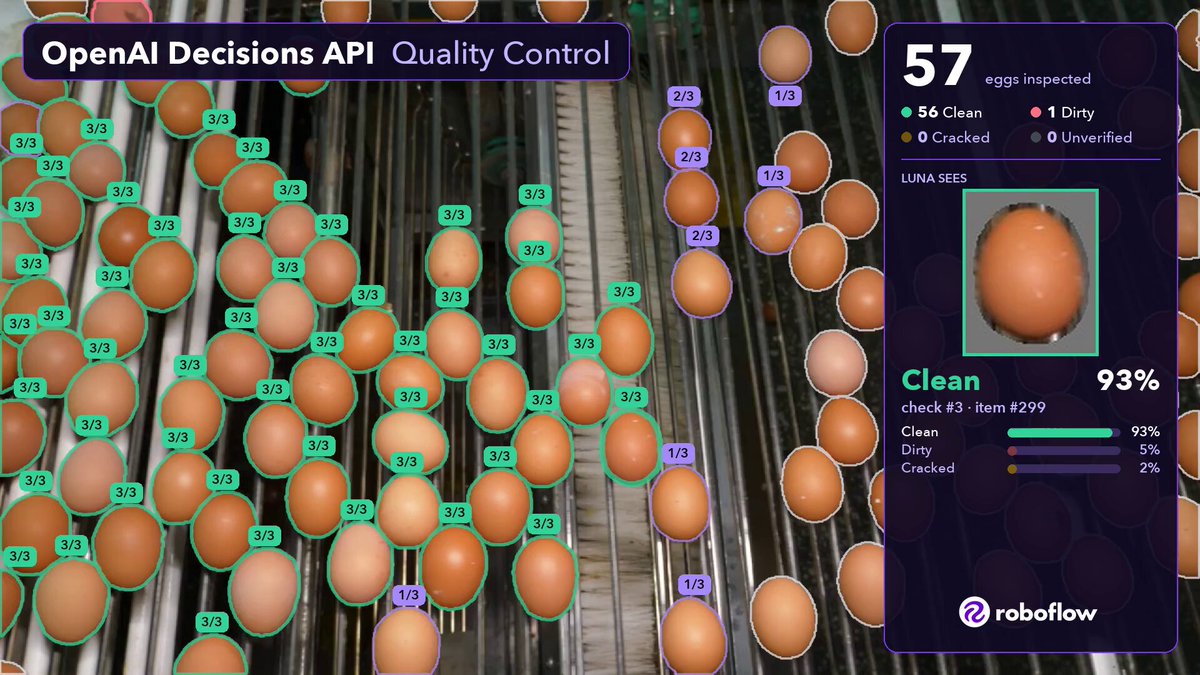
The original author is Erik Kokalj (@erik_kokalj), who published this egg visual-inspection demo on X on October 8, 2026. This is a faithful write-up of that source: RF-DETR detects the eggs while the pipeline tracks each one, and each cropped egg image is sent to OpenAI's Decisions API, which returns clean/dirty/cracked probabilities.
Image source: Erik Kokalj (@erik_kokalj) on X; video still from original post
The pipeline splits responsibilities. RF-DETR handles localization; the Decisions API handles the final pass/fail call. Per the author, each egg crop is judged with about 270ms of latency, and the return value is not text but probabilities in the form P(clean, dirty, cracked). One image crop consumes roughly 280 input tokens, stated by the author as roughly $0.03 per 1K images.
Why split detection and decision
Asked why a network call is needed when segmentation and tracking are already in place, the author answered that when training data for every edge case is hard to collect, using a general model is easier and faster. He added that training the egg detector itself is comparatively easy because training data can be gathered quickly.
For background, third-party reporting says the Decisions API was previewed to selected customers at DevDay on September 29, 2026 and moved to public beta on October 6, 2026. One outlet describes it as GPT-6 Luna powered and returning structured answers (predicates, choices, scores) instead of generated text, but another outlet noted that as of September 30, 2026 no request/response schema, endpoint path, or pricing had been published. This article therefore does not assert a specific path such as /v1/decisions. The "up to 10x faster than the Responses API path" figure is OpenAI's claim, not an independently verified fact.
Triple verification per egg, with tracking
This demo does not find the same defective egg 270ms later by searching. The author states that the pipeline tracks each egg separately and runs quality control three times on each egg for verification: "it tracks each egg separately, and only runs quality control three times on each egg (for verification)". In the video, a checked egg turns green and is not checked again.
On the question of the unseen side of the egg, the author said a rolling conveyor belt would be needed and linked prior roller-line work. The acquired evidence does not include the linked post's contents, so this article does not assert how the eggs rotate on it or the check counts and pass criteria of the earlier lemon work.
Cost math and when to scale up
The author's measured cost: roughly 200 eggs in 15 seconds, each requiring about 3 decision calls — about 2 cents per 15 seconds, or roughly $5 per hour. These are the author's estimates and change with throughput and call counts.
At larger scale, he recommends fine-tuning a dedicated classification model. The practical takeaway of this tip is a two-stage strategy: use the general-purpose decision API for fast prototyping and small runs, then move to an in-house classifier once volume stabilizes.
Original source
- Erik Kokalj (@erik_kokalj), original post: Decisions API egg quality demo
- Cost measurement reply: ~200 eggs in 15sec, ~2c/15sec
- Triple-check logic reply: tracks each egg separately, QC three times
- Why a general model reply: easier/faster to use general model
- Rolling conveyor reply: rolling conveyor belt