Self-Improving Agent Harnesses with Small Models: CMU's 6-Step Optimization Loop
A practical breakdown of CMU research where a 4B model out-edited its 35B teacher: a 6-step loop to evolve agent harnesses without modifying the underlying task
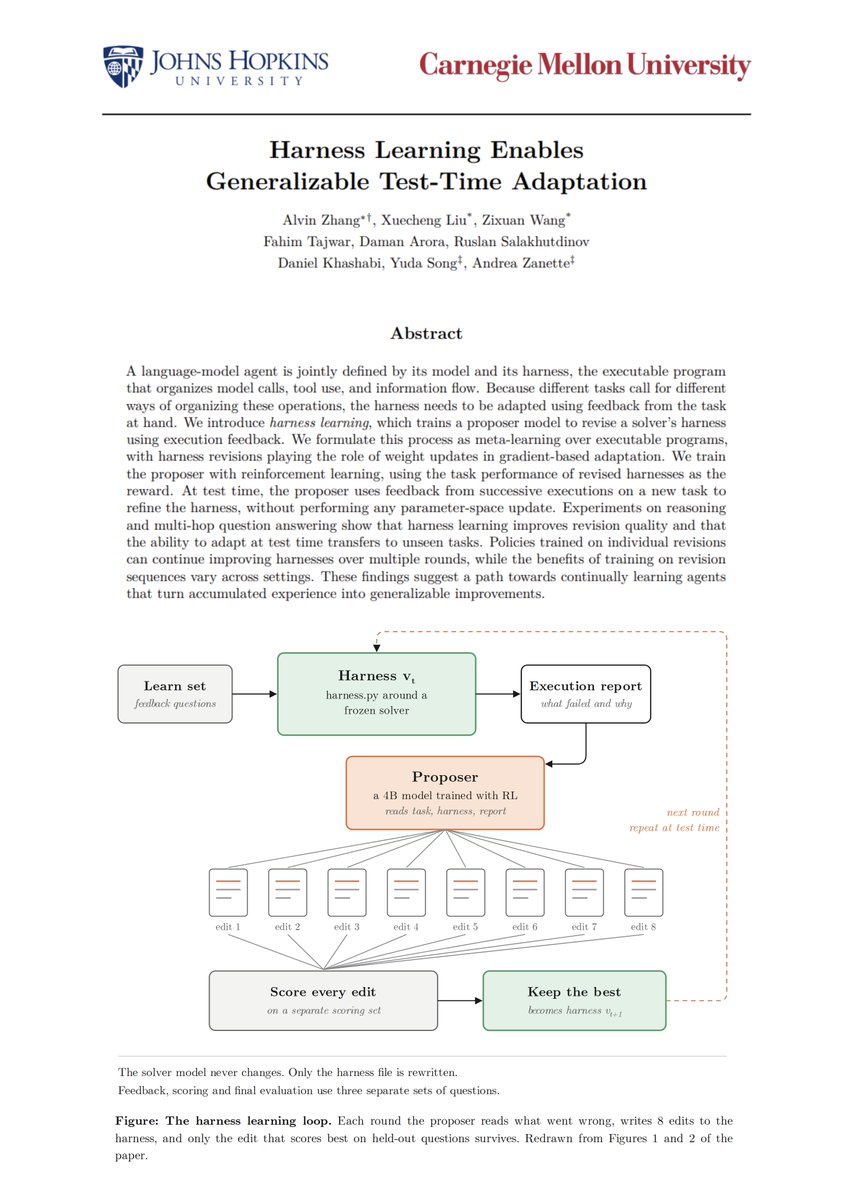
The original author is AI researcher Yarchi (@undefinedKi) on X, who highlighted practical engineering takeaways from a recent Carnegie Mellon University (CMU) paper on self-improving AI agent harnesses. In modern AI agent engineering, the scaffolding wrapped around a foundation model—orchestrating prompts, tool calls, and data execution flows—frequently yields greater practical performance gains than retraining the model weights themselves. The CMU study reveals that a compact 4B model trained to rewrite agent harness code can surpass the 35B teacher model it learned from, all while keeping the underlying task solver completely untouched.
Image source: @undefinedKi on X
When deploying large language model (LLM) agents into production, real-world task completion rates are often constrained not by the raw reasoning ceiling of the base model, but by the precision of the program executing around it: how the model is invoked, how tool execution results are parsed, and how error recovery is managed. Rather than manually tuning prompt chains and routing heuristics, this research explores an autonomous feedback loop that directly treats the harness codebase as an evolutionary optimization target.
Key Findings: A 4B Model Out-Editing Its 35B Teacher
The CMU researchers set up a meta-agent pipeline where a lightweight 4B language model reads structured execution reports from previous runs, drafts concrete code edits to the harness, and retains the variant that achieves the highest validation score. Crucially, the underlying model responsible for solving the end tasks (the solver) never changes throughout the entire optimization process.
The empirical findings from the paper demonstrate compelling efficiency gains:
- Quality Surge on Unseen Tasks: On task types the model had never encountered during training, the harness edit quality score jumped from 0.32 to 0.62, representing a substantial gain in out-of-distribution generalization.
- Sharp Reduction in Broken Edits: The proportion of proposed harness modifications that resulted in broken edits dropped from 38% down to 15%.
- Cumulative Power of Sequential Edits: Applying five iterative, sequential edits in a row matched or outperformed the best single candidate selected across eight parallel exploration attempts.
- Student Surpasses Teacher: The compact 4B model was trained to rewrite agent harnesses based on the 35B model it learned from, but ultimately produced better harness edits and outperformed its 35B teacher model.
The 6-Step Self-Improvement Loop for Production Agents
Developers can implement this optimization loop on existing agent systems today without requiring large-scale reinforcement learning clusters. The workflow follows six structured phases:
- Consolidate Harness Logic into One File (Single-File Harness): Place the complete orchestration logic—prompts, sequential steps, and tool execution interfaces—into a single file. Fragmented multi-file architectures introduce context fragmentation and increase the likelihood of unintended side effects during code generation.
- Split Test Cases into Three Partitions (Three-Way Data Split): Divide your evaluation dataset into three strictly separated sets: learn, score, and final check.
- Execute on Learn Set and Log Failures (Run & Failure Report): Run the baseline harness across the learn set and generate a concise report documenting which test cases failed and what error signatures occurred.
- Request 5 Target Edits Based on Failure Reports (Generate 5 Edits): Feed the short failure report and current harness code into your code-modification model, instructing it to propose five distinct edit candidates addressing the observed bottlenecks.
- Evaluate Candidates on Score Set and Select the Winner (Score & Keep Winner): Execute each of the five proposed edits independently against the score set. Retain only the highest-scoring candidate as the new baseline harness.
- Iterate for 5 Rounds, Then Run a Single Final Check (Iterate & Final Test): Repeat steps 3 through 5 for five full cycles. Once complete, evaluate the final winning harness exactly once against the untouched final check set to determine unbiased real-world performance.
Overfitting Safeguards and Production Considerations
Running automated harness modification loops requires strict discipline around data isolation and variance management:
- Strict Isolation of the Final Check Set: The final check dataset must remain completely untouched throughout the entire search and selection process. If candidate harnesses peek at or score against the final verification set during intermediate iterations, the codebase will inevitably overfit to specific validation quirks, deteriorating real-world generalization.
- Stochastic Variance and Sample Size: LLM agents exhibit non-deterministic behaviors across runs. When evaluating candidates on the score set, ensure the partition contains enough diverse cases to prevent stochastic anomalies or lucky single passes from masquerading as genuine algorithmic improvements.
- Key Paper References: For developers interested in the formal implementation details, page 2 of the paper outlines the complete architectural loop, page 6 details performance benchmarks across unseen tasks, and page 8 provides an annotated walkthrough of an actual harness synthesized by the model.
Original source
- Yarchi (@undefinedKi) on X: https://x.com/undefinedKi/status/2110034831941709935