Claude Announces Four Major Updates Marking the 2nd Anniversary of MCP
Anthropic's Claude has unveiled four core updates for the 2nd anniversary of the Model Context Protocol (MCP), featuring automated skill delivery, asynchronous
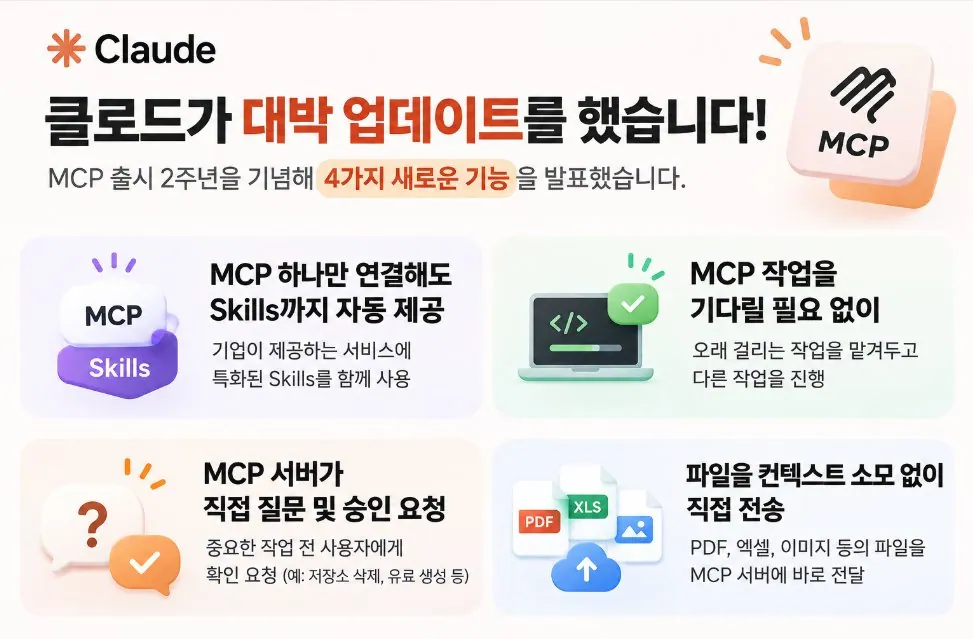
Anthropic's conversational AI assistant, Claude, has announced a major feature update to celebrate the second anniversary of the Model Context Protocol (MCP). The update introduces four core capabilities designed to dramatically enhance workflow efficiency for developers and everyday users alike, with several features rolling out immediately in the latest Claude Code (v2.1.332) environment.
Image source: https://x.com/lucian__03/status/2125754832778850764
Image Credit: @lucian__03 via X
MCP is an open standard protocol that enables AI models to interact safely and seamlessly with external databases, development tools, and file systems. Having established itself as essential infrastructure for the developer ecosystem over the past two years, MCP is evolving beyond a simple data integration conduit into a robust platform that significantly expands agent autonomy and efficiency. The newly announced capabilities are slated for rollout across public beta, general availability, and phased deployment stages.
Automated 'Skills' Delivery Tied to MCP Connections (Public Beta)
The most striking initial change is the integration of service-specific skills delivered automatically alongside MCP connections. Skills refer to predefined execution modules that allow AI to autonomously perform complex, repetitive tasks tailored to specific applications or platforms.
Previously, even when users connected a specific service's MCP, they had to manually search for, download, and configure separate skill files to make the AI work smoothly with that service. Under the new update, enterprises providing MCPs can bundle and distribute specialized skills optimized for their platforms right alongside the protocol.
- Streamlined Setup: Eliminates the need to manually acquire or configure disparate skill packages.
- Automatic Loading and Updates: Only the skills relevant to the current conversation context are loaded automatically, and any updates made by the enterprise are reflected in real time.
This feature is expected to deliver exceptional convenience, particularly for users interacting with Claude through standard web and app interfaces. However, because companies must first configure these skills on their respective MCP servers, widespread adoption will depend on provider implementation timelines.
Asynchronous Task Processing and Server-Initiated Approvals (Generally Available)
The second and third updates, which directly boost development workflow productivity, are already generally available and ready to use in the latest Claude Code environment.
First, asynchronous task processing has been introduced. For instance, when Claude delegates an application build or heavy compilation task to an external MCP server via Claude Code, users no longer need to wait idly or have their chat blocked until the process finishes. Developers can immediately move on to other coding tasks while the build runs in the background.
Complementing this is the server-initiated approval requests feature, which substantially enhances AI agent reliability. Previously, when an AI autonomously determined it needed to delete a file or modify system settings, users had to painstakingly predefine boundaries. Now, the MCP server can request explicit confirmation directly from the user immediately before executing sensitive operations.
- GitHub: Prompts the user to type the exact repository name before executing a permanent deletion.
- Supabase: Asks for confirmation before provisioning paid database projects.
- Railway: Requires operator sign-off before deleting or unlinking cloud services.
By placing these server-driven checkpoints before irreversible, destructive actions, developers can safely delegate broader autonomy to AI agents without sacrificing operational safety.
Direct Large File Transfers to Alleviate Context Window Load (Phased Beta Rollout)
The fourth feature directly targets the capacity limits of the context window—the maximum volume of information an AI model can process and retain at any single moment—which has long been a bottleneck in heavy AI workflows.
When handling massive PDF documents spanning hundreds of pages or complex spreadsheets filled with dense data, users previously had to copy or convert text and feed it directly into the AI's dialogue context. This process frequently exhausted token limits or resulted in information loss.
With the new update, original files such as 100-page PDFs or large spreadsheets can be sent directly to the MCP server without burdening the context window. The AI queries the necessary data efficiently using the original file reference, preserving dialogue memory capacity while enabling precise document analysis. This capability is scheduled for a phased beta rollout.
This second-anniversary update signals MCP's maturation from a basic data-passing standard into a practical agent platform capable of elevating automation and document processing efficiency to new heights. Moving forward, the perceived value of these enhancements will largely depend on how effectively service providers build out high-quality skills alongside their MCP servers.
Sources
- @lucian__03 on X: Summary of the 4 Key Updates for MCP's 2nd Anniversary