Anthropic Engineers Release a 37-Minute Guide to Building Business Automation AI Agents
Anthropic engineers have released a free 37-minute guide on building AI agents using Claude to automate complex business workflows and delegate tasks.
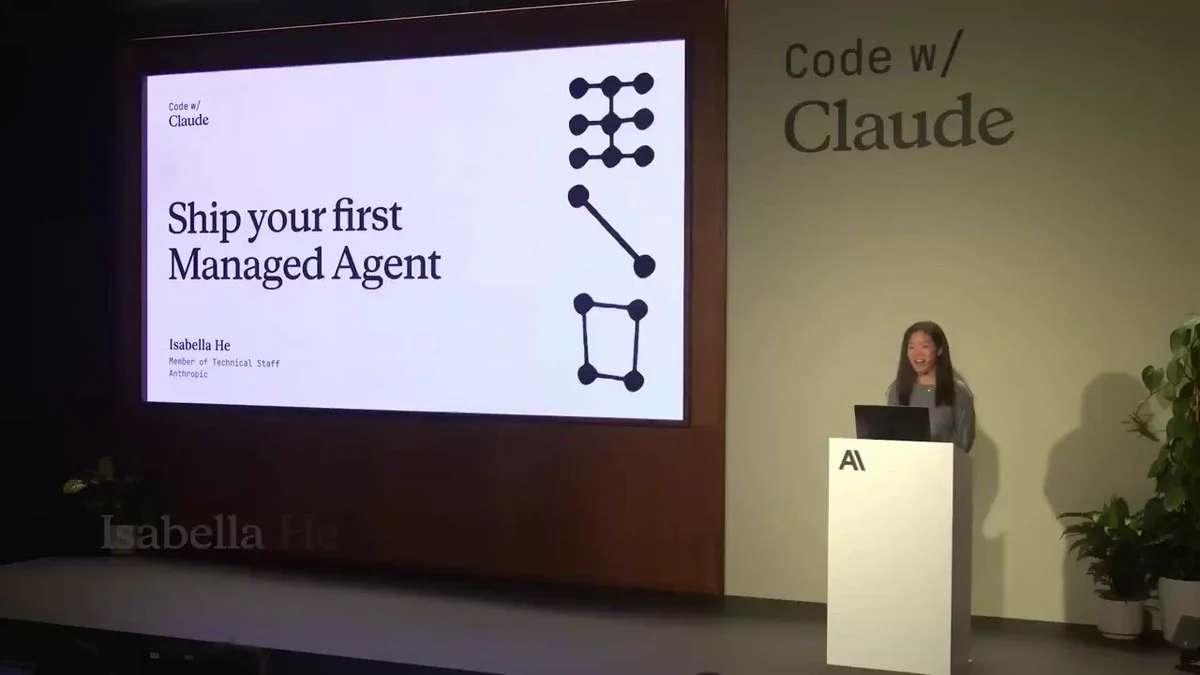
A 37-minute practical guide video produced directly by core engineers at artificial intelligence research firm Anthropic has gained widespread attention, shared via the tech creator account @bmontsur on X (formerly Twitter). The newly released material covers how to build autonomous artificial intelligence agents using the large language model Claude to automate complex business processes and autonomously delegate sub-tasks to get things done.
Image source: https://x.com/bmontsur/status/2126721436828270679
As the adoption of AI agents accelerates across software development and business operations, there has been a strong demand for robust architectural designs that go beyond simple chat-based interfaces to proactively execute real-world tasks. At a time when external third-party tutorials and unverified courses are abundant, practitioners have welcomed this resource because it comes straight from the engineers who built and refined Claude, offering design insights and architectural patterns for free.
Background and Value of the Engineer-Led Agent Building Guide
An AI agent refers to an autonomous system that, given a high-level goal without requiring constant micro-management, reasons, plans, invokes tools, and produces results independently. While many developers and product managers have attempted to build agentic systems, they have frequently faced practical limitations, such as context loss during handoffs between agents or getting trapped in infinite execution loops.
The 37-minute guide directly addresses these operational hurdles. Core engineers from the creator of Claude step in front of the camera to demonstrate not just theoretical concepts, but concrete code and architectural patterns for designing functional agents. A standout aspect is the transparent demonstration of how to structure complex business workflows and enable distinct agents to collaborate through clear task division to achieve tangible outcomes.
Core of Agent Automation: Task Delegation and Practical Application
The success of business automation depends heavily on the 'delegation' mechanism—breaking down tasks across multiple specialized agents and connecting them fluidly, rather than relying solely on individual model performance. Most experimental agent setups tend to break down precisely at the handoff boundary between agents.
The guide details methods to minimize such handoff errors and establish structures where an agent autonomously evaluates sub-tasks and distributes them to appropriate sub-agents.
- Clear Role Separation: Instead of attempting to solve everything with a single massive prompt, individual agents are isolated with distinct objectives and constraints.
- Autonomous Tool Invocation: Forming execution loops where agents query external APIs or databases when needed and determine subsequent steps based on findings.
- Exception Handling and Validation: Addressing methods to detect and correct misbehavior or erroneous outputs generated by agents.
These approaches provide direct guidelines for automating repetitive, multi-step internal workflows such as market research, customer support response handling, and data analysis report generation.
Getting Started with Business Automation Using the Free Guide
The newly released guide can be viewed and studied by anyone via the original source link, free of charge and without complicated registration requirements. It serves as an excellent compass for developers, product managers, and workflow automation engineers seeking to achieve a practical productivity leap using Claude in business environments.
However, since the architecture and code presented in the guide offer general best practices and foundational skeletons, applying them to enterprise security environments or legacy systems requires additional considerations, such as data privacy and API cost management. It is best utilized as a starting point to understand fundamental agent design principles and evaluate how to integrate them into proprietary pipelines.
Original source
- X (@bmontsur): Anthropic 37-minute guide on building AI agents announcement