Designing Agent System 1 Decision Models: Avoiding 27B Footprint Bloat and 4 Essential Capabilities
Analyzing why 27B open-source decision models create hot-path cost inefficiencies in agent workflows, and exploring the four essential capabilities required for
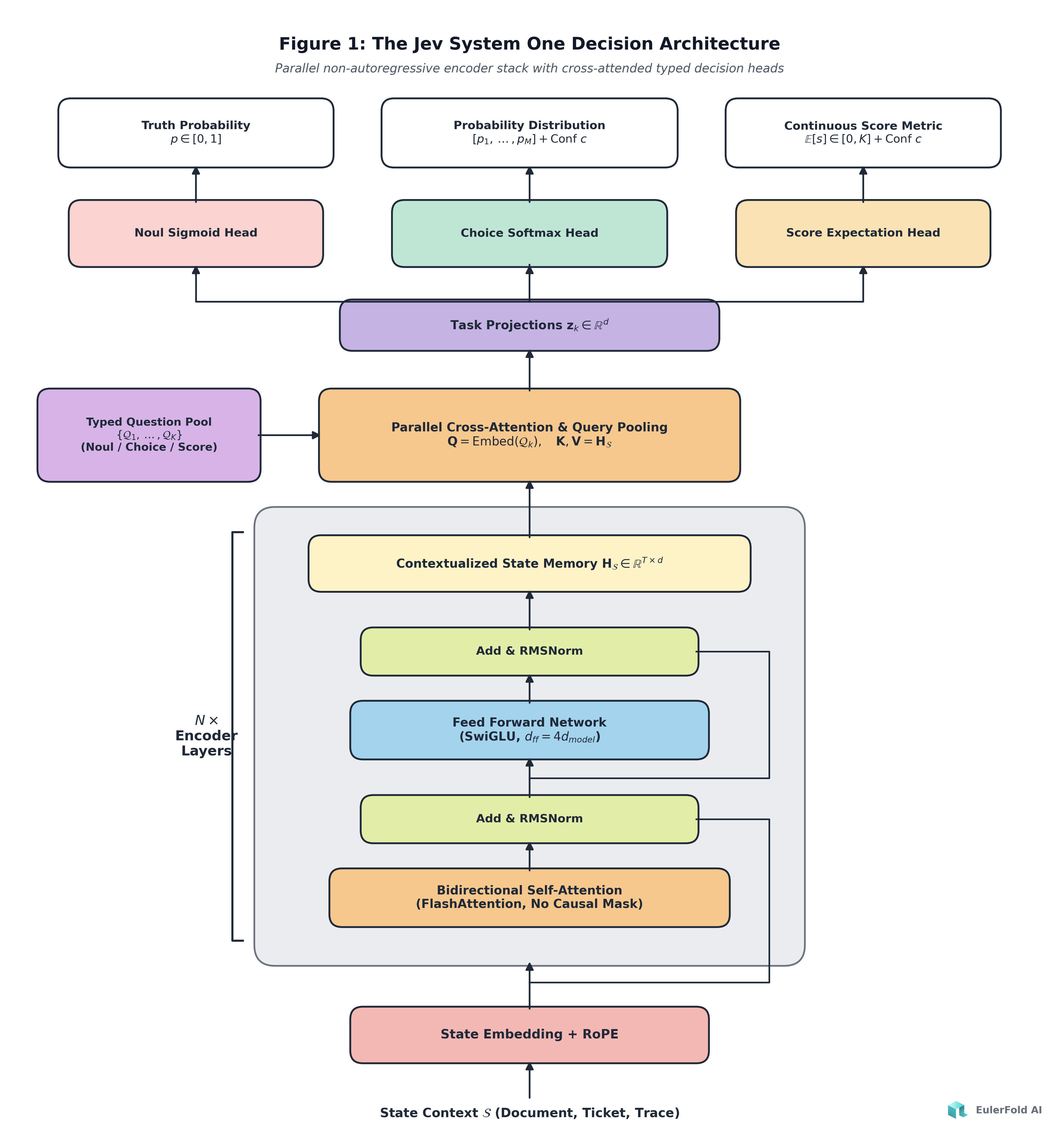
Image source: https://www.eulerfold.com/articles/what-is-jev-system-one-architecture
AI routing and agent researcher OrcaRouter (@OrcaRouter) on X has highlighted the growing footprint bloat in recent open-source "decision models," outlining the foundational architectural requirements and four essential capabilities necessary for true System 1 execution in AI agents.
While recent open-source releases have produced a wave of decision models fine-tuned on 27B bases like Qwen3.8-27B, most projects release weights without offering a hosted API. The root issue is operational economics: keeping a 27B model resident in an agent's continuous, high-frequency execution loop (the hot path) is prohibitively expensive.
Kahneman's Dual-Process Framework and the 27B Hot-Path Inefficiency
The dual-process cognitive framework introduced by Daniel Kahneman provides a clear structural baseline for multi-model AI agent architectures:
- System 1 (Fast & Action-Oriented): Must be fast, cheap, always-on, and action-oriented.
- System 2 (Deep & Deliberate Reasoning): Slower, deeper, and invoked only when complex cognitive reasoning is explicitly needed.
If an agent requires an expensive 27B reasoning model for every low-level micro-decision along its execution path, it has not implemented a true System 1—it has simply introduced a slightly smaller System 2. In continuous execution loops, running 27B models at every branch incurs severe VRAM residency costs and compute overhead that degrade overall scalability.
4 Essential Capabilities for a True System 1 Decision Model
According to OrcaRouter, improving lightweight decision engines like Jev without inflating their physical parameter footprint requires focusing on four core architectural capabilities:
- Statefulness: The ability to track what happened previously, what parameters changed, and maintain the agent's current belief state across execution turns.
- OOD / Uncertainty Recognition: Knowing when the model does not know the answer. (OrcaRouter notes that current iterations like Jev cannot yet reliably detect when they do not know, making this an active area of refinement.)
- Native Escalation: Moving beyond passive probabilistic confidence outputs to an explicit three-way operational choice:
ACT: Execute the determined action with high confidence.ABSTAIN: Hold back execution when conditions are ambiguous.ESCALATE: Pass control upward to a System 2 deep reasoning model when complex problem-solving is detected.
- Action Selection: Shifting from passive query responses ("answer this question") to autonomous next-step determination ("given the current state, what should happen next?").
Maximizing Useful Decisions Per Dollar Over Raw Single-Call Intelligence
The primary optimization metric for an agent's System 1 layer should not be maximum raw intelligence per call, but maximum useful decisions per dollar.
The real engineering goal is combining lightweight, ultra-low-latency decision loops with the reliable self-awareness needed to escalate tasks to a heavy System 2 model only when strictly required.
Addressing community questions regarding even smaller models (such as 0.6B, 2B, or 4B variants), OrcaRouter noted that generic small models consistently underperform against purpose-built decision architectures like Jev on benchmark tasks. Consequently, production agent design hinges on tailored state tracking and native escalation primitives rather than brute-force model scaling.
Original source
- OrcaRouter (@OrcaRouter) X Post: Reflections on Agent System 1 Decision Models and Core Architectural Capabilities