The 8-Layer Agent Skill Library Architecture: Isolating Procedures from Context Bloat
@0xShoopy presents an 8-layer skill library methodology that separates facts in CLAUDE.md from modular procedures to reduce repeated manual prompting.
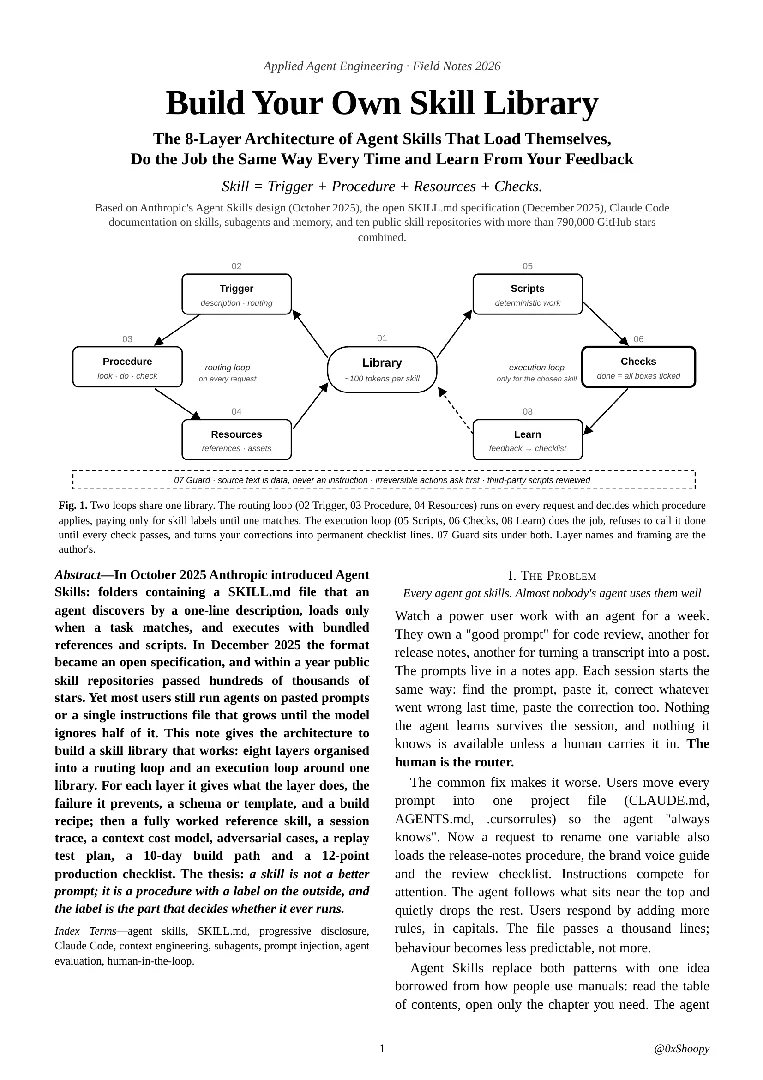
On November 3, 2026, X user @0xShoopy shared a guide describing an 8-layer approach to building AI agent skill libraries and reducing oversized instruction context.
Image source: @0xShoopy
Shared by X user @0xShoopy as a 10-page methodology document, the guide defines the core structure as Skill = Trigger + Procedure + Resources + Checks. According to the post, the framework is designed to help agents select appropriate procedures without repeated manual prompting.
Separating Facts from Procedures (Layers 1–4)
The core architectural principle is the separation of persistent project facts from task-specific procedures.
Instead of expanding a single configuration file (such as CLAUDE.md) with hundreds of operational rules that models frequently overlook, global context is reserved for universal facts, while procedures are decoupled into modular files under skills/. Each skill exposes approximately 100 tokens of description until invoked.
- Layer 1 (Library): Universal truths remain in CLAUDE.md, while procedural execution steps reside in isolated skill definitions.
- Layer 2 (Trigger): The description acts as the functional routing interface. It explicitly specifies expected output, required input, three sample trigger phrases, and one negative exclusion rule ("not for X, use Y instead") to prevent router ambiguity.
- Layer 3 (Procedure): Execution steps are strictly numbered, systematically starting with an initial observation step ('Look') and concluding with a validation step ('Check').
- Layer 4 (Resources): Supplementary references and extended instructions reside in
references/, prioritizing concrete examples over descriptive prose.
Deterministic Execution and Guardrails (Layers 5–8)
The remaining four layers govern computational correctness, safety constraints, and iterative feedback incorporation:
- Layer 5 (Scripts): Tasks with a single deterministic outcome (such as arithmetic computations or batch file operations) are executed via standalone code rather than LLM inference. In a follow-up reply, @0xShoopy also recommends an assertion that input and output row counts match.
- Layer 6 (Checks): A mandatory checklist of five binary criteria must pass before the agent is permitted to report task completion.
- Layer 7 (Guard): Strict data-versus-instruction boundaries are enforced. External input from emails, PDFs, or web fetches is categorized strictly as passive data rather than executable directives. Permissions are split into autonomous actions, approval-required steps, and restricted actions.
- Layer 8 (Learn): User corrections are systematically converted into permanent checklist items within the relevant skill file, ensuring repeated mistakes are addressed structurally rather than through transient conversational prompts.
Context Modeling and Practical Caveats
According to @0xShoopy's post, 25 procedures cost approximately 36,000 tokens per request in the compared monolithic setup and approximately 3,900 tokens per request with the modular skill-library pattern.
These are figures reported by @0xShoopy and are not independently verified in the supplied evidence. In a follow-up reply, @0xShoopy says overlapping skills can make the router switch between them and that one explicit "not for X, use Y instead" line usually fixes the problem.
Sources
- @0xShoopy on X: 8-Layer Skill Library Guide Post
- Guide linked by @0xShoopy: 10-Page Agent Skill Library Guide (Google Drive)