Pine Computer Unveiled: A Virtual OS Rebuilt from the Ground Up for AI Agents
Pine Computer redesigns the operating system around AI by turning app state changes into direct data instead of human-facing GUIs. Offering Server and Web SDKs,
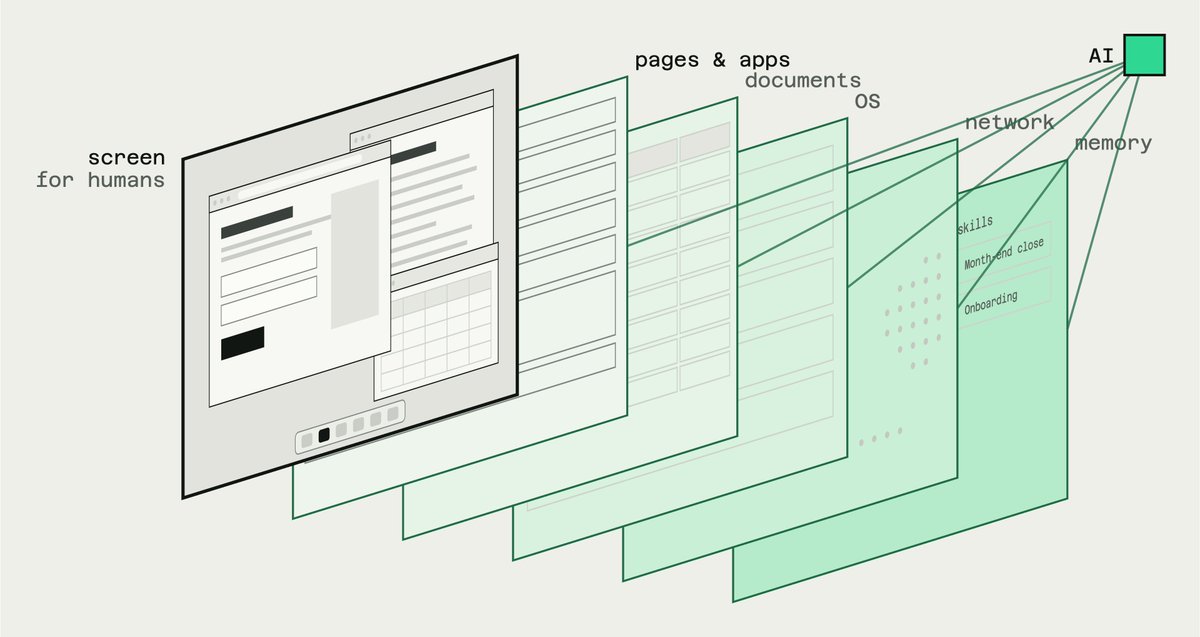
On October 10, 2026, Stanley Wei (@StanleyWei4748) and the Pine Computer team announced the release of Pine Computer, a specialized virtual computing environment re-architected at the OS level for AI agents, and opened registration for its private beta waitlist.
Image source: Pine Computer / Stanley Wei (@StanleyWei4748)
Existing approaches hand AI a computer built for humans and wrap it in a heavy harness, leaving real-world tasks slow, expensive, and unreliable. Pine Computer redesigns the operating system around AI under the premise that screens are for humans, turning every change in every application into something AI can read.
Rebuilding the Operating System for AI Beyond Human GUIs
Pine Computer's core design premise is straightforward: visual screens are for humans, but the underlying computing environment should be natively built for AI.
Rather than having AI use a computer the way humans do through visual displays, Pine Computer rebuilds the OS so AI can directly read application and system state changes.
- Reliable handling of complex workflows: Cleans and analyzes large spreadsheets and navigates legacy web portals that lack public APIs.
- Parallel multi-tasking: Runs multiple agent workflows simultaneously on a single virtual computer instance.
- Cross-environment automation: Executes long-running tasks spanning web browsers, desktop applications, and file systems.
- Reusable skills and persistent logins: Teach a task once to reuse it as a skill, with sign-in sessions and learned skills carrying over between runs.
SaaS-Bench v1.1 Benchmark: Higher Accuracy with Smaller Models at Lower Cost
According to SaaS-Bench v1.1 benchmark results shared by the developers, a smaller model running on Pine Computer outperformed a larger model configuration operating in a traditional human-centric desktop environment:
- Checkpoint Score: GPT-5.6 Luna on Pine Computer achieved a 78.3% checkpoint score, outperforming GPT-5.6 Sol + Codex in a standard setup (71.1%).
- Model Cost: Achieved 20× lower model cost with the smaller model configuration.
- Execution Speed: Delivered up to 5× faster execution compared to the traditional setup.
Note: Benchmark metrics represent internal test results reported by the Pine Computer team.
Developer Tooling: Server SDK and Web SDK
Pine Computer provides two developer SDKs to integrate AI computer-use agents into external applications:
- Server SDK: Enables backend infrastructure to programmatically launch virtual computer instances, dispatch agent tasks, and manage files.
- Web SDK: Allows developers to embed a live interactive desktop directly within web applications. This enables seamless human-in-the-loop handoffs, allowing users to complete multi-factor authentication or sensitive logins before handing control back to the agent.
Pine Computer is currently available in Private Beta, with waitlist signups open through its official website.
Sources
- Pine Computer Blog: Introducing Pine Computer
- Stanley Wei on X (@StanleyWei4748): Pine Computer Announcement Thread
- Pine Computer Manifesto: Why We Built Pine Computer